Military-Historical Reenactment Marking Missile Forces and Artillery Day

On 21 November 2026, the Stalin Line Historical and Cultural Complex, with the support of the Ministry of Defence of the Republic of Belarus, will host its annual Missile Forces and Artillery Day event. It is dedicated to the professional holiday of all veterans and serving personnel of the missile forces and artillery, which is celebrated annually in the Republic of Belarus and other post-Soviet countries.

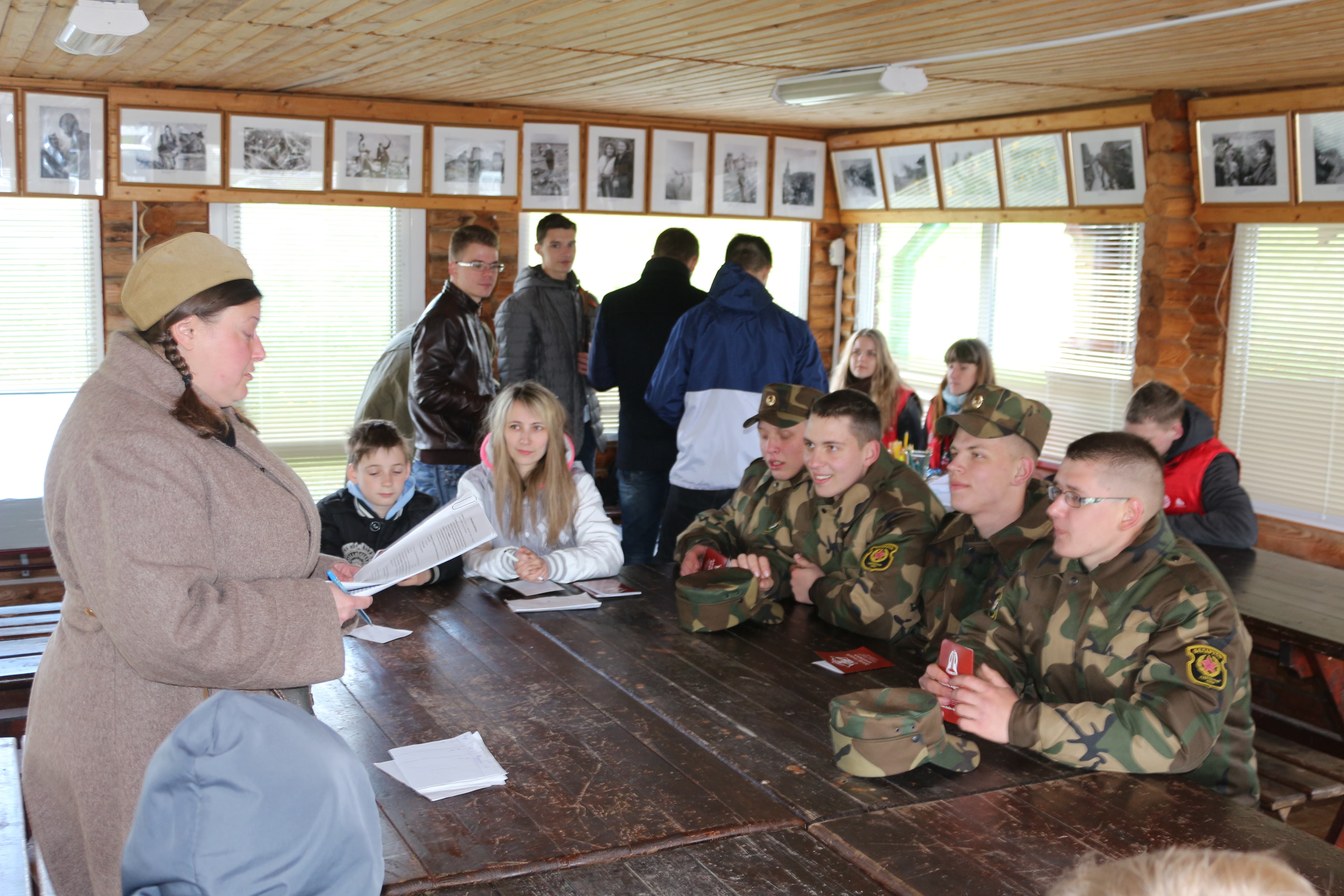
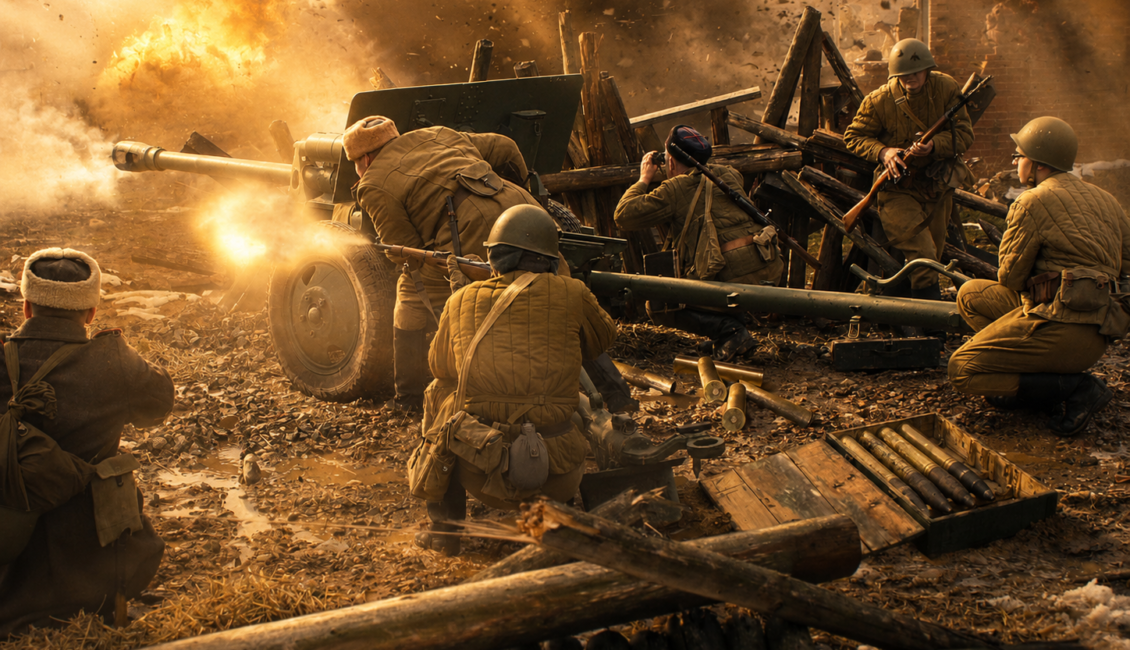
For residents and visitors to the Republic of Belarus, we have prepared a large-scale military-historical reenactment featuring military-history clubs and combat vehicles from the Great Patriotic War.

Dear visitors!  To avoid congestion at the entrance to the complex, please purchase your tickets online and arrive 2–3 hours before the reenactment begins! Visitors with electronic tickets may park cars and minibuses FREE OF CHARGE, subject to availability!!!

Among all tickets purchased through the website, 10 tank ride certificates will be awarded in a prize draw. All tickets purchased before 20:00 on 17 July will be entered into the prize draw. The results, including the winning ticket numbers, will be posted on the VKontakte and Instagram social media accounts after 20:00 on 17 July. Each winner will receive a tank ride certificate at the email address provided when purchasing the ticket.
Event Details
  • Days
    Hours
    Min
    Sec
  • Start Date
    November 21, 2026

With the support of the Ministry of Defence of the Republic of Belarus, an exhibition of military equipment belonging to the country's Missile Forces and Artillery will be held at the Stalin Line Historical and Cultural Complex. The following weapons systems will be on display:

9P129 Tochka-U Tactical Missile System

300 mm 9A52 Smerch Multiple Launch Rocket System

152 mm 2A65 Msta-B Towed Gun-Howitzer with Tractor

Opening of guided-tour and interactive areas to visitors:

  • “Stalin Line” Guided Tour Route
  • “Our Armoured Train” Exhibition
  • Operational Military Vehicle Display
  • Photo Area
  • Firing from a tank, field gun and anti-aircraft gun **
  • Firing deactivated weapons adapted for blank ammunition **

Ready for Labour and Defence (GTO) These are interactive entertainment areas.

Everyone taking part in the Stalin Line GTO Challenge Area can enter the prize draw.

To enter the prize draw, you must:

  • Complete all GTO areas and receive a score for each one
  • Arrive at the specified time for the announcement of the prize-draw results
  • Certificates and prizes will be awarded exclusively to participants who attend the prize-giving ceremony.

Main GTO areas:

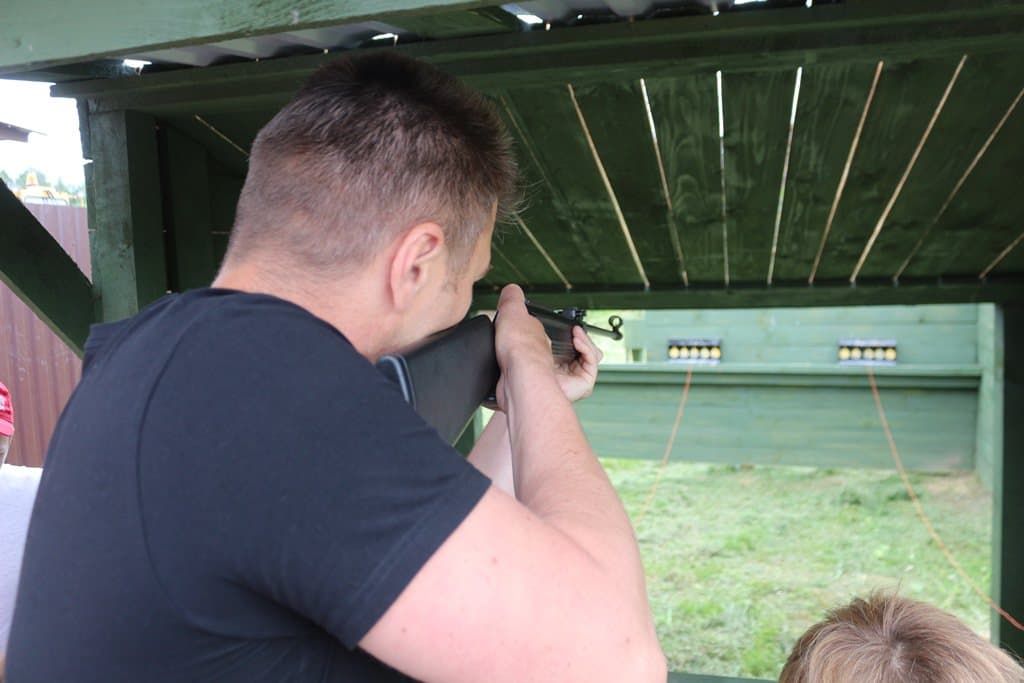
  • Airgun Shooting

  • Weapon Assembly and Disassembly

  • Scout Trail

  • Historical Quiz

  • Grenade Throwing

  • Artillery School

In accordance with the reform plan for the Armed Forces of the Republic of Belarus, and to improve the security of military facilities belonging to Armed Forces units and institutions, the 1st Military School for Junior Specialists (Service Dog Training) was established in 1993. Now the Armed Forces Canine Centre, it is based in Krupki, Minsk Region. Its official date of establishment is 16 November 1993, when the first school order was issued.

In 1995, recognising the importance and potential for the development of military working dog training, a decision was made to relocate the Armed Forces Canine Centre to the settlement of Kolodishchi, Minsk District.

Since the centre was established, it has trained more than three thousand service dogs and over three thousand military working dog specialists.

Today, the Armed Forces Canine Centre is a military training unit responsible for training military working dog specialists and service dogs for a variety of roles, including mine detection, search and rescue, tracking, the detection of weapons, narcotics and explosives, guard duties, patrol work and others.

The centre devotes considerable attention to breeding and dog shows. More than 500 dogs and puppies have taken part in national and international shows.

The centre’s dogs hold titles including International Champion, Candidate for International Champion, Champion of Belarus, Candidate for Champion of Belarus, class winner and FCI group winner.

The Canine Centre plays an active role in the military-patriotic education of schoolchildren and in enhancing the prestige of military service. To this end, the centre’s personnel give demonstrations, conduct informative guided tours and take part in other civic and patriotic events.

Since the centre was established, there has not been a single breach of any facility guarded by service dogs trained there.

The Salang Folk Ensemble of Patriotic Song was founded in 1990 by amateur musicians and former internationalist veterans. Its members work at various enterprises and institutions in the city of Zhodino. The ensemble is led by Vitaly Vladimirovich Zhigimont, Artistic Director of the Zhodino City Centre for Culture and Leisure. In 2004, the Board of the Ministry of Culture of the Republic of Belarus awarded the ensemble the honorary title of ‘Folk Ensemble’. Today, its repertoire includes songs by Belarusian and international composers, as well as original works. Over the course of its development, the group has progressed from a traditional guitar-based beat ensemble through drum machines and polyphonic synthesisers to modern computer arrangements, while always retaining live performances of vocals and individual instrumental parts.

The ensemble’s principal aim is to promote patriotic song, foster a strong sense of patriotism among the younger generation and encourage respect for veterans and those who currently defend our country.

The ensemble takes an active part in city events, performs concert programmes at organisations and enterprises throughout the Republic, and is also a welcome guest abroad. It always takes pride in representing the city, region and Republic at international competitions and festivals.

Finally, we would like to quote the ensemble’s favourite saying: ‘We do not say farewell; we say goodbye until we meet again!’

The Service Dog Handler Training School was established on 24 January 1995 at the Smorgon Border Guard Training Detachment in the settlement of Devyatni, Smorgon District, Grodno Region. 

In October 1995, the Service Dog Handler Training School was relocated to the Smorgon Border Guard Detachment in the settlement of Gauti, Smorgon District, Grodno Region. 

In November 2002, the Service Dog Handler Training School was reorganised as the Canine Centre. 

The Canine Centre is now a training unit of the border guard service. It trains, retrains and provides advanced training for canine specialists, as well as training service dogs for a variety of duties, including tracking people by scent, sentry duties, specialised searches for narcotic drugs and psychotropic substances, weapons, ammunition and explosives, and guarding facilities. It also breeds and raises working dog breeds. 

Today, the Canine Centre of the border guard service is recognised as one of the best not only in the CIS, but also in Eastern Europe. 

The Battle of Stalingrad (17 July 1942–2 February 1943)
Stalingrad was a major communications hub linking the country’s central regions with the Caucasus and Central Asia, while the Volga was a vital transport artery for delivering Caucasian oil. The capture of Stalingrad could have had catastrophic consequences for the USSR. The German command believed that the fall of Stalingrad would undermine the authority of the Soviet leader, affect the political situation and prompt Turkey and Japan to take decisive action against the USSR.

The Battle of Stalingrad is conventionally divided into two periods according to the nature of the fighting: defensive operations from 17 July to 18 November 1942, and offensive operations from 19 November 1942 to 2 February 1943. The German offensive began on 17 July 1942. Army Group B included Paulus’s 6th Army, comprising 270,000 soldiers and officers, around 2,200 guns and mortars, and approximately 500 tanks. The 6th Army received air support from General Richthofen’s 4th Air Fleet, which had around 1,200 aircraft. Hermann Hoth’s 4th Panzer Army was transferred to Army Group B shortly afterwards.

The assault on Stalingrad began on 13 September 1942. Fighting took place over every district, every street and every house, and even individual floors, basements and rooms. On 19 November 1942, the Red Army launched a large-scale operation involving three fronts, codenamed ‘Uranus’. That day, the salvoes of thousands of Soviet guns and mortars heralded the beginning of our forces’ counter-offensive at Stalingrad. The artillery bombardment lasted for around two hours. It was subsequently in commemoration of this bombardment that 19 November became the professional holiday of artillery personnel.

On 23 November, the encirclement closed between the Volga and the Don around Paulus’s 6th Army and the main forces of Hoth’s 4th Panzer Army. Twenty-two German divisions, numbering more than 300,000 men, were trapped in the ‘pocket’. Paulus’s force was doomed. On 2 February, Friedrich Paulus and a further 24 generals surrendered with the remnants of their forces, comprising around 90,000 soldiers and officers. Three days of mourning were declared in Germany.

Over the course of the Battle of Stalingrad, the enemy lost a total of around 1.5 million men killed, wounded, captured or missing—a quarter of its forces operating on the Soviet–German Front.

Victory at Stalingrad marked the beginning of a decisive turning point in the war and had a determining influence on the subsequent course of the fighting. The Red Army seized the strategic initiative and retained it until the end of the war. The defeat of major German fascist forces at Stalingrad significantly worsened Germany’s military and strategic position. Japan and Turkey were forced to abandon their plans to enter the war against the USSR.

The successful execution of the Stalingrad operation was recognised by awarding the rank of Marshal of the Soviet Union to the outstanding commanders G. K. Zhukov and A. M. Vasilevsky. I. V. Stalin was awarded the rank of Marshal that same year. These were the first appointments to the highest military rank since the beginning of the war. Thousands of Red Army soldiers and officers received orders and medals for the steadfastness, courage and heroism they displayed in the Battle of Stalingrad, while 112 were awarded the title Hero of the Soviet Union. Forty-four formations and units that had particularly distinguished themselves in the fighting received honorary titles such as ‘Stalingrad’, ‘Don’ and ‘Kantemirovka’. A total of 183 units were redesignated as Guards units. The Medal ‘For the Defence of Stalingrad’ was instituted on 22 December 1942 and awarded to more than 700,000 participants in the battle. Stalingrad was among the first cities to be named a Hero City. This honorary title was first proclaimed in an order issued by the Supreme Commander-in-Chief on 1 May 1945. To commemorate the achievements of the heroes of the Battle of Stalingrad, a memorial complex was built on Mamayev Kurgan between 1963 and 1967.

Stalingrad became a symbol of the resilience, courage and heroism of the Soviet people in their struggle for the freedom and independence of their Motherland.

Please be aware that the gunfire will be EXTREMELY LOUD: the modern-day episode of the reenactment is expected to include eight rounds fired from the 122 mm gun of a 2S1 self-propelled artillery system.

This reenactment is dedicated to the artillerymen who fought heroically in the Battle of Stalingrad

Gavriil Dmitrievich Protodyakonov, Hero of the Battle of Stalingrad

Gavriil Dmitrievich Protodyakonov demonstrated great resourcefulness during the fighting on Mamayev Kurgan. As our 45 mm anti-tank gun could not penetrate the frontal armour of German tanks even when fired at point-blank range, he began rolling it out into no man's land, carefully camouflaging it and opening sudden fire from there against the sides of German tanks. In one engagement, the gun's optical sight was shattered by shell fragments, but the ‘forty-five’ itself remained intact. Protodyakonov then began aiming at enemy tanks through the gun barrel. As soon as a tank appeared in the bore, he quickly loaded the gun, applied a small amount of horizontal lead and fired over open sights. In this way, he knocked out three tanks.

Throughout the Battle of Stalingrad, he personally destroyed seven German tanks and several firing positions, killed fascist infantry with shrapnel fire and shot down an aircraft. During the fighting for Mamayev Kurgan, his gun crew destroyed nine machine-gun positions, four dugouts and two anti-tank guns. In August 1942, the battery under his command knocked out 20 tanks. He is even depicted with his gun crew and gun in the ‘Battle of Stalingrad’ panorama. Gavriil Protodyakonov was awarded three Medals ‘For Courage’, the Medal ‘For the Defence of Stalingrad’, the Medal ‘For the Liberation of Warsaw’ and the Medal ‘For the Capture of Berlin’.

* The organisers reserve the right to amend the programme due to weather, technical or other circumstances.
** Additional charges apply
*** weather permitting

The Stalin Line Historical and Cultural Complex is located at kilometre 31 of the P28 road (Minsk–Molodechno), 20 km from the Minsk Ring Road.

For visitors travelling without a car:

Shared minibuses on the Minsk–Radoshkovichi (Minsk–Sosnovy Bor) route depart every 30 minutes from the stop at 19 Bobruiskaya Street, opposite the Tsentralny Bus Station. Alight at the Stalin Line stop.

Shared minibuses to Molodechno depart every 20 minutes from the stop at 9 Bobruiskaya Street, near the junction with Leningradskaya Street and across the road from the Minsk–Molodechno railway services. Alight at the Stalin Line stop.

Three designated car parks with a total capacity of 1,500 vehicles are available for visitors travelling by car.

Directions to the Stalin Line Historical and Cultural Complex are available here.

The Stalin Line Historical and Cultural Complex is located at kilometre 31 of the P28 road (Minsk–Molodechno), 20 km from the Minsk Ring Road.

For visitors travelling without a car:

Shared minibuses on the Minsk–Radoshkovichi (Minsk–Sosnovy Bor) route depart every 30 minutes from the stop at 19 Bobruiskaya Street, opposite the Tsentralny Bus Station. Alight at the Stalin Line stop.

Shared minibuses to Molodechno depart every 20 minutes from the stop at 9 Bobruiskaya Street, near the junction with Leningradskaya Street and across the road from the Minsk–Molodechno railway services. Alight at the Stalin Line stop.

Three designated car parks with a total capacity of 1,500 vehicles are available for visitors travelling by car.

Directions to the Stalin Line Historical and Cultural Complex are available here.

Dear visitors! To avoid traffic congestion at the entrance to the complex, please purchase electronic tickets and arrive 2–3 hours before the reenactment begins.

Admission tickets may be purchased online or from the complex’s ticket offices on the day of the event.

There is no limit on the number of tickets available. Please note that a ticket grants admission to the complex but does not entitle the holder to a seat in the grandstand for the reenactment. Grandstand seats cannot be reserved or purchased.

Once electronic tickets have been purchased and paid for, PDF copies will be sent to the email address provided during registration. The tickets must be presented at the entrance to the complex, either printed or on a mobile device. The unique QR code on each ticket must be clearly visible. If you have paid for your tickets but have not received them by email, please also check your spam folder and then use our Telegram bot. The bot will instantly find your order using the email address provided when you made your purchase and send you all your tickets as PDF files.

Admission prices:

  • Adults – 30.0 Belarusian roubles;
  • Students with valid student ID – 25.0 Belarusian roubles;
  • Schoolchildren – 15.0 Belarusian roubles;
  • Children aged 6 and under do not require a ticket and may attend the event free of charge when accompanied by an adult.

Discounts:

  • For large families, upon presentation of a large-family certificate, children’s tickets cost 10 roubles and are available only from the complex’s ticket offices.
  • Free admission:

    • Orphans (on presentation of valid identification)
    • People with Group I or II disabilities and those accompanying them
    • Veterans of the Soviet–Afghan War and the Great Patriotic War
    • Conscripts

    Dear visitors! To avoid traffic congestion at the entrance to the complex, please purchase electronic tickets and arrive 2–3 hours before the reenactment begins.

    After payment, e-tickets are automatically sent as PDF files to the email address provided during registration.

    What to do:

    • Check your inbox.

    • Be sure to check your spam folder.

    • Make sure that the email address was entered correctly.

    If you cannot find the email, please use our Telegram bot. The bot will instantly find your order using the email address provided when you made the purchase and resend the tickets as PDF files.

    At the entrance, you must present your ticket:

    • as a printout
      or

    • on the screen of a mobile device

    The unique QR code must be clearly visible and available for scanning.

    Parking for cars and minibuses is free for e-ticket holders, subject to availability.

    When purchasing tickets at the complex ticket offices:

    • Car or minibus – 3.0 BYN per day
    • Coach parking costs BYN 4.0 per day.

    Dear visitors! To avoid traffic congestion at the entrance to the complex, please purchase electronic tickets and arrive 2–3 hours before the reenactment begins.

    Visitors with electronic tickets may park a car or minibus free of charge, subject to availability.

    We recommend arriving early, as parking spaces can fill up quickly on major event days.

    No, grandstand seats cannot be purchased or reserved in advance.

    Seating is on a first-come, first-served basis:
    those who arrive first can watch the performance from the grandstand.

    We recommend arriving early so that you can find a good seat without rushing.

    To avoid congestion when entering the complex, we recommend:

    • purchasing electronic tickets in advance;

    • arriving 2–3 hours before the reenactment begins.

    This will give you enough time to:

    • pass through the entry checks without rushing,

    • find a good seat,

    • park conveniently.

    Yes, there are several cafés and food outlets within the complex.

    On major event days, additional mobile food outlets offer hot meals, drinks and snacks.

    Visitors can also purchase traditional soldiers’ porridge at the complex. It forms part of the atmosphere of military-history events and is especially popular with visitors attending reenactments.

    We recommend arriving early to avoid queues during peak visitor times.

    Yes, the complex is suitable for families.

    There is a children’s playground where children can enjoy active play in a safe environment.

    For the most active youngsters, there is also an interactive Ready for Labour and Defence (GTO) activity zone at Stalin Line.

    Everyone taking part in the GTO activity zone can enter the prize draw.

    To enter the prize draw, you must:

    1. Complete all the GTO zones and receive a score for each one.

    2. Be present at the specified time for the announcement of the results.

    Certificates and prizes will be awarded exclusively to participants who are present at the prize-giving ceremony.

    Animals are permitted within the complex.

    Please note, however, that reenactments and demonstrations involve extremely loud gunfire, explosions and operating military vehicles. This may cause severe stress to dogs and other animals.

    We ask owners to consider their pets’ sensitivity to loud noises and assess any potential risks to their health and behaviour in advance.

    The owner bears full responsibility for the animal’s welfare and behaviour.

    If you:

    • purchased a ticket for the wrong event;

    • made an error when purchasing your ticket;

    • were unable to attend the event;

    • made an error when entering your details during purchase;

    • or have any other questions about tickets,

    please email:

    bilet@stalin-line.by

    In your email, please provide:

    • your full name,

    • the date and name of the event,

    • the email address used for the purchase,

    • a description of the problem.

    The support team will review your enquiry and contact you to resolve the issue.

    Event Details
    • Days
      Hours
      Min
      Sec
    • Start Date
      November 21, 2026
    Sponsors