

The Polotsk Fortified Region, extending for 56 km, formed part of the Stalin Line.
It was built along the River Ushacha to defend the Vitebsk–Smolensk axis against Poland. In the summer of 1941, however, it had to be used in fighting against Hermann Hoth’s German Panzer Group. Hoth proposed taking Minsk by means of an extremely deep envelopment: advancing through Glubokoye, Postavy and Polotsk to reach Orsha via Beshenkovichi. Hitler, however, insisted on a less risky envelopment of Minsk: advancing through Traby and Molodechno to Smolevichi, which was the route ultimately taken. When the 19th Panzer Division encountered determined Russian resistance near Traby, Hoth sent its tanks on his deep envelopment towards Polotsk. As a result, meeting no Soviet troops, the 19th Panzer Division covered some 200 km along good roads through Glubokoye and Postavy.
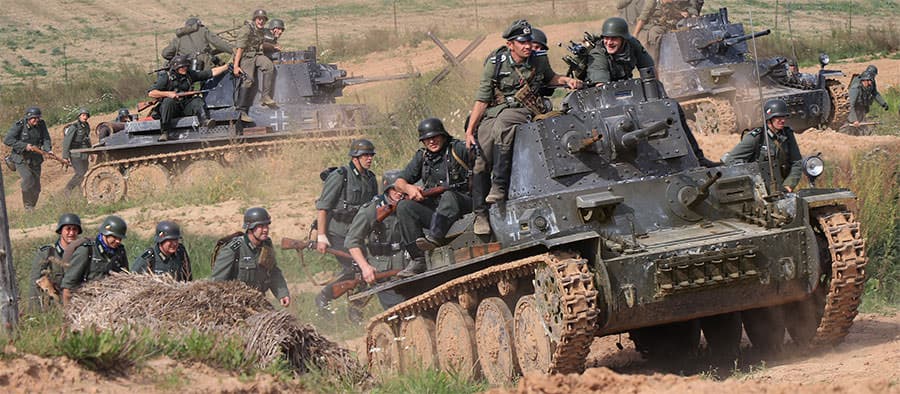
On 27 June, its advance detachment reached the crossing over the River Ushacha, where it was spotted by an observer in a pillbox near the village of Kutnyany. Major Kolokolov’s howitzers immediately unleashed a powerful barrage on the enemy. Having travelled a full 200 km without encountering any fighting, the Germans paid for their carelessness: some were killed, while others were taken prisoner.
Grigory Kuzmich Kolokolov later recalled: ‘It is difficult to say how many of the Germans managed to escape. The officers and men from the observation posts, having met with no return fire from the enemy, went to see the results of their collective efforts. In the meantime, the small groups of Germans who had survived our artillery fire had almost managed to dig trenches for themselves! They were so terrified that they surrendered without offering any resistance.’
During interrogation, the prisoners stated that they had not expected to encounter resistance there. They had intended to seize the bridges over the Western Dvina in Polotsk and hold them until the main forces arrived.
Meanwhile, because the Germans had been delayed by the fighting at the Minsk Fortified Region, fully manned rifle divisions from Udmurtia, Perm and Bashkiria had time to reach the Polotsk area. The positions of the Polotsk Fortified Region were occupied by Colonel Alexei Ivanovich Zygin’s division, which had arrived from Chelyabinsk.
Near the village of Latyshki, three German reconnaissance troops swam across the Ushacha River. Having failed to spot the camouflaged pillbox in the field and established that there were no Red Army soldiers in the village, they signalled to their comrades that the way was clear. A German infantry detachment with a gun then crossed the river. On entering the village, the German soldiers drove all the inhabitants beyond its outskirts. After separating the men of military age from the other villagers, the Germans marched them towards the river. D. V. Tolochko, a resident of the village, later recalled: ‘Suddenly, an order was given, and the foreigners opened fire on the men with rifles and machine guns. They used explosive bullets. My father, Vasily Markovich Tolochko, aged 43, was among them. But an instant before the shooting began, he dived into the water and swam away. The other 28 men were killed.
The Germans then began setting fire to the houses. In the last cottage, a soldier found an infant in a cradle and carried the child outside. The child’s mother rushed towards him, but she was shot dead. They took the dead woman by her arms and legs, swung her and threw her into the fire. The German carrying the infant then approached the crowd of women, asked them something and handed the child to one of them.’

The further development of the tragedy was halted by Soviet artillery, which opened fire from the direction of the village of Merugi. The pillbox, which had remained silent until then, also suddenly unleashed a burst of machine-gun fire. Under cover of a smoke screen, the Germans attempted to attack it. But each time they rose to attack, bursts of machine-gun fire forced them to hug the ground. Even a gun brought up to fire over open sights failed to help the enemy. The outcome of the battle was decided by an attack by Captain Kalashnikov’s battalion. Having lost up to 15 men killed, including one officer, the invaders retreated towards the village of Farinovo.
On 3 July 1941, after bringing up its main forces, the Wehrmacht’s 19th Panzer Division resumed its advance. Encountering fierce resistance in the belt of Polotsk pillboxes, Hermann Hoth sent the panzer division on a flanking manoeuvre towards the town of Disna. Its place in the assault on the pillboxes was taken by the newly arrived 18th Motorised Division (an infantry division transported by lorry). At a critical moment in the battle, Alexei Zygin, who was commanding the defence of the Polotsk Fortified Region, even left his observation post to direct the fighting in person. Every attack by the assaulting forces was repulsed. Hoth intensified the pressure by committing the 14th Motorised Division, which had arrived from the Minsk area. Zygin then formed a mobile detachment comprising a large number of lorries and guns, together with an infantry battalion, and began deploying it to the most threatened sectors of the defences. It was commanded by Captain A. I. Kochnev. The detachment proved particularly valuable in relieving our pillboxes when they were surrounded by the Germans.

Late in the evening, a battle group from the mobile detachment under the command of Political Commissar M. I. Kargopoltsev arrived at a village where the Germans intended to spend the night. Some of them had laid down their weapons and were carefreely swimming in the lake. Battery commander Agapetov prepared the firing data, and his guns opened fire. The Germans and their military vehicles were destroyed.
From the first days of the fighting in the Polotsk Fortified Region, Senior Lieutenant Fyodor Andreyevich Demidov, commander of a battery of 152 mm howitzers, particularly distinguished himself. Even before the war, he had been awarded the Order of Lenin for saving a collective farm’s harvest from fire. Now, with the fire of his powerful howitzers, he was destroying the enemy trampling our land. His fellow serviceman G. K. Kolokolov recalled Demidov: ‘He was a very brave commander who knew his business. His howitzer battery caused the Germans a great deal of trouble. He was killed in the following circumstances. The Germans established an artillery observation post (OP) in the water tower at Farinovo station. From its height, our positions could be clearly observed to a depth of up to 3 km. The tower was a fairly robust structure, and destroying it with artillery fire from concealed firing positions would have been very costly and unlikely to succeed. Demidov therefore volunteered to demolish it by firing… over open sights! But this was extremely dangerous, as the enemy would spot the howitzer and attempt to destroy it. Despite this, Demidov personally directed the fire of a 152 mm howitzer and brought down the tower with just six shells, destroying the ill-fated OP along with it. Unfortunately, the Germans identified where the fire was coming from and subjected Demidov’s howitzer position to heavy mortar fire. Our glorious artillery hero was killed by the explosion of one of the mortar bombs. This was our first major loss. He was buried beneath the canopy of ancient pines, not far from his battery’s firing positions.’
On 4 July, the 19th Panzer Division succeeded in crossing the Western Dvina and establishing a bridgehead near Disna. Units from no fewer than three of our rifle divisions attempted to drive the Germans back into the Dvina, but failed. To break the resistance of Polotsk’s defenders, the Germans shelled their positions with artillery and bombed them from the air for two days.
On 7 July, around 30 German tanks of the 19th Division launched an attack. Fighting continued throughout the day at the edge of the forest east of Disna. Zygin’s troops repelled the enemy attacks and even captured a tank and two armoured cars, incorporating them into their mobile detachment. On 8 and 9 July, the Germans attempted to break through near Borkovichi. Their fierce attacks were repelled thanks to an ample supply of shells. Lieutenant Syrovatsky recorded in his diary that, over the course of just two evenings, his battery alone fired 442 shells at the enemy.

On 9 July, the German 20th Panzer Division broke into Vitebsk. The defenders of the Polotsk Fortified Region were in danger of being encircled, but they did not abandon the belt of pillboxes. Around 100 German tanks then attacked in the Borovukha sector. Fighting broke out at Zaruchevye, Zalesye, Oserotki and Makhirovo. Under heavy enemy fire, our troops were forced to abandon some of the first-line pillboxes.
On 10 July, near Mekhelevo, the Germans succeeded in blockading six pillboxes and demolishing two of them before advancing towards Gorodok with around 100 tanks. That same day, Wehrmacht infantry divisions also began reaching the battle zone. Two of them crossed the Western Dvina during the night. On 11 July, they attacked the pillboxes near Borovukha-1 and supported the advance of the 19th Panzer Division and the 14th Motorised Division towards Nevel.
By this time, the Battle of Smolensk was already beginning, yet the defenders of the Polotsk Fortified Region still refused to surrender, tying down substantial German forces. As a result, 16 German divisions were advancing against six Soviet divisions in the Polotsk area. By comparison, Paulus’s army, which would break into Stalingrad in August 1942, would comprise only 13 divisions. Even so, our troops still managed to mount attacks. Units under Colonel T. P. Miloradov attacked a crossing near the town of Ulla, destroying up to 50 enemy lorries. At a discovered airfield, around 30 German aircraft were put out of action. Hermann Hoth later wrote: “The advance of the 18th Motorised Division from Ulla towards Gorodok was delayed by a strike against its rear by the garrison of the Polotsk fortress.”
The Wehrmacht infantry divisions, having arrived on foot, began preparing for a decisive assault on the Polotsk Fortified Region. Artillery was brought up to the positions, including highly accurate 88 mm anti-aircraft guns. German reconnaissance revealed that the Soviet positions were well camouflaged and protected by anti-tank obstacles and barbed-wire entanglements. Trenches had been dug between the pillboxes for the defending infantry.
On the morning of 15 July, the artillery of the 6th Infantry Division unleashed a devastating barrage against the pillboxes near the village of Gomel. A total of 152 guns opened fire, ranging from 37 mm anti-tank guns to heavy 210 mm mortars and special 250 mm guns. The German artillery concentrated its main fire on two pillboxes in the first line of defence. For an hour, dozens of guns pounded them at point-blank range. According to the memoirs of Lieutenant Heinrich Haape, it was astonishing that the Russian concrete bunkers remained standing amid this inferno.
At 05:00, the guns shifted their fire deeper into the defences, and the assault groups launched their attack.
To the attackers’ astonishment, one of the pillboxes in the first line immediately opened machine-gun fire. It was supported by pillboxes in the second line and even by the regimental artillery of the rifle units. The assault dragged on. Only after killing our soldiers in the trenches were the German assault groups able to reach the pillboxes and begin destroying them. The pillbox garrisons fought to the last. Using flamethrowers and explosive charges, the Germans had destroyed five concrete bunkers by noon.

Our defences were breached in this sector. The German units assaulting the pillboxes to the left of the village of Gomel failed to make any headway. All their attacks were repulsed.
However, our forces were unable to halt the German offensive towards Nevel, which had begun on 13 July. Bypassing Polotsk from the north, the Wehrmacht’s 19th Panzer Division and 14th Motorised Division advanced rapidly towards Nevel. On 15 July, the Germans severed the Polotsk–Idritsa railway and even captured the part of Polotsk on the left bank. Columns of German lorries carrying the fuel and ammunition needed for the capture of Smolensk immediately began moving through it. On 16 July, tanks of the 19th Panzer Division broke into Nevel, threatening the defenders of the Polotsk Fortified Region with encirclement. The command authorised Alexei Zygin to begin withdrawing the troops towards Velikiye Luki. Their retreat was covered by Captain Kochnev’s battalion and several machine-gun pillbox garrisons. These heroes did everything they could, holding their positions until the evening of 19 July!
On 21 July, during a night attack, Zygin’s units succeeded in breaking out of the encirclement with their equipment and heavy weapons. For his skilful command of the Polotsk Fortified Region, personal courage and successful withdrawal of his units from encirclement, Alexei Zygin was awarded the Order of Lenin and promoted to the rank of Major General. A. I. Kochnev also received the Order of Lenin for successfully covering the withdrawal and for his courage and bravery.
The Polotsk Fortified Region, built to hold back the Polish army for 14 days, managed to delay the Germans for 22 days! This helped to prolong the Battle of Smolensk until 10 September. After capturing it, the Germans were forced to turn towards Ukraine to break through the defences of the Stalin Line’s Kiev Fortified Region. Fighting there continued until 26 September 1941.
Germany could not defeat the Soviet Union in a protracted war and therefore relied on a lightning campaign. However, because of the prolonged fighting in the fortified regions of the Stalin Line, the blitzkrieg plan, which envisaged the capture of Moscow by 25 August, ultimately failed.
Although the Wehrmacht would continue to capture one Soviet city after another in October and November 1941, Germany would ultimately lose its war against the Soviet Union.


 Russian
  English