
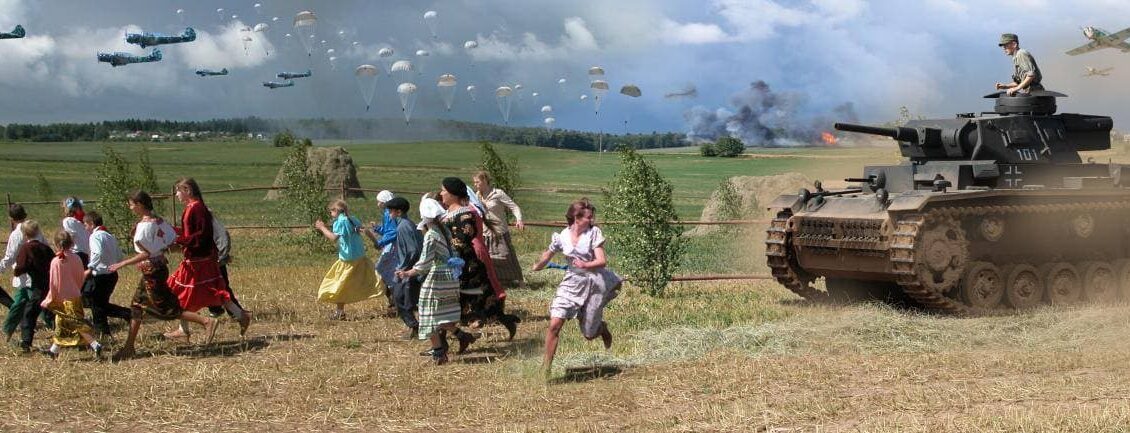
I Became a Tank Crewman Instead of a Teacher
I come from a large peasant family. My eldest brother, Konstantin, was born in 1905. Before the war, he worked as the foreman of a tractor brigade. In 1937, he was awarded the Order of the Badge of Honour. The award was presented to him in Moscow by Mikhail Ivanovich Kalinin, the All-Union Headman himself.
Fyodor was born in 1910. He would serve as a tank crewman throughout the war.
Hanna was born in 1912. She was married to Ivan Ivanovich Komeshan, the chairman of a collective farm. During the war, the fascists would execute him, leaving Hanna alone with three children.
Sofia was born in 1914. She worked as a teacher in Western Ukraine. When the war began, she and her husband, Luka Iosifovich Panchenko, left behind their home, their cow and everything they owned. They did, however, manage to evacuate eastwards with their three-year-old son. Luka went to the front and was killed.
Feodosiy was born in 1915. I do not remember him because he fell from the loft as a child and died.
Ivan was born in 1918. Before the war, he was called up and sent to serve on the border. That was where the war found him, and afterwards he remained in Lviv.
Grigory was born in 1921. When the war began, he was serving in Leningrad as an air defence lieutenant. He spent the entire siege serving first in a searchlight battalion and later in reconnaissance.
And then I, the youngest, was born on 1 December 1923. So there were six sons and two daughters in our family. We lived in the village of Bakaevo, Chernobay District, Poltava Region — after the war, this became part of Cherkasy Region. Our parents worked on a collective farm.
Of course, we expected war. It was already raging across Europe, and our country was preparing for it as well.
Where Was I When the War Began?
I was studying in the town of Zolotonosha. I had completed three years at teacher-training college and wanted to become a primary school teacher. On 22 June, we were in the hostel when we heard Molotov announce on the radio that war had begun. We rushed to the college director to ask what we should do, but he did not know either. He went to the district Party committee, but they had no clear idea of what was happening there either. He returned and told us that our forces would most likely stop the Germans at the Dnieper, so we might still be able to celebrate our graduation.
Our teacher-training college building was being requisitioned for use as a hospital, so we had to sit our examinations at an ordinary secondary school. Three tables and three chairs were set up there, with one examination held at each table. That was how, just two days later, we received our graduation certificates from the Zolotonosha Teacher-Training College. I had qualified as a teacher, but because of the war I became a tank crewman instead.
The fascists had already been wreaking havoc in our land for more than a month when I was called up, not yet 18 years old. It was 28 July 1941. I was sent to the 2nd Kharkov Light Tank School at Kholodnaya Gora. We trained there until early October, when orders came to evacuate to Samarkand in Uzbekistan. The Germans were already bombing Kharkov so heavily that the nearest railway station not yet destroyed was at Valuyki, more than 200 kilometres away. We marched there for five days. This was how we were fed: in the morning, the field kitchen gave us a mess tin of rice porridge and tea with dried black bread. We were also given another mess tin of porridge to take with us for lunch, as the kitchen itself travelled ahead to wherever we were due to reach on foot that evening. In the evening, we might be given soup or even borscht, along with more rice porridge and tea with sugar and a rusk. Sugar was also included in our field rations. We were issued tobacco as well. Those who did not smoke, like me, received sugar instead. So I was lucky: not only was I spared the poison of tobacco, but I received sugar for it too! And sugar meant extra calories and energy. After all, we were given neither meat nor butter. We became so exhausted that when we finally reached Valuyki, many of us could not lift their legs high enough to climb into the railway carriages. Those men had to be hauled aboard by their arms from above.
I should add that we were also so exhausted because the snow came very early in the autumn of 1941. It was October and there were still leaves on the trees, yet we had alternating rain and wet snow. The mud was appalling, and we could barely put one foot in front of the other. We became so tired that we would march for two days, rest for an entire day and then set off again. On the march, we carried rifles with their bayonets fixed pointing upwards. The rifle itself was long, and with the bayonet protruding it was almost as tall as a man. As you walked, it seemed to sway you from side to side. Someone with more experience said that fixing the bayonet pointing downwards made marching feel easier. So that was what I did. Then a commissar from the school happened to be alongside our platoon. He saw my bayonet, pulled me out of the ranks and reached for his pistol. Fortunately, voices were raised in my defence from the ranks, saying that Germans should be shot at the front, not our own men in the rear.
It is not hard to imagine how I felt: I could barely put one foot in front of the other, and then this happened... That commissar was currying favour so that he would not be sent to the front. He spent the entire war at the school. Even after the post of commissar was abolished, he still managed to remain in Samarkand, where he began teaching the social and political studies course. In 1943, after Kursk, I was awarded the Medal For Courage and the Order of the Red Star. I could not resist writing him a letter: I am fighting the fascists and receiving decorations, while you wanted to shoot me...
 Russian
  English