
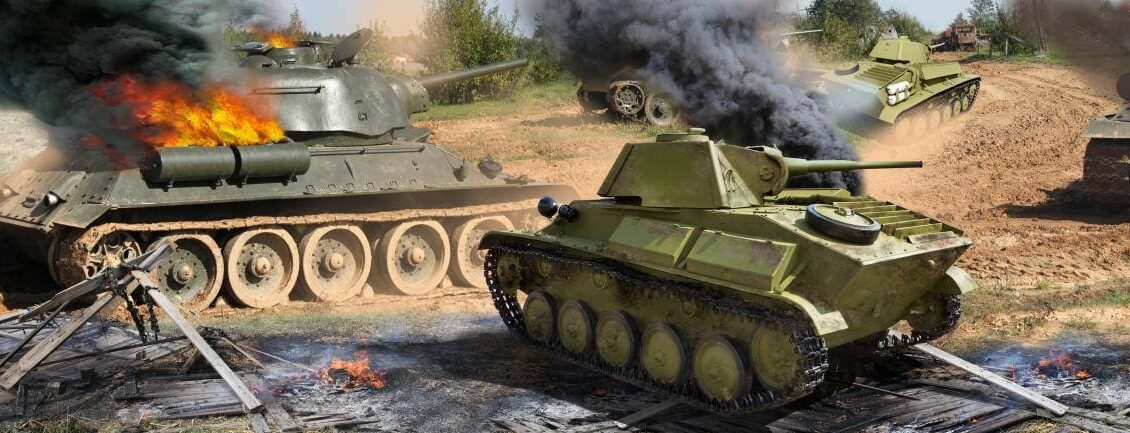
As recounted by Alexander Fen.
During the fighting at the Kursk Salient, our tank brigades often operated as follows.
The first echelon consisted of T-34 tanks capable of engaging the enemy’s medium and heavy tanks. They charged straight into the enemy’s battle formations, destroying them with gunfire as they advanced. Then, under enemy pressure, the T-34s would halt and even begin to withdraw some 500–1,000 metres. Once they had found suitable positions, they would open fire from a standstill. Under cover of their aimed fire, the second and third lines of our tanks entered the battle. Firing on the move, they advanced until they were within effective range of the tanks firing from stationary positions, before joining them in a decisive drive forwards. This manoeuvre was repeated as often as the situation required.
When this fierce battle near Prokhorovka began, I, Lieutenant Fen, was commanding a platoon of light two-man T-70 tanks in the 31st Tank Brigade. Our tank battalion, equipped with these light vehicles, advanced in the third line. Ahead of us was the 32nd Brigade, entirely equipped with T-34 tanks. They charged into the battle formations of the advancing German tanks, firing their guns at them, and many even resorted to ramming. It should be explained that when ramming an enemy tank, you generally tried to strike its drive wheel with the strong frontal section of your own hull. The drive wheel was not designed to withstand such an impact and would invariably break. Your own hull would remain unscathed, while the immobilised German tank was no longer capable of fighting.
We advanced in our light tanks 100–200 metres behind the T-34s. Progress was slow, and we frequently stopped to repel enemy counter-attacks. German tanks soon began breaking through to our positions as well. Although the T-70’s gun was of small calibre — just 45 mm — its armour-piercing shells were highly effective at setting German self-propelled guns ablaze, especially at close range. The real difficulty was telling friend from foe amid the fighting, particularly when our vehicles and the German vehicles became intermingled in the head-on engagement. Tanks were burning ahead and to the right and left, both enemy tanks and our own. We had to choose our targets carefully and fire in such a way that, if we missed, the shell would not strike a Soviet tank. To improve my own chances of survival, I disguised our T-70 as a ‘burning’ tank by placing smoke canisters on its armour. When firing from a standstill, I would throw a smoke grenade in front of the tank. Thanks to all this, I managed to destroy three German vehicles in the battle on 12 July 1943 while preserving my own.
The main difficulty of the Battle of Prokhorovka, however, lay not only in the confusion that reigned across the battlefield, where three of our tank corps were advancing simultaneously. They had been given their objective, and commanders at every level pressed determinedly to achieve it. The principal challenge was the deterioration of the overall operational situation. Confronted by such substantial Soviet forces, the Germans managed to tie us down in a gruelling battle near Prokhorovka while intensifying their offensives on the flanks, intending to encircle all three of our corps between the rivers Psel and Seversky Donets. To counter these flanking attacks, the command of our 5th Tank Army committed its reserves against the Germans. With immense difficulty, they managed to halt the enemy and even drive them back by 5–8 km.
By the evening of 12 July, the intensity of the fighting in our sector also began to subside. It is difficult to imagine the despondency that overcame us young tankers. Our losses were heavy, yet, as we saw it, we had made no progress. At the beginning of the day, our battalion had more T-70 tanks than its authorised strength: 39 instead of 31. By evening, only 15 remained! As tankers with limited experience and knowledge at the time, we could not properly assess the decisions of our senior commanders and believed that they were responsible for such heavy losses and what we saw as a failure.
That evening, however, a message to us from the commander of the 5th Guards Tank Army, P. A. Rotmistrov, was broadcast over every radio network. He said: ‘Tankers! You have worked a true miracle. You have stopped the German beast!…’ Hearing this lifted our spirits, and we began preparing for the next day’s battle with even greater enthusiasm.
During the night, we dug tank trenches and replenished our ammunition and fuel. By morning, we were once again ready either to advance or to repel an enemy attack.
 Russian
  English