
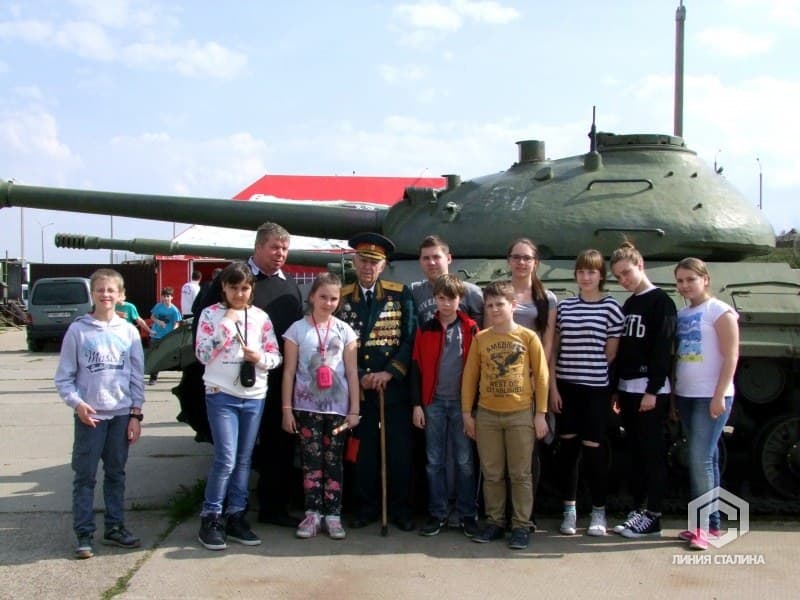
The story is told by Alexander Fyodorovich Fen.
This year marks the 70th anniversary of the victory over fascist Germany. Every people of the Soviet Union — indeed, one might say the entire Soviet population, every one of us — contributed to that victory. I destroyed twelve German tanks. If you work out how much each of them cost, you might say I earned enough to last me a lifetime! (I'm joking.)

Not long ago, when I was travelling to a conference in Berlin, I kept wondering how the Germans, and young Germans in particular, would receive me. Well, I arrived and took my seat in the conference hall. When the principal speaker, the Foreign Minister of the Federal Republic of Germany, announced that the conference was being attended by a veteran of the Battle of Stalingrad, the fighting at the Kursk Salient and the liberation of Belarus and Lithuania, the young people rose and gave me a standing ovation! I then realised that young people in Germany today are completely different from those of that time, because they understand that we liberated their country from fascism and that this was our victory — the victory of the Soviet Union! That is how the peoples of the world remember it, despite the efforts of the enemies of the USSR and even our former allies, who are so fond of rewriting history. I was born in Ukraine, graduated from a tank training school in Samarkand and am now a citizen of Belarus. As a veteran of the war against fascism, I must tell people the truth. All these ‘colour revolutions’, sanctions, double standards and the forcible imposition of ‘democratic’ regimes favoured by the United States are the machinations of a new form of fascism like the one we defeated 70 years ago. This fascism must be resisted! I am now 91 years old (not so very old, is it?). I also hope that I shall meet you many more times. But when we veterans are gone, who will stand against fascism? You will! You are our hope!
And yet I was only twenty when the liberation of Belarus began. But I want to tell you not about myself, but about the courage of my comrades-in-arms. Our tank battalion set out from Ostroshitsky Gorodok early in the morning. Ahead was a reconnaissance patrol of three tanks, commanded by Motorin, Zayats and Goryachev. Alexander Motorin was the first to spot a German Tiger bogged down beside a small river. It was a 54-tonne heavy tank armed with an 88 mm gun! Three members of its crew stood nearby, watching as the tank, its gun pointing skywards, strained its engine with a deafening roar in an attempt to free itself. Because of the noise, they did not hear Motorin's tank approaching. The Tiger's driver and commander were still inside. Alexander acted wisely. It was almost impossible to knock out a Tiger with the T-34's 76 mm gun.

Motorin therefore fired a fragmentation shell at the three fascists standing beside the tank, then struck the roof of the Tiger's turret with an armour-piercing round. Although the shell ricocheted into the sky, the impact was so violent that the driver and commander leapt out of the Tiger and were immediately cut down by machine-gun fire. That was how Alexander Motorin captured an undamaged Tiger! Motorin's next victim was a German heavy self-propelled gun, which he had to ram. Despite being only 18, his driver, Vanya Petrov, knew exactly how to do it. Ivan struck the self-propelled gun's drive wheel with the front of the T-34's hull, throwing off its track. The fascist crew jumped out of the immobilised vehicle and were killed by machine-gun fire. After the ramming attack, Motorin's tank fell to the rear of the patrol, while the T-34 commanded by Junior Lieutenant Ivan Zayats took the lead. Barely 1.5 kilometres further on, he was fortunate enough to spot and destroy a fascist Panther in time — an exceptionally powerful tank armed with a long-barrelled 75 mm gun. Thanks to the decisive actions of our reconnaissance patrol, the 31st Tank Brigade advanced out of Ostroshitsky Gorodok without suffering any losses. At a bend in the forest road, however, our reconnaissance patrol came under fire from three enemy tanks lying in ambush. All three patrol vehicles burst into flames one after another, and the enemy shifted its fire to the advancing column of the battalion's main force, followed by the forward command post of the 31st Brigade. Two more of our tanks caught fire when, to everyone's surprise, Alexander Motorin's burning tank came back to life and entered the battle.

He fired three well-aimed shots and destroyed all three enemy tanks. But our lads did not have time to escape from their burning vehicle. The tank exploded, killing the entire crew: Alexander Motorin, Ivan Petrov, Alexander Karagodin and Nikolai Razuvaev. They were only 18 to 20 years old.
A memorial now stands at the site of their deaths near the village of Markovshchina. Thanks to their heroic actions, our 31st Tank Brigade was able to break into Zaslavl as early as 3 July! At the railway station, we managed to capture fascist trains laden with cargo and ready to depart. But the most moving moment, one that has remained in my heart for ever, came when a company of submachine gunners and I began searching those long lines of railway wagons for Germans. Suddenly, we heard muffled banging and cries for help. When we opened the wagons, girls came tumbling out towards us! It turned out that around three hundred Soviet girls were crammed into five sealed wagons; the fascists had rounded them up for transportation to the West. One of them rushed to embrace me and simply froze there, clutching me and refusing to let go. But my hands were full: grenades on one side and a pistol on the other. I was still thinking about the war: what if some German threw a grenade at us now? That would be the end of us! In short, I was completely at a loss.
When I recently told this story at a school, one girl could not help interrupting at this point to ask, ‘Was she pretty?’
Did I even see her? She rushed at me so unexpectedly and held me so tightly that I had no time to take a proper look at her. But what could I say to the girl? ‘Of course she was pretty!’ I blurted out. ‘Because she was a Soviet girl!’
And that, my dear young friends, is how we fought — for you, so that you could live happy and fulfilling lives. Shall we take a photograph to remember this occasion?

 Russian
  English