
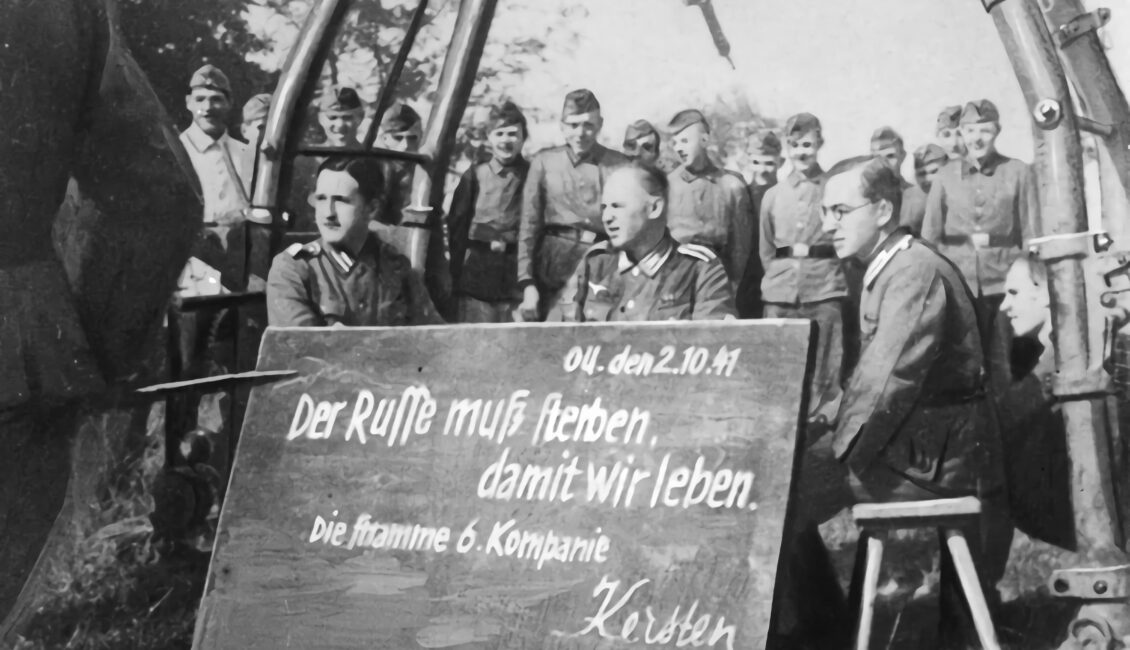
Genocide is the killing of civilians or the creation of conditions that lead to their deaths.
Who could have imagined that we would live to see the revival of Nazism in the post-Soviet space, actively supported by Europe, and, as a consequence, genocide — the extermination of people deemed undesirable. Following the coup in Kyiv in 2014, the ‘warriors of light and warriors of good’, under the genocidal slogan ‘Ukraine Above All’, went to Odesa, where they burnt 42 people alive and beat four others to death with iron bars. As Donbas was larger than Odesa, the residents of Donetsk and Luhansk began to be killed using aircraft, tanks, guns and Grad multiple rocket launchers. According to the UN commission, around 3,900 civilians were killed in Donbas. Those who were not killed were deprived of drinking water by dumping the bodies of militia members and animals into water intakes. In 2014, the Kyiv authorities cut off electricity and blocked the water supply to the residents of Crimea altogether. What is that if not genocide?
Why did Europe and the United States, which imposed sanctions on Belarus over TWO people killed during the 2020 protests, not punish the authorities in Kyiv, who killed THOUSANDS of their own citizens with tank and artillery fire?
The answer is simple: during the settlement of the American continent, the Europeans themselves exterminated around 10 million Native Americans without any authorisation, death factories or tanks (given the small population at the time, this would be comparable to 500 million people today). A similar number of Indians died under British rule in India. In the twentieth century, genocide came to Europe as well. Germany — Europe’s second great power after Britain — decided to catch up with the British in the number of civilians killed. The Germans began with the ‘Final Solution to the Jewish Question’ and, if they defeated the USSR, planned to finish by exterminating 75% of Russians, Ukrainians and Belarusians — tens of millions of people. Why? Because the idea of genocide is expressed in the very title of the German anthem: ‘Germany Above All!’
The example of the ‘final solution’ was also taken up by Croatia, which gained independence from Yugoslavia with Hitler’s help in 1941. Croats are Serbs who were forcibly converted to Catholicism during the Middle Ages. In 1941, Croatia was still home to 3 million Orthodox Serbs. Guided by the genocidal idea of ‘Croatia Above All’, the Croatian Nazis — the Ustaše — sought to dispose of the Serbs as the great European nations had done. The Ustaše decided to kill one million Serbs, forcibly convert another million to Catholicism and expel a third million from the country.
The Croatian Catholic episcopate not only approved the ‘solution to the Serbian question’, but also began actively converting Orthodox Christians to Catholicism. Many Serbs who converted were immediately killed by being thrown from cliffs. This was justified as ‘saving their souls’, since death deprived them of the opportunity to return to Orthodoxy and ensured that they entered the next world as Catholics.
An international commission of experts established that NOT all Croatian Catholic priests, but only around 1,400 of them, were directly involved in the killings of Serbs. The best known was the Catholic Franciscan friar Miroslav Filipović, whose unheard-of cruelty towards Serbs earned him the nickname ‘Brother Satan’. Early in his career, he developed a penchant for killing children and school pupils. To this end, while serving as a military chaplain, he led a special squad that executed children at their school desks. While his subordinates simply slit the children’s throats, Filipović liked to kill them by tossing them onto pitchforks.
For his achievements in building the new Croatia, ‘Brother Satan’ was promoted and appointed commandant of one of the concentration camps near the town of Jasenovac. There, a new interest awaited him: competitions between executioners to see who could kill the most Serbs. It was there that he acquired the nickname ‘the Devil of Jasenovac’.
The Croats mainly killed Serbs by hand, beheading them with an axe, cutting their throats with a knife or crushing their heads with a special ‘Serb hammer’. However, these methods of execution caused considerable fatigue among the executioners. To make their work easier, the Croatian authorities turned to German engineers for assistance. The Germans developed a special knife known as the ‘Serb-cutter’, which reduced the effort required by the executioner to a minimum.

On 29 August 1942, two executioners at one of the concentration camps in Jasenovac held a competition to see who could slaughter the most Serbs in a single night. The loser was Ante Zrinušić, who killed ‘only’ 600 people, while the winner was Petar Brzica, who cut the throats of 1,360 Serbs.
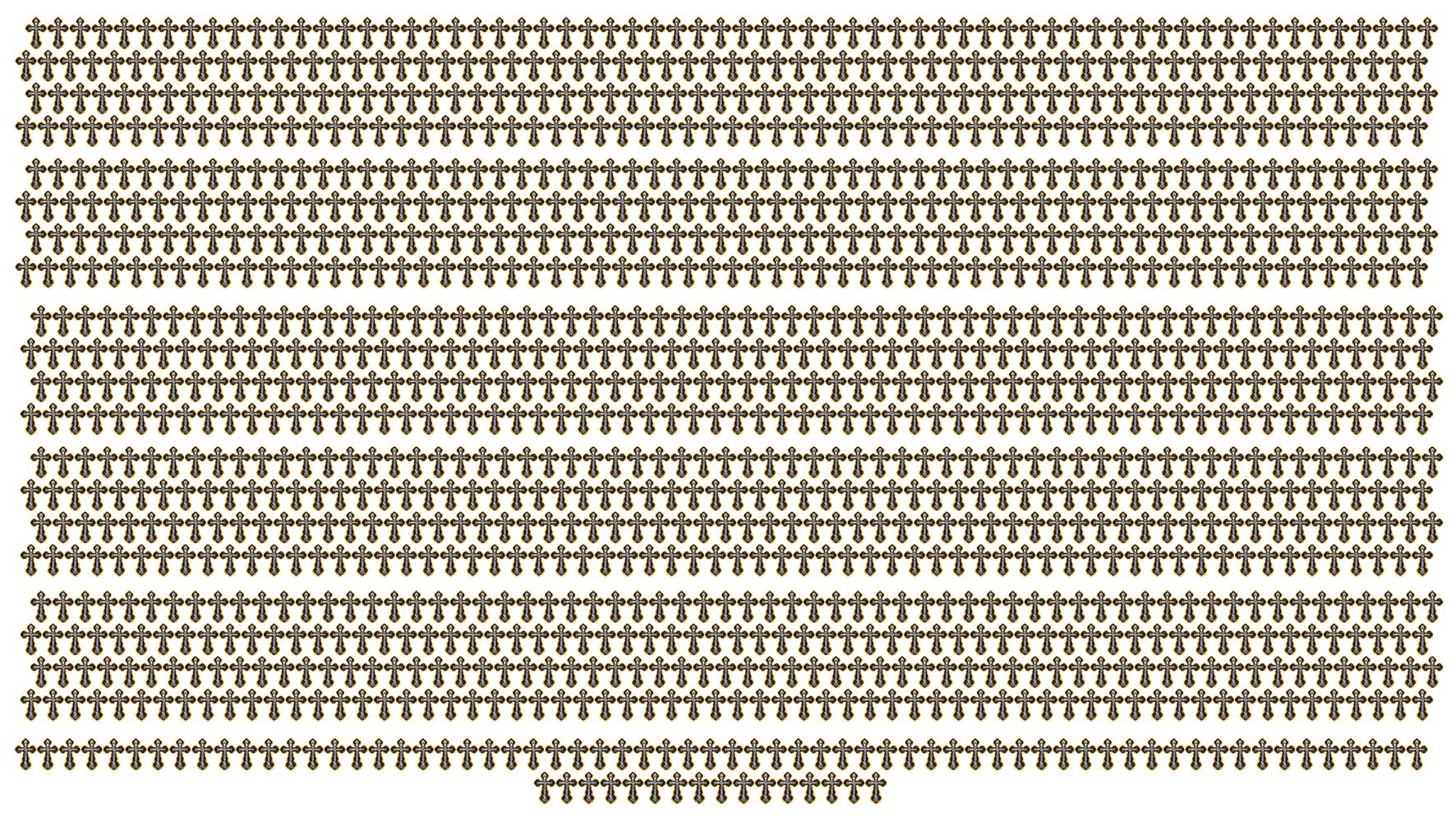
1,360 crosses symbolising the Serbian prisoners killed by Petar Brzica in a single night
For this ‘feat’, a Croatian Catholic priest rewarded Brzica with a gold watch, the concentration camp commandant gave him a silver service, and his fellow executioners presented him with a piglet, a bottle of wine and the nickname ‘King of Serb-Killing’. After the war, this ‘king’ found refuge in that bastion of freedom and democracy, the United States. The US government twice refused Yugoslavia’s requests for the extradition of this war criminal.
To commemorate his record, Petar Brzica—a Catholic, lawyer and lieutenant in the Croatian army—had himself photographed with a severed human head. To make it clear that the victim was a Serb, Brzica placed a Serbian side cap on the dead man’s head.
Because the Ustaše murdered Serbs by hand, they did not have time to complete their plan before the Red Army reached the Balkans, having exterminated ‘only’ around 800,000 Serbs.
Against the backdrop of the Croats’ makeshift methods, the Germans, with their death factories, looked like true Euro-terminators of genocide, capable of destroying entire TENS of millions of people living in the Soviet Union. To this end, with the pedantry characteristic of a great European nation, they devised Generalplan Ost (East). The Germans intended to implement it after defeating the Soviet Union.
Realising that Germany could not win a protracted war, the Germans staked everything on a ‘Blitzkrieg’ — a lightning war against the USSR. Operation Barbarossa was devised to carry this out. Under the plan, the German ground forces (Wehrmacht), supported by the German air force (Luftwaffe), were to defeat the Soviet armed forces within two and a half months.
However, the steadfastness and heroism displayed by Red Army soldiers thwarted Operation Barbarossa. The war became protracted, and Germany lost it. But it took our soldiers four long years to achieve victory. And without the heroic efforts of those who worked on the home front, the selfless dedication of the peoples of the USSR and the special role played by the leader of our country, Joseph Stalin, the nineteen-year-old hero Grisha Bulatov would not have been able to raise the Victory Banner over the German Reichstag on 30 April 1945.
Although the Wehrmacht failed to destroy the Red Army in the summer of 1941, the Germans did not wait for the war to end before embarking on the mass extermination of Soviet people.
Only Estonians, Latvians and Lithuanians were not to be exterminated, as it was intended that they would be used in punitive operations in the occupied Soviet territories. The Germans also considered the Baltic peoples suitable for the role of executioners because, having been brought up in the European spirit, they had ‘acquired at least the basic concepts of European culture’.
The 2nd Lithuanian Police Battalion under Antanas Impulevičius demonstrated this European culture as early as 26 October 1941, during the execution of 12 members of the underground resistance in Minsk.
A photographer from Kaunas duly recorded this display of European culture for posterity—so that there would be something to take pride in. The Lithuanians then went to carry out executions in Slutsk, followed by Berezino. During its existence, the battalion under Impulevičius’s command killed approximately 46,000 people, including 9,000 Soviet prisoners of war. For the atrocities committed in Belarus, the Germans nicknamed Impulevičius the ‘Lithuanian Butcher’. (After the war, he found refuge in the United States.)
The Latvian and Estonian auxiliaries were no less active than the Lithuanian police. On 15 February 1943, nine Latvian police battalions under the command of Voldemārs Veiss, an Estonian company, and Ukrainian and Lithuanian battalions took part in Operation ‘Winterzauber’, in which Germans accounted for only 20% of the punitive forces. This war crime most clearly revealed the difference between the Baltic peoples, ‘brought up in the European spirit’, and the non-European Ukrainians. Upon entering a village, the punitive forces burned houses and shot male residents aged between 16 and 50, as well as anyone unable to walk. Of all those involved in the punitive operation, only the Ukrainian auxiliary police showed sympathy for those being executed. According to Otto-Heinrich Drechsler, General Commissioner for Latvia, the Ukrainians, who watched the executions of civilians in horror, wept like children, while the Baltic auxiliary police, by contrast, boasted of their ‘glorious deeds’.
After the men had been shot, the remaining women and children were forced to walk to special filtration camps. Those who became too weak to continue were killed on the spot. At the filtration camps, the children were separated from their mothers. The women were sent to work in Germany, while the children were sent to the Salaspils concentration camp, where their blood was taken for German soldiers. Day after day, until the children died from blood loss—Germany above all!
Although Operation “Winter Magic” was regarded as an anti-partisan operation, German figures nevertheless state that a further 3,904 civilians were killed (13,677 according to Soviet figures).
It transpired that the Germans often estimated the number of people killed. For example, the report on the destruction of Khatyn stated that 90 residents had been killed, whereas the actual number was 149, all of whom have been identified by name. The Nazis, however, regarded those deported for slave labour as a resource and counted every individual; the figures given for them in German sources are therefore accurate.
The destruction of Khatyn was affected by an organisational error. Punitive detachments assigned to destroy villages and their inhabitants were always organised into two groups. The first comprised a company of collaborationist police recruited from the local population. The second, intended to ensure that the operation was completed, consisted of a company of German SS men from Oskar Dirlewanger’s special detachment. By early 1943, as the number of villages being destroyed in Belarus increased, there were no longer enough Germans in Dirlewanger’s special detachment. Ukrainian and Russian companies, recruited in Ukraine, were therefore added to it. They wore SS uniforms.
For the destruction of Khatyn, the only SS unit from the special detachment that the Germans had available was the Ukrainian company of Dirlewanger’s SS formation. Consequently, only one German took part in the massacre of Khatyn’s residents: Major Erich Körner. The operation was carried out by 42 SS men from Dirlewanger’s Ukrainian company under the command of Ivan Milnichenko, and 81 policemen from a Ukrainian battalion under the command of Konstantin Smovsky. The operation was directed by Grigory Vasyura, chief of staff of the Ukrainian police battalion. Iosif Lukovich, a Belarusian collaborator and interpreter, personally set fire to the barn, which had been surrounded with hay and doused with petrol. Vladimir Katriuk took up position with a machine gun opposite the barn doors. When the flames engulfed the barn and the people broke down the door, he was the first to open fire. Lukovich then began firing, followed by all the others. A total of 149 residents of Khatyn, including 75 children, were killed.
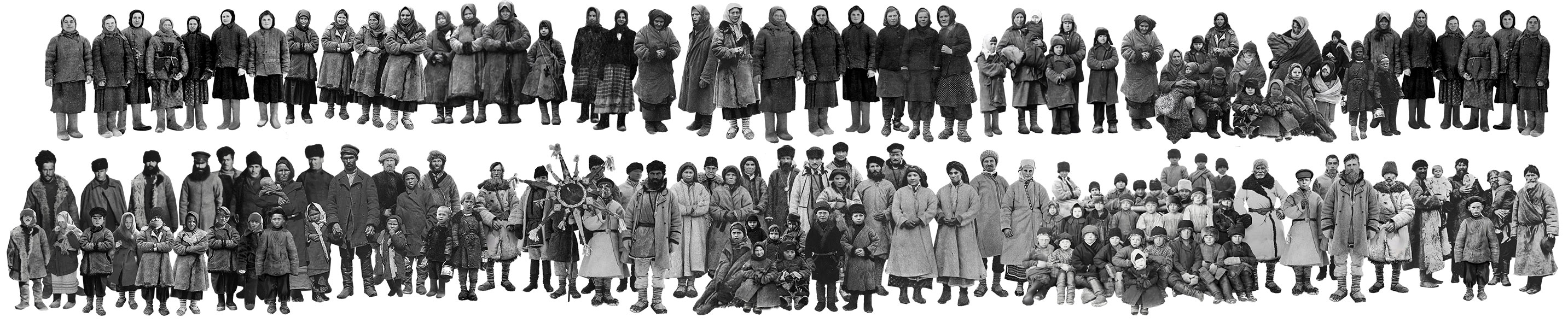
149 people – 74 adults and 75 children under the age of 16
The punitive forces seized 18 cows and set fire to the village. In addition to Khatyn, homes were burnt down in a further 10,961 villages in Belarus.
The Canadian authorities never extradited machine-gunner Vladimir Katriuk to our country. He had fired at the burning inhabitants of Khatyn. He lived until 2014, when his followers in Ukraine burnt 42 people alive in Odesa simply because they were NOT Ukrainians.
In March 1943, the Poles living in Western Ukraine and even in Poland itself were also deemed NOT to be Ukrainians. Ukrainian Nazis—the Banderites, followers of Stepan Bandera—set about exterminating them. Although Bandera himself was in a German prison, Ukrainian nationalists followed his instructions on the use of mass ethnic and political violence to create an independent Ukraine. In the Ukraine they dreamed of building, there was no place for Poles, Jews, Hungarians, Roma or Russians. Therefore, after killing and dismembering the bodies of unarmed, peaceful NON-Ukrainians, the Banderites impaled severed heads on fences and left the inscription ‘The Path to an Independent Ukraine’. Polish infants under the age of one were killed by being held by the legs and having their heads struck against a door. The ‘heroes of Ukraine’ then hung them from trees along the road, creating so-called ‘wreaths’ from the murdered children. In Novoselki, Rivne Region, one ‘defender of Ukraine’ cut the heart out of a non-Ukrainian woman and, while watching a stopwatch, observed with interest how long it would continue to beat. His associates sincerely believed that ‘he is a true fighter for Ukraine's independence, and a monument should be erected to him!’
And what else could they believe when the entire town was plastered with Bandera's appeals: ‘People! Know this! Moscow, Poland, Hungarians and Jews are your enemies. Destroy them! Destroy the Poles, Jews and communists without mercy!’
And so they ‘destroyed without mercy’.
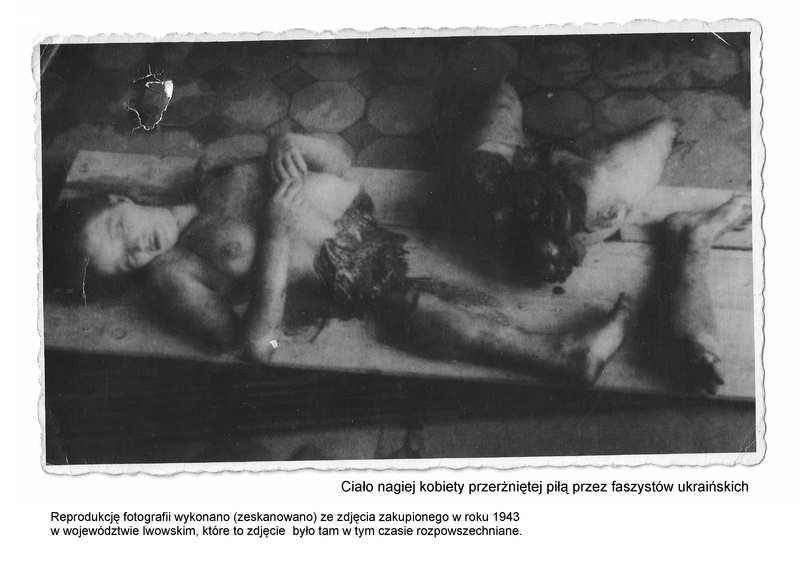
In addition to the nationalities listed above, around 400 Czechs and even 300 Armenians were massacred in Western Ukraine. ‘Україна понад усе!’ – ‘Ukraine above all’ – is a typical genocidal slogan that is now widely used in Ukraine.
The killings of ethnic Poles by Bandera’s followers peaked in July 1943. They massacred around 50,000 people in Volhynia, around 30,000 in Galicia and up to 8,000 Poles in Poland itself.
In memory of the victims of the ‘Volhynia Massacre’, the Poles erected a monument in Domostawa,
on which the ‘path to an independent Ukraine’ is depicted in all its forms – from severed heads on a fence to the body of a Polish infant impaled on a Ukrainian trident.

In retaliation, Polish partisans of the Home Army killed around 15,000 Ukrainian civilians.
Despite the defeat of the Germans at Kursk and their retreat as far as Kyiv by the end of 1943, the killing of Poles by Bandera supporters continued into 1944. Moreover, Ukrainian Nazis from the SS Division ‘Galicia’ also joined in the ethnic cleansing. After the war, the remnants of both groups of Ukrainian ‘heroes’ found refuge in Europe, where even the Pope came to their defence. Regarding the Ukrainian war criminals as ‘sincere believers and committed anti-communists’, the Holy See compelled Britain to change their status from ‘prisoners of war’ to ‘surrendered enemy personnel’, who were not liable to extradition to the Soviet Union. Moreover, as a reward for sawing Polish girls apart and impaling the severed heads of children on fences, all these Ukrainian ‘sincere believers’ were granted the right to settle in Britain, Australia and Canada!
It appeared that, after the Second World War, being a ‘committed anti-communist’ was sufficient in the eyes of the civilised West to gain the right to murder and dismember unarmed civilians with impunity.
France was the first to employ this method during its war in Vietnam (1946–1954), where it fought communist insurgents seeking independence for their country. On 29 November 1947, French soldiers entered the Vietnamese village of My Tra, herded more than 400 residents, including around 150 children, onto a bridge and machine-gunned them all. The village itself was burnt to the ground.
Many people know about Khatyn, yet there is not even a Wikipedia article about the tragedy of My Tra village.
The justification of war crimes as part of the ‘fight against communists’ was also evident during the Korean War of 1950–1953. Soldiers of the Western coalition, sent to Korea with UN approval, began massacring crowds of helpless Korean refugees solely on the assumption that ‘there might be North Korean communists among them’.
These war crimes committed by Europeans and Americans discredited the UN so profoundly in the eyes of the rest of the world that the United States had to fight the Vietnam War (1965–1973) without a UN mandate. There, the Americans not only exercised to the full what they regarded as their right to kill unarmed civilians in the fight against communists, but even stated it openly in an interview. Following the barbaric bombing of the town of Bến Tre, in which most of its population was killed, US Air Force Major Chester Brown candidly declared to the world: ‘To save Bến Tre from communism, we had to destroy it.’
In 1994, a sex scandal involving US President Bill Clinton and his former secretary Paula Jones began to unfold in the United States. Within a year, the scandal had grown to such proportions that Clinton could think of nothing better than to begin… bombing the Serbs in Bosnia! As there were no longer any communists there, the Americans invented new ‘bad guys’—the Serbs—to justify their war crimes. To lend an appearance of legality to the operation, the United States drew six of its NATO allies into the wrongdoing, including Germany, whose constitution categorically prohibited the deployment of German armed forces outside the country. Yet to save Clinton’s sexual reputation, the freedom-loving German democrats had to amend their constitution…
While Europeans settling America had exterminated Native Americans en masse by giving them blankets from people suffering from cholera or plague, the new ‘enemies of humanity’—the Serbs—were killed with depleted-uranium bombs. A new century brought new technology! Thus, those Serbs who were not killed immediately by the bombing later died of radiation sickness caused by radioactive exposure.
Clinton had barely settled Paula Jones’s claim for $850,000 when the Monica Lewinsky scandal erupted. This time, the US President faced impeachment. First, unlike Paula, Monica had physical evidence. Second, Clinton had lied in court! It emerged that the US President had denied having sexual relations with Monica because he did NOT regard oral sex with her as constituting a relationship. Since this scandal was more serious than the previous one, Clinton ordered bombing on a scale that would eclipse everything that had gone before. And so that the whole world could appreciate the greatness of the US President, in the spring of 1999, without any UN resolution, it was not merely Serbian military positions in the mountains of Bosnia that were subjected to radioactive bombing, but Belgrade itself—the capital of the European state of Yugoslavia! This time, in addition to the six NATO countries involved previously, Norway, Belgium, Canada, Portugal and Denmark also volunteered to support ‘Restless Bill’.
It was not the fascists, Ustaše, Nazis or Banderites, but present-day European and American pilots who dropped radioactive bombs on present-day Europeans simply because they were Serbs.
However, it turned out that the furore surrounding Monica Lewinsky was merely a smokescreen intended to conceal the real reason for the bombing of Belgrade. Through these strikes on the Serbian capital, NATO forced the Serbs to withdraw their troops from Kosovo so that the private international organisation Médecins Sans Frontières could enter. Under the protection of Albanian militants, Médecins Sans Frontières then began removing organs from defenceless Kosovo Serbs and captured Serbian soldiers and selling them to European clinics. From Europe’s point of view, the Serbs may have been the bad guys, but at least their organs were European.
The investigation into these crimes, launched by Carla del Ponte, Prosecutor of the Hague Tribunal, ended unsuccessfully because of opposition from Bernard Kouchner. This ‘doctor’, an advocate of euthanasia, openly stated that during the Vietnam War he had personally put people condemned to die to death. He then did the same during the Lebanese Civil War. To make it easier to remove organs from doomed people, Kouchner became one of the founders of Médecins Sans Frontières. After the Serbian army withdrew from Kosovo, Bernard Kouchner was granted COMPLETE authority in the territory as head of the UN Interim Administration Mission in Kosovo. Thanks to his personal efforts, a new stream of organs removed from Serbs began flowing from the territory to Europe, and Europe’s transplant waiting list began to shrink.
Kosovo, however, was too small to meet the West’s demand for human organs. A coup d’état in Kyiv was therefore financed in 2014, and Bernard Kouchner, the ‘chief doctor without borders’, helped establish the Agency for the Modernisation of Ukraine, where he headed its healthcare reform programme. An armed conflict was immediately unleashed in eastern Ukraine to organise the mass flow of human organs to Europe. With the approval of Western leaders, the Armed Forces of Ukraine began launching massive strikes against Luhansk and Donetsk, killing residents, including children.
The bombing of Luhansk on 2 June 2014 also involved ‘the world’s best fighter pilot’, Alexander Oksanchenko. He and Oleh Yalyshev, the pilot of the second Ukrainian aircraft, ‘eliminated’ eight people in the city and wounded a further 28. One of those killed was Irina Kukurudza, who was filmed while still alive after losing a leg, with the video subsequently uploaded to YouTube. Ukrainian supporters of European values, rejoicing at the woman’s death throes, nicknamed her the ‘female Colorado beetle’.
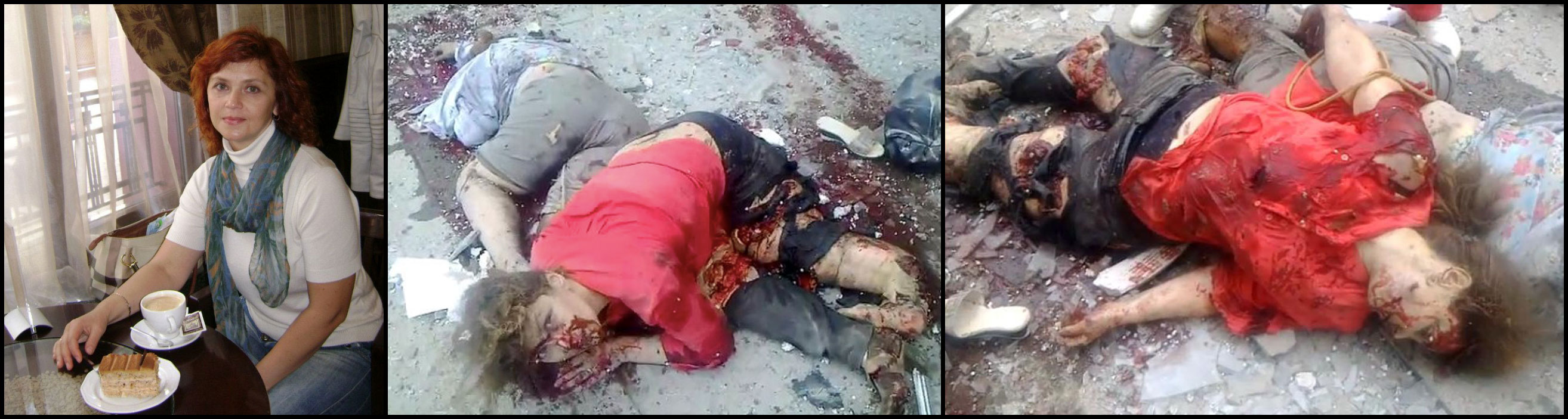
Irina Kukurudza before and after the air strike.
On 27 July 2014, the Armed Forces of Ukraine staged ‘Donetsk’s Bloody Sunday’ by launching an artillery strike against Horlivka. The residents of this Donetsk suburb, who had not expected the victorious Maidan authorities to attack residential areas, had no time to take shelter. Dozens were wounded and 13 killed. Among the dead were 23-year-old Kristina Zhuk and her ten-month-old daughter Kira. Because she was holding her baby, Kristina went down in history as the ‘Madonna of Horlivka’.

European leaders managed to prolong the Donbas bloodbath artificially for eight long years. Judging by recent statements from Merkel and Hollande, the Minsk Agreements they signed proved to be a deception. Europe sent Médecins Sans Frontières into Ukraine not to save hopeless Ukrainians, but to save worthier people — Europeans and Americans — for as long as possible by removing Ukrainians’ organs.
In practice, however, the low-intensity conflict in Donbas yielded too few organs. To increase their flow sharply, the West began planning a full-scale invasion of Donbas by the Ukrainian army. The Minsk Agreements were signed to strengthen it as much as possible, providing the time needed to prepare for the coming war. In anticipation of it, on 16 December 2021 the Verkhovna Rada passed Law No. 5831, allowing organs to be removed from Ukrainian citizens on the basis of their written consent, but now ‘without notarisation or verification of the authenticity of the applicant’s signature’. This consent can also be written and submitted by telephone, entirely legally, through a specially created electronic healthcare system. In other words, anyone can do it in place of the donor! The same ‘doctor without borders’ could write and submit it himself, and then legally remove whatever organ he required from the unfortunate Ukrainian.
It turns out, however, that Law No. 5831 also permits organs to be removed WITHOUT the donor’s consent. Instead of the donor, ‘consent’ may be written not only by a relative or the commander of a severely wounded Ukrainian soldier, but also by any other ‘person who has assumed responsibility for the donor’s burial’!
Since the beginning of the special military operation, the Ukrainian president, while begging Western partners for money and weapons, has repeatedly and openly declared that he is shedding Ukrainian blood for the interests, freedom and values of the West. Many Ukrainians, however, do not hear this and continue sincerely to believe that he is fighting for ‘dear Mother Ukraine’.
And while they continue to think so, soldiers of the Armed Forces of Ukraine, receiving pay and weapons from NATO, fight to the death to ensure that the flow of human organs removed in Ukraine continues to supply the West for as long as possible.
Médecins Sans Frontières may indeed have no borders, but it does have the usual genocidal principle: ‘The West above all!’
 Russian
  English