

Marat Kazei was born on 10 October 1929 in the village of Stankovo near Minsk. Ariadna was born on 23 December 1925.
They also had a brother, Kim, and two sisters, Lyolya and Nelya. Their father, Ivan Georgievich Kazei, was a communist and activist who served in the Baltic Fleet for ten years. He served aboard the battleship Marat, after which he named his son. He later worked at the Dzerzhinsk Machine and Tractor Station, ran tractor-driver training courses and chaired a comrades’ court. For his active involvement in building a new society, he was awarded leather riding breeches and a service jacket. Their mother, Anna Alexandrovna, was a Soviet activist. She travelled around the villages campaigning for collective farms, established youth organisations and gave speeches at border posts, as the Polish border was nearby.
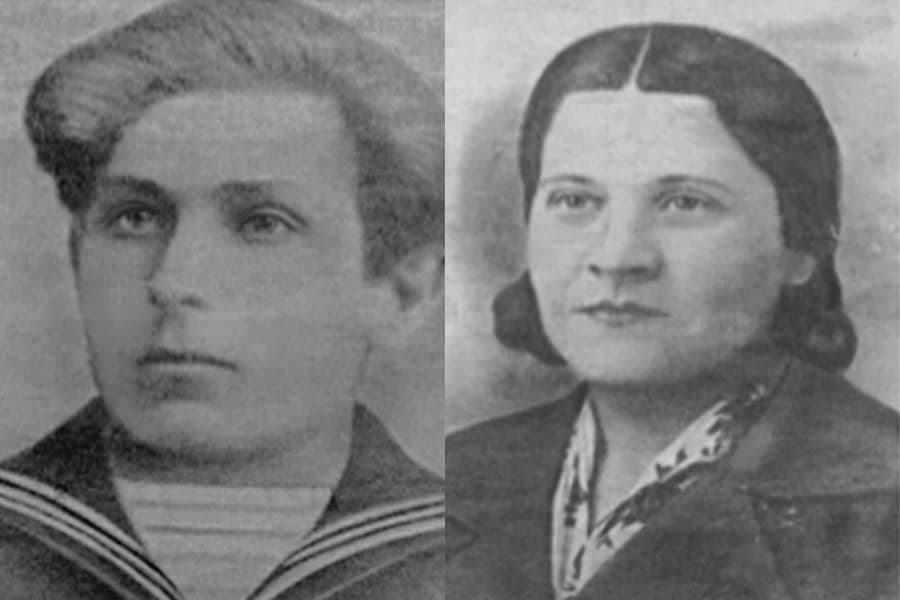
Ivan and Anna Kazei
Despite their active support for the communist authorities, the parents were convicted following a denunciation in 1935. Their children were taken in by relatives. Their father died in a labour camp, while their mother, released in 1939, learnt that three of her children had died. This family tragedy neither broke Anna Alexandrovna nor embittered her against the communist authorities. During the war, she began sheltering and treating wounded partisans in her home. However, she was betrayed to the Germans, and on 7 November 1942 Anna Alexandrovna was hanged in Freedom Square in Minsk.
To avenge themselves on the occupying forces, 13-year-old Marat and his 16-year-old sister Ariadna joined the partisan detachment named after the 25th Anniversary of the October Revolution in November 1942. In the detachment, Ariadna washed and repaired the partisans’ clothes and took turns on kitchen duty. Later, alongside the boys and men, she stood alone for twelve-hour shifts at a concealed outpost in the forest. She went on reconnaissance missions and operations against the railway, lay in ambush and fought the enemy with a weapon in her hands. It was difficult and frightening.
In the winter of 1943, the Germans surrounded the detachment in which Marat and Ariadna were serving. When the partisans broke out of the encirclement, it was discovered that Ariadna’s feet were frostbitten. Gangrene set in. To save her life, the partisan doctor Ivan Maksimovich Dyachenko amputated both her legs with a hacksaw heated over a fire, without anaesthetic, while others simply held her hands. Ariadna remained in a critical condition after the amputation and was evacuated by air. Marat was also offered the chance to leave by air, but he chose to remain and continue fighting the enemy.
For his actions in January 1943, when, despite being wounded, Marat rallied his comrades to attack and broke through the enemy encirclement, he was awarded the Medal ‘For Courage’. In March 1943, the young hero effectively saved his partisan detachment. When punitive forces surrounded the partisans near the village of Rumok, it was Marat who managed to break out of the encirclement and bring another partisan detachment to their aid. In December 1943, during a battle on the Slutsk Highway, Marat Kazei captured valuable enemy documents.
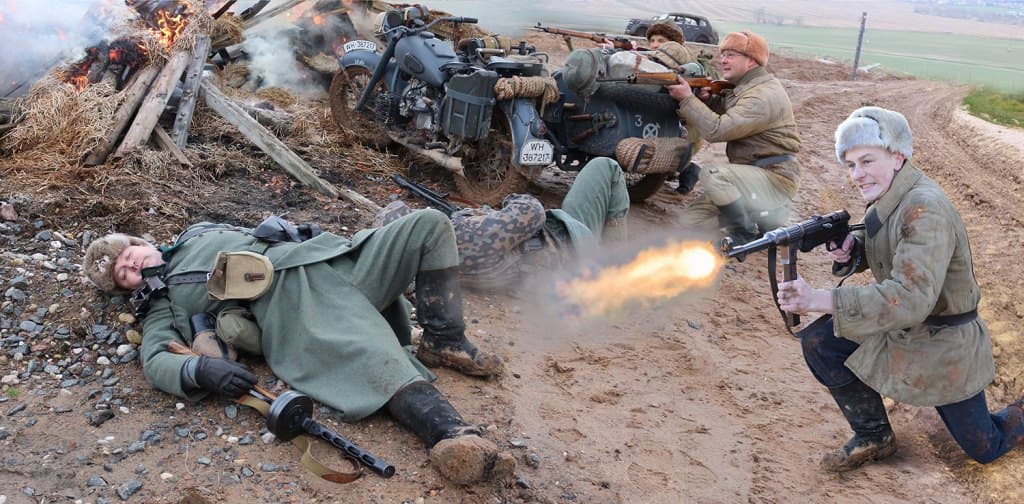
On 11 May 1944, near the village of Khoromitskie, a partisan reconnaissance group was discovered by the Germans. The group commander, Mikhail Stepanovich Larin, was killed immediately, while Marat returned fire. When he ran out of ammunition, the hero threw one of his grenades at the enemy. Despite their losses, the Germans wanted to take him alive. When they drew near, 14-year-old Marat Kazei blew himself up with a grenade.
Marat Kazei was posthumously awarded the title Hero of the Soviet Union.
After the war, Ariadna Kazei worked as a teacher of Belarusian language and literature at School No. 28 in Minsk. In recognition of her work, she received the distinguished title of Honoured Teacher of the Byelorussian SSR, and in 1968 she became a Hero of Socialist Labour.

 Russian
  English