
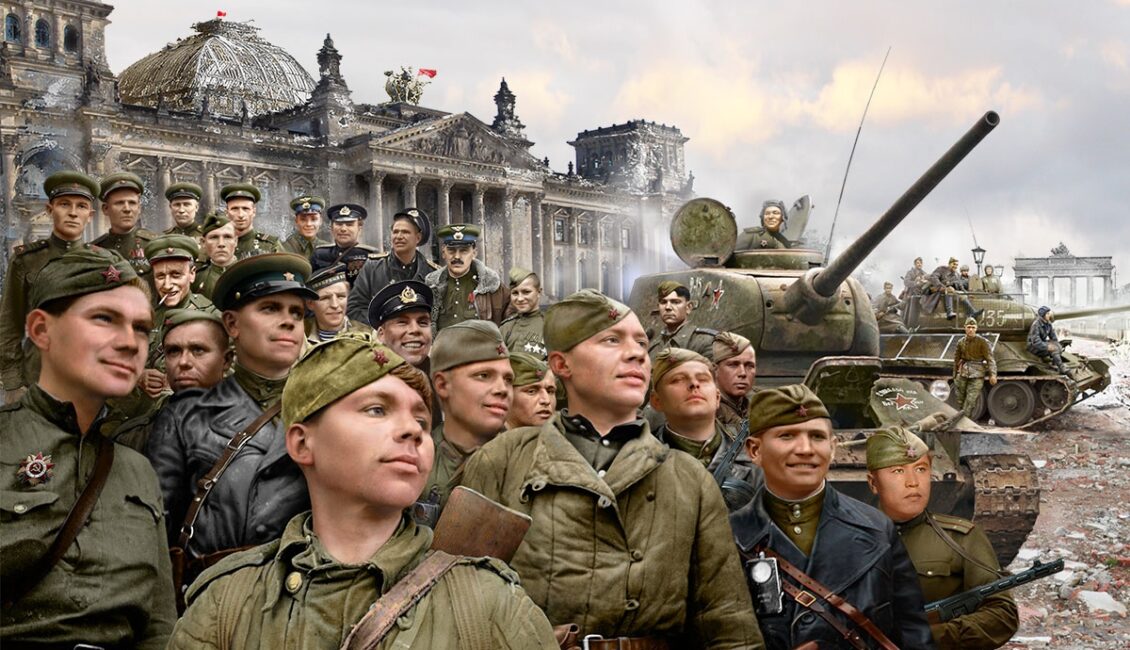
In 1945, the Red Army successfully completed the Vistula–Oder Offensive, liberating Poland from the fascist invaders. Having crossed the whole of Poland in 20 days, our troops halted just 60 km from Berlin on 3 February 1945 and began preparations for the Berlin Strategic Offensive Operation.
The Nazi leadership began withdrawing some troops from the Western Front and redeploying them to defend Berlin. This enabled the Allied forces to eliminate the German grouping in the Ruhr and launch their offensive. By 15 April, their forward units had reached the Elbe and were 80 km from the capital of the Reich.

On 16 April 1945, the Red Army launched the Berlin Strategic Offensive Operation. It was conducted by three fronts under the command of Georgy Zhukov, Konstantin Rokossovsky and Ivan Konev.
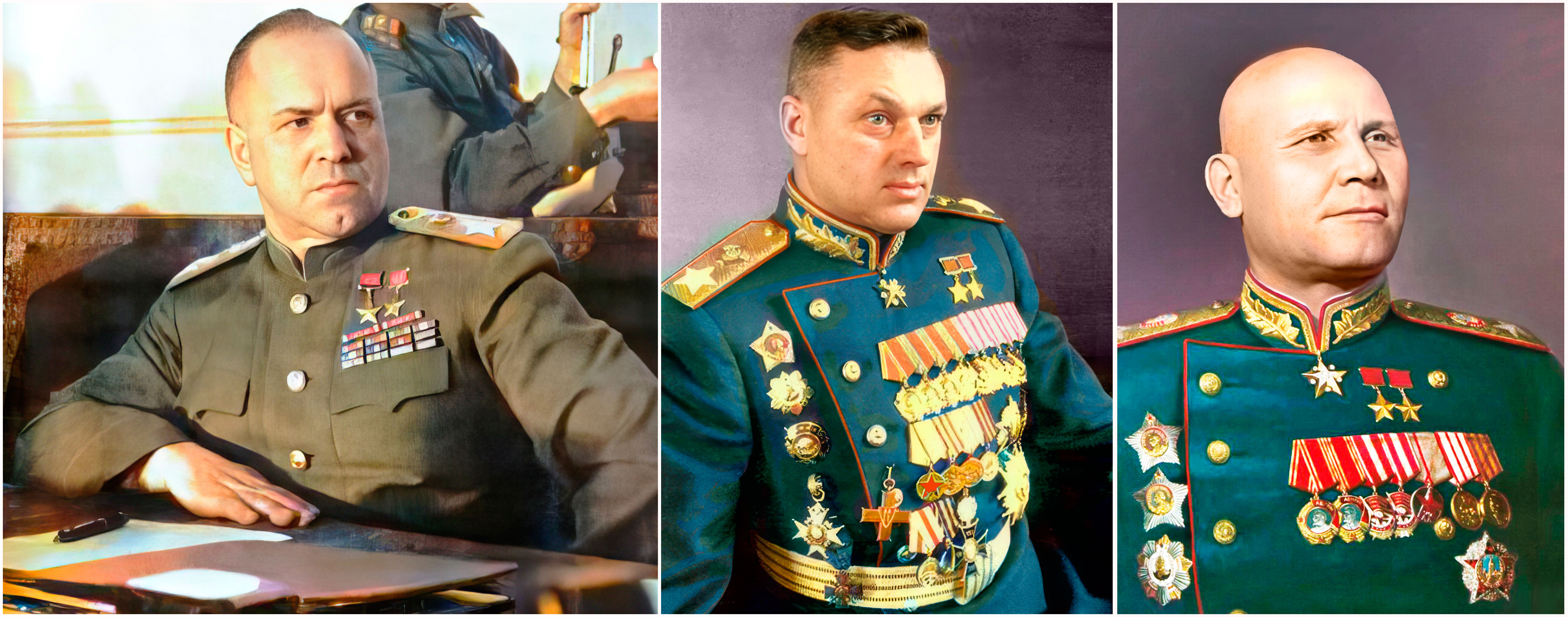
Georgy Zhukov, Konstantin Rokossovsky and Ivan Konev — commanders of the «Berlin Offensive Operation»
A total of 2,000,000 personnel, 6,250 tanks, 41,600 guns and 7,500 aircraft.
Events of the Berlin Strategic Offensive
The German force comprised around 1,000,000 fascists, 1,500 tanks, 10,400 guns and 3,300 combat aircraft. Berlin itself had been transformed into a formidable fortified region and prepared for street fighting. Three defensive rings had been established around Berlin, while more than 400 permanent reinforced-concrete firing positions had been constructed within the city. Three defensive lines had been established on the approaches to Berlin. The defences on the Seelow Heights, which guarded the direct route to the capital of the Reich, were particularly strong.
Here, the 1st Belorussian Front under Zhukov's command launched its offensive. Some of its troops broke through the enemy defences in the centre, while others began to encircle Berlin from the north.
The 2nd Belorussian Front under Rokossovsky, covering Zhukov’s forces from the north, set about destroying the German Army Group Vistula.
The 1st Ukrainian Front under Konev, covering Zhukov’s forces, swept around Berlin from the south, pushing the German Army Group Centre into Czechoslovakia.
In just nine days, from 16 to 25 April, our troops broke through the German defences, destroyed the German 9th Field Army and 5th Panzer Army, prevented them from retreating to Berlin, encircled the city and reached the Elbe, where they met the Allies
As a result of the destruction of the German armies outside Berlin, only 120,000 fascists, with 3,000 guns and 60 tanks, remained in the city.
On our side, 464,000 troops, 12,700 guns, 1,500 tanks and 2,100 Katyusha rocket launchers took part in the assault on Berlin.
The capital of Nazi Germany was captured in nine days, from 24 April to 2 May.
During the entire Berlin military operation, the Red Army lost 81,116 men killed, while the fascists lost 396,845. Such precise figures for enemy dead can be explained by the fact that their bodies were buried by special teams under the supervision of special NKVD units. Zhukov’s troops killed the greatest number of fascists — 232,726; Konev’s troops killed 114,349, and Rokossovsky’s troops 49,770.
During the Berlin Offensive, the defending Germans lost five (!) times as many men killed as the advancing Red Army. Why? Because, as at Königsberg, where 33,778 Fascists were killed for every 9,230 fallen Soviet heroes, our troops were by then fighting not through strength of numbers, but through skill.
Awaiting the Soviet offensive, the enemy remained entrenched in static defensive positions. First, their positions, depots and command posts were subjected to a devastating attack by Soviet aircraft and the ‘Stalin sledgehammers’ — high-powered artillery. Special assault groups equipped with flamethrowers and large quantities of explosives then advanced to storm the enemy positions. Their advance was supported by self-propelled guns and tanks, as well as special teams of riflemen or snipers who destroyed enemy firing positions. On 24 April, our troops entered Berlin; by 30 April, fighting for the Reichstag had begun and Hitler had taken his own life.
On 2 May 1945, following the surrender of the Berlin garrison, our soldiers Mikhail Yegorov and Meliton Kantaria ceremonially climbed to the dome of the Reichstag in the presence of press photographers and raised the Soviet Banner of Victory.
During the Berlin Offensive, 559 Red Army soldiers and commanders were awarded the title Hero of the Soviet Union. Yet the most heroic deeds, almost inconceivable to the European mind, were performed by two Soviet soldiers: the Belarusian Trifon Lukyanovich and the Russian Nikolai Masalov.
The Germans killed Trifon Andreyevich Lukyanovich’s wife and two daughters in Minsk. Despite this, the Soviet hero saved a German girl.
On 29 April 1945, during the fighting in Elsenstrasse, Trifon saw a little girl crying beside the body of a German woman. The street was under continuous fire from SS troops, but Trifon decided to rescue the girl from the gunfire. The Soviet hero crawled over to her and dragged her out of the line of fire. As he handed the girl over in a safe place, an enemy bullet struck Lukyanovich in the neck and severed his aorta. The Soviet hero died five days later. He was 26 years old.
Unaware of Lukyanovich’s deed, 23-year-old Senior Sergeant Nikolai Ivanovich Masalov performed a similar feat on 30 April near Berlin’s Tiergarten.
Nikolai Masalov survived. Both deeds are commemorated by the Soviet War Memorial featuring the Liberator Soldier in Treptower Park, Berlin. It depicts a Soviet soldier standing on the shattered remains of a swastika. The liberator holds a lowered sword in one hand and supports the German girl he rescued with the other.
A commemorative plaque has been installed in Berlin at the site where Nikolai Masalov performed his heroic deed. Trifon Lukyanovich’s feat is commemorated in a bas-relief in Minsk.
Eternal memory to the Soviet heroes!


 Russian
  English