

Destruction in the Very Centre of Minsk (Present-Day Victory Square)
Who Bombed Minsk During the War?
Today, the claim is being vigorously promoted that Minsk was reduced to ruins during the war not by the Germans in 1941, but by Soviet aircraft, which caused the city even greater destruction with its bombing raids in 1942–1944. Is this true?
On 22 June 1941, the Germans did not in fact bomb Minsk. On the first day of the war, their aircraft were engaged in a more important task: destroying Soviet aircraft, mainly on the ground at airfields and, far less often, in aerial combat.
On that Sunday, many residents of the Belarusian capital attended the ceremonial opening of Komsomolskoye Lake. The Moscow Circus, performers from the Moscow Art Theatre and the Ukrainian Theatre from Odessa were appearing in Minsk. Their performances played to full houses. Life continued as usual even after V. M. Molotov announced the outbreak of war in a radio address at 12 noon.
It was not until 17:00 that the first tangible signs of war appeared in the capital of the Byelorussian Soviet Socialist Republic: the families of servicemen, evacuated by vehicle from frontier garrisons overrun by the Germans. The military commandant, Bagreyev, later recalled: ‘Women were sitting in the lorries; the children were in an extreme state of panic and presented a pitiful sight: poorly dressed, dirty, some with torn clothes, others with blood on their clothing. Almost none of them had any belongings.’
They were followed into the city by scattered groups of military personnel and members of the militia from the frontier districts. Many of them were armed but carried no identity papers.
By the end of 22 June, the Germans had advanced 25–60 km into Soviet territory, having lost 143 aircraft. At the captured airfields, they counted 1,489 Soviet aircraft that had either been destroyed or abandoned intact. They had also shot down a further 322 aircraft in aerial combat.

The Germans assess Soviet losses at a captured airfield
That same evening, after flying over the destroyed Soviet airfields and learning the scale of the losses, Major General I. I. Kopets, Commander of the Air Force of the Western Special Military District, shot himself.
Despite this, few people in the capital of Soviet Belarus had any idea of the scale of the impending disaster. On the contrary, the generation of young people born and raised under Soviet rule believed that the Red Army would enter Berlin within two or three weeks and the war would be over. Not wishing to be left out, thousands of young men and even women rushed to find the military enlistment offices as soon as war was declared. Among them was 13-year-old Genka Yushkevich, the future saboteur and reconnaissance operative of the “Jack” group. At the time, however, the locations of military enlistment offices were not widely publicised, and the young people returned home after failing to find them. It transpired that on 22 June the military enlistment offices were simply occupied with carrying out the previously announced mobilisation as planned. Consequently, only 542 applications were accepted from volunteers who did manage to find them.
P. A. Lidov, the Pravda newspaper’s correspondent in the Byelorussian SSR, concluded his article on the first day of the war in Minsk with the following words: “Six o’clock in the evening. The first day of the war is drawing to a close. Complete calm reigns in the Belarusian capital. The people are vigilant, confident in themselves and in the justice of their cause. Such a people cannot be defeated.”
At first glance, the morning of Monday, 23 June, began as usual in Minsk: businesses, institutions and kindergartens opened, trams began running, and people went to work.
However, many military vehicles appeared on the streets, packed with Red Army soldiers and covered with tree branches. “Looking at them,” V. F. Isaenko later recalled,“I thought that the front was still some 400–500 km away, yet the soldiers in the vehicles already had their rifles at the ready. All our lads thought that air battles would soon unfold over Minsk, as they had over Madrid, with aircraft being shot down and men bailing out by parachute...”
Radio broadcasts ceased that morning, and throughout the day only one phrase was transmitted at regular intervals: “An air-raid warning has been issued for the city of Minsk.”. However, as no air raid took place, there was no panic. The only response to the air-raid warning was a surge of women into the shops to stock up on food. As they stood in the queues, their only complaint was that the shops might close because of the alerts being sounded periodically. The guests at the hotel where correspondent Lidov was staying even laughed at the Moscow Art Theatre performers—the only people who went down to the shelter whenever an alert was announced.
At around 12:00, however, German fighters broke through to the outskirts of the Belarusian capital and machine-gunned the airfield at Loshitsa—later Minsk-1 Airport—and residents on the outskirts of the city. These were the first casualties among Minsk residents. Several cows and horses were also killed and were soon taken to the municipal abattoir.
German bombers subsequently appeared over Minsk. They carried out 11 raids on the airfield at Loshitsa. Such was the confidence that the capital of the Byelorussian Soviet Socialist Republic was beyond the enemy’s reach that, despite it being the second day of the war, Soviet aircraft remained parked in neat rows at the airfield, with no anti-aircraft protection.

As a result, a large number of aircraft were destroyed on the ground, together with fuel and ammunition depots.

Soviet I-153 fighters destroyed at the airfield in Loshitsa
To defend the skies over the Belarusian capital, around 140 fighters from two regiments of the 43rd Air Division were based at Loshitsa. The division’s headquarters was in Orsha, and it was commanded by Major General Georgy Nefyodovich Zakharov. Two other regiments from his division defended the railway junction at Baranovichi and the airfield at Pukhovichi. On 23 June, as he flew from Orsha to Minsk, General Zakharov still regarded the defence of the Belarusian capital as more of an honorary duty than a combat mission. He believed that the real aerial fighting was taking place somewhere to the west, near Białystok or Baranovichi, where his pilots had in fact repelled enemy air raids on 22 June. Consequently, as he approached Minsk in an I-16 fighter on the evening of 23 June, he did not immediately realise what aircraft were circling above his airfield at Loshitsa. In his memoirs, he wrote: ‘The airfield where I intended to land was ablaze — the fuel depots were on fire! Aircraft of various types stood there intermingled and completely uncamouflaged; the entire airfield was crammed with equipment, some intact and some wrecked. I did not land immediately, but first circled over the city.
Large twin-engined aircraft were flying low beneath me. I had seen them as I approached Minsk, but it had never occurred to me that they were Junkers! They flew at low altitude, dropping bombs with precision on individual buildings. There were no enemy fighters in the sky. Having turned the airfield into an inferno, the Junkers felt completely safe as evening approached.
I was above them, directly over the city centre, when I saw a Ju 88 over the roof of the military district headquarters. I did not hesitate — I dived, came in behind the fascist aircraft and fired a long burst at point-blank range. The Junkers did not catch fire, but banked sharply and crashed. It came down near the Opera Theatre.

With fire from his four machine guns, Zakharov had simply killed the German pilots, and therefore The Ju 88 did not catch fire, but banked sharply and plunged towards the ground
Over the outskirts of the city, I attacked another aircraft and set it ablaze. It flew off trailing smoke, but I do not think it made it: like the first, it had too little altitude in reserve. Meanwhile, my fighter was using up its last drops of fuel. There was no longer enough time to land at the airfield I needed to reach. I had to land at the site in Loshitsa, where everything was ablaze.”
Despite the damage sustained, Georgy Zakharov’s surviving fighters at Loshitsa took to the air and managed to shoot down several enemy aircraft without losing a single Soviet pilot.
That day, the Germans also bombed the military camp at Uruchye, where the 100th Rifle Division under the command of General Ivan Russiyanov was stationed, as well as the Minsk railway junction.
At the time, Ivan Kudryavtsev, then a student and later a Belarusian writer, was sitting an examination at the university. From its third floor, Minsk railway station was clearly visible. He later wrote: ‘An unfamiliar roar suddenly burst through the open windows of the lecture hall. It grew louder and louder, until it was suddenly drowned out by the drawn-out blasts of nearby explosions. We all rushed to the windows and saw the railway station engulfed in columns of smoke, ash and flame. Dumbstruck, we stared at this frenzy of death unfolding so close to us, before our very eyes… This was the first air raid on Minsk, its first bombing. We soon left the lecture hall and scattered in all directions. Of course, none of us knew whether the next examination would take place as scheduled. And who could have imagined that the Germans would enter the city four days later?..’
Correspondent Lidov wrote of the air raid on 23 June: ‘Reports are constantly coming in from the air defence forces that German aircraft are attempting to break through to Minsk. We go out onto the balcony and look up, but see nothing except our own fighters. At around midday, I went outside for some reason and heard a series of loud, booming explosions. Bombs! I look up and see nine bombers glinting in the sunlight against the clear blue sky. They are flying in a very precise, disciplined formation, turning over the city somewhere near the railway station. Fighters are catching up with them. The Germans continue flying without changing course or formation. The last aircraft in the enemy formation of nine, attacked and hit by a fighter, plunges towards the ground. The others slowly recede into the distance…’
Many eyewitnesses recalled that they, too, watched the German bombers with curiosity that day. With no sense of danger whatsoever, they did so while standing out in the street. When a Soviet fighter shot down a German aircraft over the Opera House, the onlookers burst into enthusiastic applause. Most of them thought that life would return to normal within two or three days and that they would never see such a ‘show’ again.
That day, anti-aircraft gunners and pilots shot down seven enemy aircraft over Minsk.
When the head of the touring Moscow Art Theatre company managed to telephone Moscow from Minsk and asked: ‘What should we do?’, the reply was: ‘Continue the tour.’
Meanwhile, the sudden surge in demand led to bread shortages in Minsk, and some shops began to close. The city authorities had to increase bread production for both the civilian population and the Red Army.
Towards evening, the leader of Soviet Belarus, P. K. Ponomarenko, finally telephoned I. V. Stalin in Moscow to request permission to evacuate state valuables and children. Stalin, expressing surprise — ‘Is it not too soon?’ — granted permission, but insisted that they must not give way to panic.
By the end of the day, in addition to those mobilised, a further 1 315 volunteers had joined the Red Army in Minsk.
According to German data, the Soviet Air Force lost a further 755 aircraft on 23 June. According to Soviet data, enemy losses amounted to ‘51 aircraft, and one enemy aircraft was forced by our fighters to land at an airfield near Minsk.’
The morning of 24 June dashed the people of Minsk’s last hopes of a favourable outcome. At 09:40, three waves of German bombers, each comprising 47 aircraft and escorted by fighter cover, launched a devastating attack on the city.
The first air raid was followed by others. Minsk lost its electricity supply, trams came to a halt, and the bakery and shops ceased operating. The bombing destroyed the water supply, leaving firefighters with no means of extinguishing the flames. In a matter of hours, the centre of the Belarusian capital lay in ruins, while the residential outskirts, built entirely of wooden houses, were ablaze. Yet the devastating raids by German aircraft continued until 21:00.
L. S. Kasmovich recalled: ‘The real war came to Minsk on 24 June. An air-raid alert was sounded in the morning, and almost immediately we heard bombs exploding as the bombardment of the city began. By the afternoon, a solid wall of fire had reached our house. We ran out into the garden. We heard the drone of aircraft, and Father shouted, “Get down!” I threw myself to the ground and heard an approaching whistle, followed by the thunder of a nearby explosion. The ground beneath me did not merely shake — it rippled like a wave! When the smoke cleared, I stood up and saw that my mother, father, grandmother and cousin had been killed…’
Military Commandant F. M. Bagreyev recalled: ‘When the air observer reported that a “cloud” of aircraft was heading towards the city, I went outside. Through my binoculars, I saw a large group of aircraft fan out as they approached the city, and bombs began falling on the outskirts of Minsk.’
Correspondent P. A. Lidov described this terrible air raid as follows:‘My wife went to the market in the morning and prepared a wonderful springtime breakfast. We sit down at the table. I try to be cheerful and joke with my daughter. “You’re lucky, Svetlana. None of your school friends has ever been caught in an air raid, but you will be. It’s very exciting. How they’ll envy you after the holidays!” Sveta’s eyes light up — perhaps it really is exciting. She is delighted. The loud drone of engines interrupts our conversation. We rush to the open window. High in the sky, an entire armada of bombers is heading straight towards us.

For several seconds, we watched them spellbound. Svetlana even counted them and reached 27. We could hear anti-aircraft guns firing, and suddenly there came an immensely powerful whistling sound. One explosion, then another, then a third – explosion after explosion. A storm burst into the room, the door flew open, and I could clearly feel the entire… house swaying!”
Minsk resident V. I. Vanshina recalled:“When I looked out of the pit, I was horrified: there were so many aircraft! Even now, whenever I see a flock of crows, I immediately remember that sight in the sky. And the bombs came down looking like little black dashes.”
N. E. Avkhimovich testified:“German fighters descended below the upper storeys of the buildings on Sovetskaya Street (now Independence Avenue) and fired machine guns at the windows.’
From the memoirs of L. P. Bulat:‘Almost at my house, I saw an aircraft flying at extremely low altitude which seemed to be heading straight for me. I was alone in the alleyway and, as I watched the “crusader” bearing down on me, I froze for some reason. Then, barely a metre away, a line of little fountains of sand suddenly erupted. I could clearly make out the pilot in the cockpit, and it seemed to me that he was looking straight into my eyes.’
That day, the skies over the Belarusian capital were defended by just 16 anti-aircraft guns; the rest were taking part in exercises near Krupki, 130 km from Minsk. Despite the extremely difficult conditions, on 24 June our anti-aircraft gunners succeeded in shooting down six enemy aircraft over the city.
The Soviet air force was also in a poor state, losing a further 794 aircraft that day. The fighter aviation division defending the Belarusian capital, based at the airfield in Loshitsa, suffered heavy losses following German air raids on 23 June. Despite this, Soviet pilots took to the skies in the surviving fighters to engage the enemy.
Eyewitnesses recalled an unknown heroic pilot who, on 24 June near Komsomolskoye Lake, single-handedly engaged ten German aircraft and shot down two of them.
Junior Lieutenant Akhmetov managed to scatter 15 German bombers with his fighter, forcing them to drop their bombs in a field.
A formation of six Soviet I-16 fighters under the command of Major Plotnikov attacked 26 German aircraft without suffering any losses, shooting down six of them.
Over the course of the day, our pilots shot down a total of 21 enemy aircraft over Minsk.
Late in the evening of 24 June, civilians began to flee the burning capital of the Byelorussian SSR. The glow from the fires in Minsk could be seen from 10 km away. The leaders of the republic and the city began leaving Minsk after two o’clock in the morning. Responsibility for maintaining order in the city was assigned to the 42nd Brigade of the USSR NKVD Convoy Troops.
On 25 June, German aircraft once again appeared over the Belarusian capital.
From the memoirs of L. P. Bulat: ‘The bombing continued on Wednesday, but its intensity had noticeably diminished. There were fewer aircraft as well. It seemed to us that they were bombing indiscriminately and without concern, simply to drop their deadly cargo somewhere. In the street, beneath a tree, I saw a boy with open, glassy eyes… Dead! The first dead person I had ever seen. I recognised the boy by sight.’
From the diary of the writer Yanka Maur, we learn that few German aircraft appeared that day, but they arrived methodically, every 15–20 minutes. He goes on to write:‘Our anti-aircraft guns fire sporadically, but there are no aerial engagements at all. The Germans have complete control of the skies and fly low. In the morning, we learn that the authorities have abandoned the city. Everyone has begun to think only of themselves.’
On this day, the commander of the German 2nd Air Fleet, A. Kesselring, stated that, following the massive bombing raid on Minsk on 24 June, his airmen had accomplished their task in relation to the capital of the Byelorussian SSR and could now turn their attention to destroying the retreating Red Army units. This may explain why they bombed Minsk so half-heartedly on 25 June, while subjecting columns of refugees fleeing the burning capital of the Byelorussian SSR to intense strafing.

Photograph of fires caused by the ‘half-hearted’ bombing of Minsk on 25 June 1941
From Commissar Grigorenko’s report: ‘One German aircraft landed on the Minsk–Moscow road and strafed civilians as it taxied along the tarmac.’
L. P. Bulat recalled that when his family were preparing to leave Minsk, they intended not to travel along the roads to Moscow or Mogilev, where “German aircraft were running riot, mercilessly strafing people”, and along country roads towards Bobruisk.
On 26–27 June, the Germans carried out their final bombing raids on Minsk in 1941.
At 15:00 on 26 June, the NKVD convoy brigade responsible for maintaining order in the city also left the capital of the Byelorussian SSR. A power vacuum ensued, and residents flocked to the shops that had survived the bombing.
From the memoirs of L. P. Bulat: “When I reached the shop, I was dumbfounded: the window was smashed, the door was wide open, and people were helping themselves inside. ‘What are you standing there for, lad?! Grab what you can! The Germans will be here any moment, bomb the place, and everything will be lost.’ A boy I knew was standing nearby: ‘Some Red Army soldiers came through here. They broke down the door. They took some bread and told the people to help themselves to what was left.’
As it turned out, the German air force had used against Minsk the same tactic of a massive air strike that it had already tested in Europe, inflicting more damage on the city than the ground operation. The devastation of the Belarusian capital was such that, by the Germans’ own admission, the heavily damaged city of Warsaw appeared untouched compared with the mercilessly bombed Minsk.
After 16:00 on 28 June, German troops began entering the Belarusian capital. The fires caused by the previous day’s bombing had still not died down.

28 June 1941. Houses burning on Bobruiskaya Street in Minsk
On 29 June, signaller R. Königer recorded in his diary his impressions of the destruction in Minsk, as seen from the Opera House: ‘The war swept through Minsk like a volcanic eruption — with fire and ash. This is the first time we have seen such destruction. We had already seen ruined cities in the West, but nothing on this scale!’

The Opera House amid the ruins of central Minsk
According to German data (Gerlach C. Op. cit. – p. 382), Minsk was 85% destroyed by German aircraft in the summer of 1941. Of its 330 industrial enterprises, 313 were reduced to ruins. How could the Soviet Air Force have caused even greater destructionif only 15% of its buildings remained standing?

This is what 85% destroyed and 15% surviving buildings looked like in Minsk
So what was destroyed by Soviet bombing?
In January 1942, a Soviet air raid damaged one of the workshops of the bristle and brush factory, which the Germans had restored shortly beforehand.
On 8 March 1942, bombing shattered many panes of glass and destroyed several window frames in Government House, which housed numerous German institutions.
On the night of 26 March 1942, bombs killed around 300 Lithuanian policemen in barracks on Krasnoarmeyskaya Street. They belonged to a battalion that had taken part in punitive operations on Belarusian soil. Two bombs struck the airfield canteen, killing 29 German aircrew officers. One bomb hit the remand prison on Volodarskaya Street, killing a German investigator. Several bombs damaged part of the railway station building and tore away the façade of the People’s Commissariat for Forestry building. Bombs intended for Government House severely damaged houses on Berson Street.
On the night of 19 October 1942, a Soviet liaison officer recorded three aerial bombs, two high-explosive bombs and one incendiary bomb falling on wasteland and marshland. The explosions blew the glass from the window frames of local residents’ wooden cottages.
In late May 1942, according to intelligence officer M. V. Proyavkin, all the bombs dropped during a raid on the Myasnikov Factory exploded nearby without damaging it.
In late June 1942, a workshop at the Voroshilov Factory, where the Germans repaired tanks, was destroyed.
On 20 and 21 August, the German airfields at Loshitsa and Slepyanka were subjected to heavy bombing.
On 2 May 1943, the raid lasted two hours.
On the night of 6 October 1943, two people were killed and several wounded during the bombing of the Nazi SD hospital. During the bombing of the airfield at Slepyanka, 47 German anti-aircraft gunners were killed. The military compounds at Krasnoye Urochishche and Kozyrevo were destroyed.
On 6 October 1943, the Minsk railway junction was subjected to heavy bombing.
During one of the raids, a house on Kirov Street and a wallpaper factory were destroyed.
On the night of 14 June 1944, Soviet aircraft bombed the airfield at Loshitsa.
As we can see, the Soviet Air Force caused no greater destruction than the German aircraft.
It is important to note that, after bombing Minsk in June 1941, the Germans had no intention of rebuilding it. Under Nazi plans, one section of the Soviet urban population was to be exterminated, another was to work in support of the Wehrmacht, and a third was to be resettled in the countryside for use as agricultural slave labour. Wilhelm Kube, the German General Commissioner for Belarus, even declared that large cities should not be rebuilt, also because “the city corrupts the Belarusian, as he is tied to the land”.
It is therefore unsurprising that the Germans continued to destroy the capital of the Byelorussian SSR during the occupation.
On 8 March 1944, Hitler designated Minsk a “fortified region” and ordered permanent firing positions to be built there. It was decided to use “building materials” from nearby houses for their construction, and the houses were therefore blown up. To clear fields of fire, the occupying forces also demolished surviving houses that obstructed them after all the vicissitudes of the war.
On 1 July 1944, as they withdrew from Minsk, the Germans set fire to the city, disabled the water supply, sewerage and telephone and telegraph communications, and blew up 23 enterprises that had remained operational until then.
On the nights of 3, 4, 5 and 6 July 1944, German aircraft again subjected the now-liberated Minsk to heavy bombing.
On the night of 21 July, up to 120 German bombers attacked the railway junction in the Belarusian capital. Fifty-one wagons carrying military supplies were destroyed, around 30 nearby houses burnt down, 15 people were killed and 58 wounded. Three anti-aircraft gunners were killed and 13 wounded.
On the night of 23 July, 120 bombers again attacked Minsk. This time, the timely blackout of key sites and the creation of decoy lights disorientated the enemy and minimised the damage: three houses were destroyed, three people were killed and 12 wounded.
The war ended. Architect G. A. Parsadanov, who returned from the front to rebuild the capital of the Byelorussian SSR, recalled: “The devastation of Minsk was staggering. Everywhere, all that could be seen were the shells of buildings and burnt-out ruins. Only the thoroughfares had been cleared”. Overall, the destruction was so extensive that doubts arose over whether it was worthwhile rebuilding the capital of Soviet Byelorussia amid such ruins; plans were even discussed to build it on a new site 10 km from the city…
On 15 July 1945, Joseph Stalin stopped in Minsk on his way to the Potsdam Conference in Germany. Emerging onto the station square in the centre of the Belarusian capital, he was struck by the scale of the destruction: unbroken ruins stretched to the horizon, with only the surviving Opera House and Officers’ House rising in the distance.
Once he had recovered from the shock of what he had seen, the Soviet leader proposed building two large blocks opposite the station, forming a symbolic “gateway” to the city, which would “conceal the ruins and beautify Minsk”.
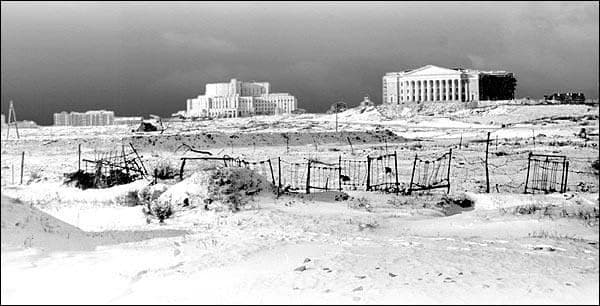
Yet even two years later, as construction of the headquarters of the Byelorussian Military District was nearing completion in 1947, central Minsk still resembled a wasteland.
Publications by A. M. Litvin and I. Yu. Voronkova were used in preparing this article


 Russian
  English