

The Mi-24 is one of the best-known attack helicopters in the world. Its design was based on the Mi-8 transport helicopter, which had proved highly successful in service. Development was personally led by Mikhail Leontyevich Mil. The powerplant and dynamic systems were taken from the Mi-8 virtually unchanged, but the five-bladed main rotor was extensively modified and reduced in diameter, while the tail rotor was moved from the right to the left side of the tail boom. In 1971, the Mi-24 transport and attack helicopter entered series production and was adopted by the Soviet Army.
Its roles include supporting ground forces, destroying enemy armoured vehicles, deploying troops, transporting cargo, evacuating the wounded and engaging enemy helicopters.
In the first production variant, the gunner-operator and pilot shared a single cockpit; in subsequent variants, they were seated in tandem, with the gunner-operator’s cockpit at the front. Both cockpits are pressurised and equipped with air conditioning, enabling the helicopter to conduct combat operations in areas contaminated by chemical or radioactive agents and across a wide range of temperatures. The cargo compartment can accommodate eight fully armed troops with their standard ammunition.
The Mi-24 carries not only machine-gun and cannon armament and anti-tank guided missile systems, but also external launchers for 57, 80, 122 and 240 mm unguided rockets.
The helicopter’s pylons can also carry aerial bombs for various purposes weighing up to 500 kilograms, as well as incendiary mixture tanks.
The Mi-24P variant is fitted with a fixed twin-barrelled 30 mm GSh-30 cannon in the nose of the fuselage.
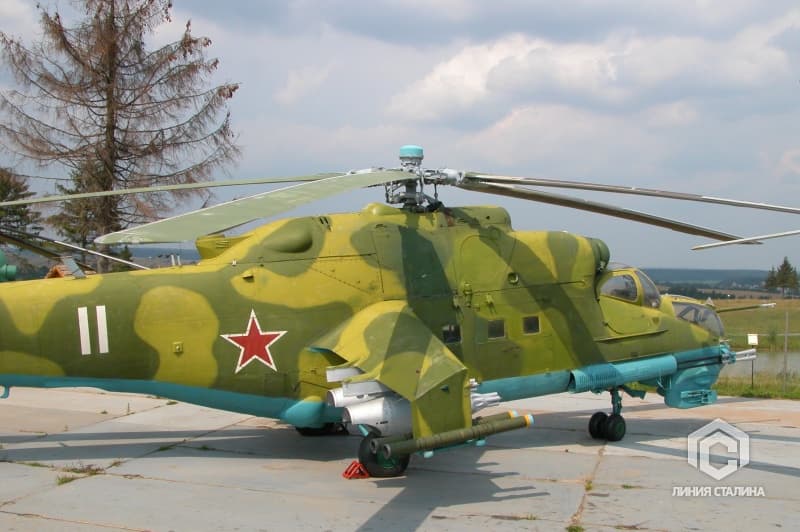
Series production of the Mi-24 continued until 1992. A total of 2,400 helicopters were built and served with the armed forces of around 30 countries.
The Mi-24 was used effectively in combat operations in South Asia, the Middle East, Africa and Afghanistan.







 Russian
  English