
On 24 June 1941, the Germans entered Vilnius. Afterwards, three of Hermann Hoth’s tank divisions (the 7th, 12th and 20th) unexpectedly turned towards Minsk.
The change of direction by the German tank columns was spotted by Soviet pilots. When the commander of the Western Front was informed, he did not believe the report, considering such a deep envelopment to be madness. Indeed, how could the enemy dare attempt it when, 400 km west of Minsk, the most powerful concentration of Soviet forces was still positioned in the Białystok salient — effectively behind the German lines — with more tanks than the entire Wehrmacht had on all fronts?
On the other hand, there were no Red Army units in the path of these three tank divisions as far as Molodechno. Only at Zaslavl, within the belt of pillboxes belonging to the Stalin Line’s Minsk Fortified Region, had a single Soviet rifle division — the 64th — managed to detrain. Its artillery, however, had only 20 to 50 rounds per gun because the train carrying the required quantity of ammunition had been halted by German air strikes and subsequently returned to Orsha.
Unsurprisingly, early on the morning of 25 June, the command of the 64th Division sent out a reconnaissance detachment. It was led by Major Yakov Vlasovich Chumakov, commander of the division’s independent reconnaissance battalion.
The neighbouring 108th Rifle Division, which guarded the approaches to Minsk from the direction of Brest, assigned its own reconnaissance group under Captain Pavlenko to assist Chumakov.
Near Radoshkovichi, the Soviet reconnaissance troops spotted German staff buses turning towards the village of Shelukhi and disappearing into a nearby wood. The road to the wood was guarded by three machine-gun-armed Panzer I tanks. They bore large white letters ‘H’ and small yellow symbols resembling an inverted Cyrillic letter ‘ш’. At the time, the reconnaissance troops did not yet know that the white letter was the Latin ‘H’, signifying Hermann Hoth’s 3rd Panzer Group (German: Hermann Hoth), while the yellow symbol was the emblem of the Wehrmacht’s 20th Panzer Division.

Chumakov assigned a six-man group led by Commissar Gontsov to destroy the tanks, while he and the remaining troops crept towards the wood. There they quickly discovered a concentration of staff vehicles and waited for the destruction of the tanks guarding the road.
As soon as explosions were heard on the road, Major Chumakov led his troops into the attack. The element of surprise enabled them to kill the guards, take two officers prisoner, seize German documents and return to their own lines.
The captured documents revealed that Hoth’s tank divisions, advancing from Vilnius, were to link up east of Minsk on 27 June with Guderian’s tank divisions advancing from Brest, thereby encircling all Soviet troops of the Western Front. A similar pincer movement was then planned to continue the advance towards Vitebsk and Smolensk.
These important documents were urgently delivered to Marshal of the Soviet Union B. M. Shaposhnikov and the Red Army General Staff.
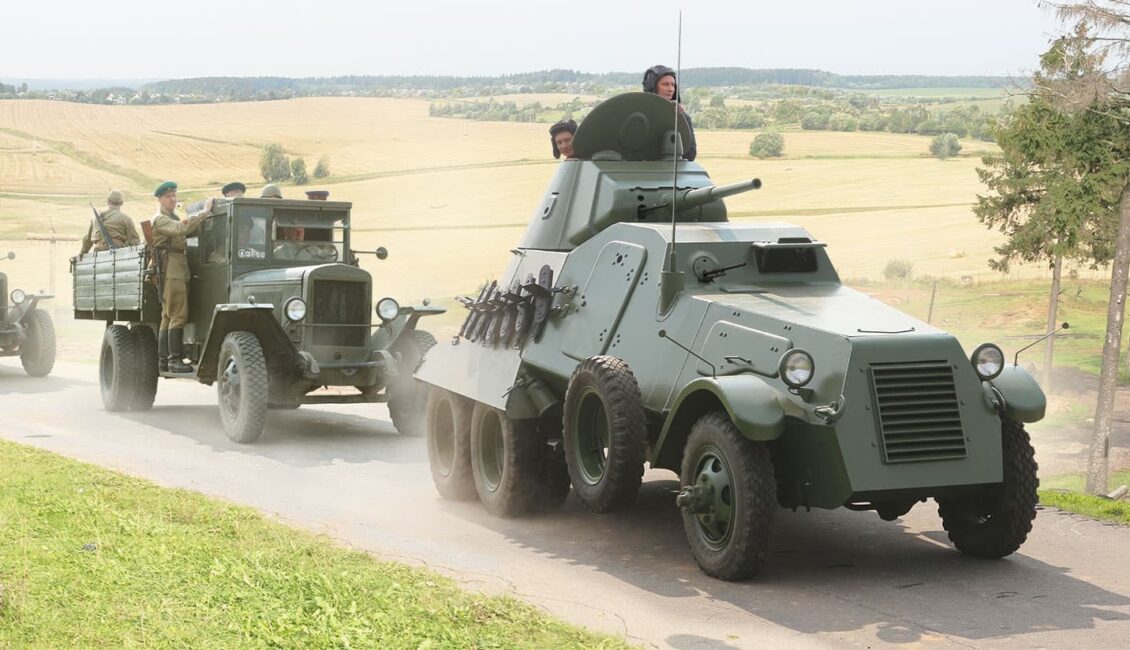
As soon as the documents had been sent to Moscow, a concentration of German troops was spotted near the town of Rakov. This time, Major Chumakov led a mobile reconnaissance detachment. Travelling along country roads in four vehicles, accompanied by three armoured cars and two motorcyclists, the reconnaissance troops headed towards Rakov.
Late in the evening of 25 June, before reaching Rakov, they discovered a column of German armoured vehicles that had stopped for the night in a village at the junction of four roads. The German vehicles again bore large white letters ‘H’, as well as small yellow circles containing a symbol resembling a chicken’s foot.
Chumakov devised a plan of attack: the roads running south and west from the village were to be mined; the main body of the reconnaissance troops would attack the village from the north, while the remainder, supported by the armoured cars, would attack from the east.
As soon as the sappers reported that the roads had been successfully mined, a red flare rose into the sky. On the western outskirts, a petrol bomb set one German tank ablaze. Two others rushed towards the road but soon struck mines. Attacked in the village from the north and east, the remaining German armoured group lost another five tanks in the brief night battle. Having captured prisoners for interrogation, the Soviet reconnaissance troops returned to their own lines.
Interrogation of the prisoners revealed that the yellow circle containing a chicken’s foot was the emblem of the 12th Panzer Division. As of 22 June 1941, the most numerous tank in the division was the captured Czech Panzer 38(t), accounting for 109 of its 220 tanks.

The remainder comprised 40 Panzer I tanks, 33 Panzer II tanks, 30 Panzer IV tanks and another eight command tanks based on the Panzer 38(t). It emerged that on 22 June the 12th Panzer Division had managed to capture an important bridge over the River Neman near Merkinė and had advanced unopposed as far as Volozhin via Varėna in Lithuania and Voronovo and Oshmyany in Belarus. There, on 25 June, it had to engage encircled Soviet units. Its second clash, on the night of 25–26 June, took place here near Rakov, against Major Chumakov’s reconnaissance troops.
The division would then spend a full two days destroying just 23 pillboxes of the Stalin Line. When it entered Minsk on 28 June 1941, it was so exhausted that it could not resume its advance until 2 July.
Chumakov’s reconnaissance troops, the pillbox defenders, the soldiers of the 64th Rifle Division and other Soviet units all contributed to the Soviet Union’s ultimate victory over Nazi Germany.
 Russian
  English