

This richly illustrated publication, devoted to the history and present-day life of the Stalin Line, describes the construction of its defensive structures and their role in the Great Patriotic War. It also highlights the museum’s importance in educating the younger generation.
The 200-page large-format book contains numerous photographs of the complex and examples of military equipment, as well as reportage photographs of historical reenactments and commemorative events held at the museum since it opened.

— Today, it is often said that, since the Stalin Line did not stop the Germans in the first days of the war, its construction was a pointless waste of resources. History, however, tells a different story, — emphasised during the press conference Leonid Kasinsky, Assistant Minister of Defence for Ideological Work in the Armed Forces and Head of the Main Directorate for Ideological Work of the Ministry of Defence of Belarus. – The task was accomplished by people — ordinary soldiers and officers who found themselves on the front line. They proved stronger than steel and stronger than concrete. It was thanks to their efforts that we prevailed in that terrible war. I was fortunate to be involved at the beginning of the construction of the Stalin Line Historical and Cultural Complex. What makes it unique is that it enables visitors to connect with the origins of those heroic days, see the weapons and military equipment of that era with their own eyes and take part in reenactments of wartime events. The most important thing is to convey the truth about those harsh years to the younger generation. It is essential that our children understand that the sacrifices made by the Soviet people during the Great Patriotic War were not in vain.


The book explains that construction of the defensive structures around Minsk began in 1928, when the Soviet Union’s western borders were not with Germany, but with Poland, Romania and the Baltic states. “The purpose of the fortified regions was not to halt and defeat the enemy, as many mistakenly believe, but to hold the border areas while general mobilisation was carried out throughout the country,” the publication states.

— The best evidence that the Germans did not simply pass through the line of defensive structures unopposed is found in declassified German war diaries, — explains Boris Prokazov, the book’s author and a research fellow at the Stalin Line Historical and Cultural Complex. – The Germans recorded that it took them two days to destroy 23 pillboxes in the Zaslavl area alone. This demanded considerable effort from their soldiers. The Stalin Line delayed German forces for four days in the Minsk Fortified Region, 20 days in the Polotsk Fortified Region, 60 days in the Kyiv Fortified Region and nine days in the Novograd-Volynsky Fortified Region. In total, the German army was held up for 107 days by the Stalin Line alone. It is clear that the resistance along the line of defensive structures made an invaluable contribution to the Great Victory.


The publishers, the Petrus Brovka Belarusian Encyclopaedia, sought to present information about the complex’s past and present in a vivid, contemporary style.
— The text is presented in Russian and English, — noted Olga Vanina, the publishing house’s director. – The book will be useful not only to visitors from Belarus, but also to those from abroad. It will soon be available in bookshops across Belarus.

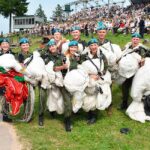
The presentation at the Stalin Line open-air museum was open to everyone. As well as discovering the new publication, its first readers took part in a training exercise involving firing from the Armoured Train at mock enemy armoured vehicles and sampled soldiers’ porridge.
Photo: Alexey STOLYAROV
Author: Marina KUZMICH
https://www.sb.by/






 Russian
  English