
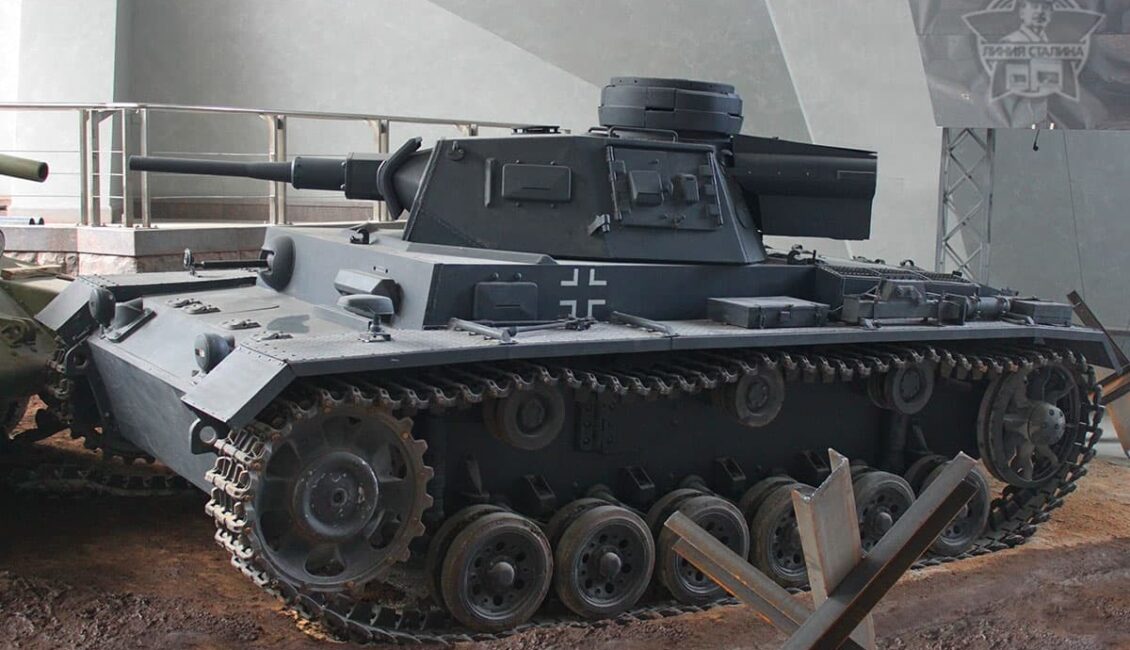
Until recently, the best-known German tanks here were the Tiger and Panther. However, Germany began its war against the Soviet Union with very different vehicles, known to the Germans as Panzers (tanks). On 22 June 1941, the Panzer III was the most numerous tank in the Wehrmacht.
For many years, it was known here as the German T-3 tank. When computer games brought its real name—and later the abbreviated form Pz III—to wider attention, young gamers simply began calling it the ‘Pazik’.
To mark the 70th anniversary of the liberation of Belarus, a new building for the Museum of the History of the Great Patriotic War was constructed in Minsk. The centrepiece of its exhibition was a scene depicting a T-34 ramming a Panzer III. Both tanks were restored by the restoration team at Stalin Line.
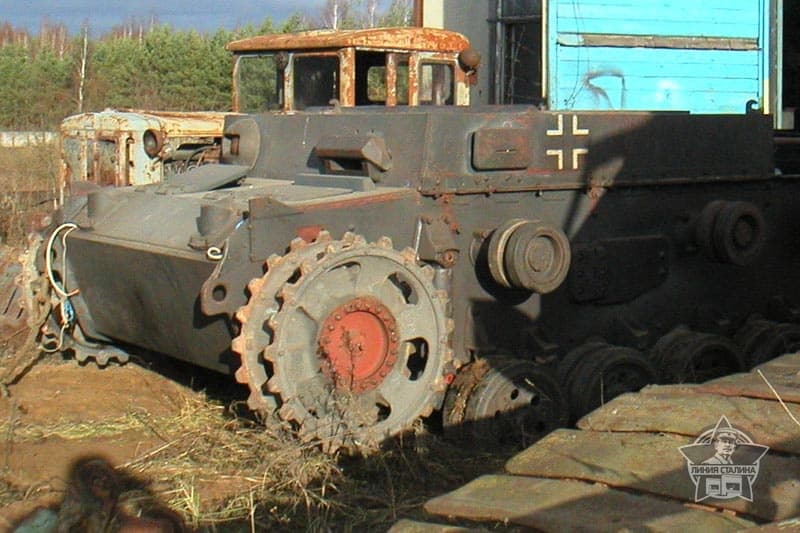
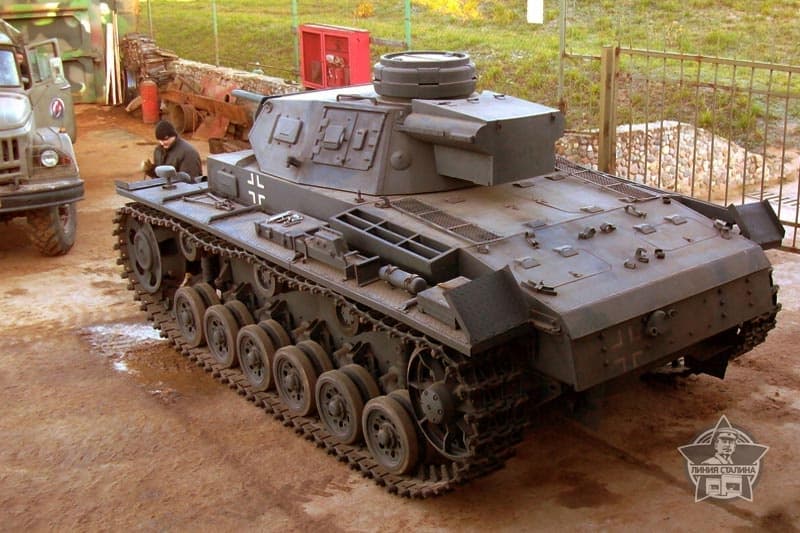
Unlike the T-34, sourcing the missing parts for the Panzer III was no easy task. Our craftsmen therefore had to do more than restore the tank recovered from a swamp: they also had to manufacture its tracks, track guards complete with the full set of German tank tools and equipment, and a turret with a gun. This required two months of intensive work.
The photo report shows the appalling condition of the tank’s internal equipment and how it was transformed by the restorers’ skilled hands. It had been known from the outset that the vehicle would be displayed in the museum with its hatches permanently closed, and that no one would ever see inside it. However, thanks to those who managed to photograph the interior of the restored tank, we can compare its condition before and after the restoration work.
Particular mention should be made of the Panzer III turret, whose highly distinctive and recognisable features are not always easy for artists to capture on paper—and are even harder for replica builders to reproduce in metal. The author of these lines has drawn the Panzer III on more than one occasion and has even seen the tank in person at Kubinka. The precision of its German proportions and the unique sweep of its lines made such a lasting impression that even slight deviations from these proportions made any replica immediately apparent. Indeed, even Western reproductions are often marred by distorted forms. As for the Panzer III restored at Stalin Line, before meeting its restorers I believed that its turret simply had to be original. Imagine my surprise when I discovered that they had made it with their own hands—not even from drawings prepared at Kubinka, but simply from… photographs! That is true God-given skill!
Of course, I now know that Alexander Mikalutsky, Vladimir Yakushev and his sons Alexei and Maxim approach all their work with the same dedication. At the time, however, looking at the turret, it was almost impossible to believe that they had made it entirely from scratch. It is hardly surprising, then, that Wargaming commissioned our craftsmen to build an MS-1 tank from the ground up.
Another distinctive feature of the Panzer III is its tracks. Until the work was almost complete, the tank was fitted with Soviet tracks from a PTS-M amphibious transporter. Before the vehicle was handed over to the customer, new track links were cast in Mozyr to a German pattern copied from the original tracks of the operational StuG III self-propelled gun at Stalin Line.
The Panzer III met the acceptance commission’s quality requirements, and today it and the T-34 are the most popular subjects for photographs among visitors to the Museum of the History of the Great Patriotic War.
A photographic report showing individual elements of the tank before and after restoration.





 Russian
  English