
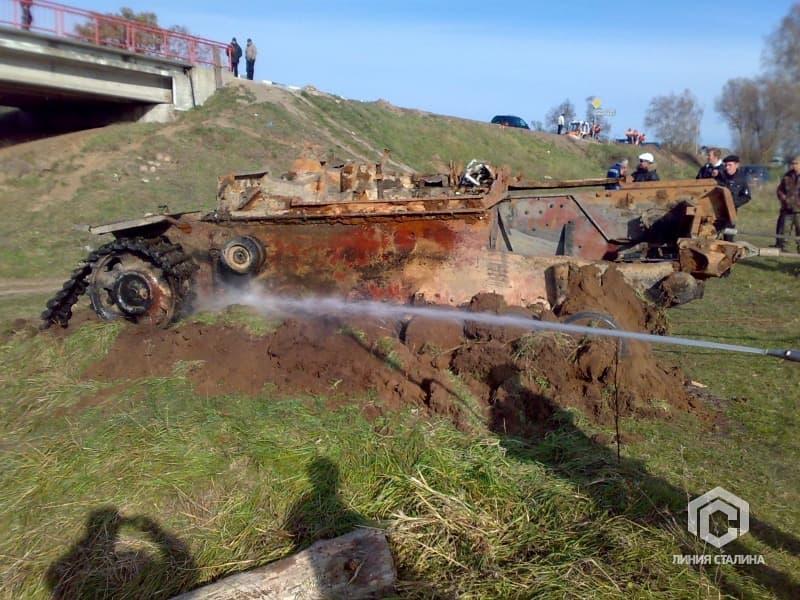
The restoration of an object begins with its discovery. For example, we may receive word from the military commissar of Mstislavl that a decision has been made to recover a tank from the River Vikhra. Vehicles carrying the necessary equipment are then dispatched to the search site.
Divers enter the water, locate the object and attach cables to it. Moving the find often requires extensive digging or washing away the earth in which it has lain embedded for decades. This takes a considerable amount of time — sometimes even several days. When a mass of rusty metal finally emerges from the Vikhra, it turns out not to be a tank at all, but a German StuG III self-propelled assault gun. What a find!
Admittedly, the self-propelled gun was missing the upper part of its superstructure, as well as its engine and gun. It emerged that, after the war, the part protruding above the water had simply been cut off and sent for scrap along with the gun. The serviceable engine — a mighty 300-horsepower German Maybach — was put to work driving a collective farm mill. Could there be anything more symbolic?
At first sight, another expedition produced rather less: in winter, fragments of the hull floor and a torsion bar from a KV heavy tank were pulled from a frozen marsh. A number of other small finds followed. Tanks were often torn apart by explosions, leaving only fragments that, for one reason or another, were not collected as scrap metal after the war.
On one occasion, we managed to find a commander's cupola from a German Panzer III. It might seem a minor find, but this was precisely the part missing from the tank we had restored for display at the Great Patriotic War Museum. Other small items — jacks, cables, axes and shovels — had to be ordered for it from Germany itself, using a catalogue. And they certainly did not cost a trifling sum…
Fragments of side and rear armour for the self-propelled gun recovered from the Vikhra were later found. A 75 mm assault gun was also ‘fished out’, but it was a short-barrelled weapon from an earlier variant. Our StuG III, however, proved to be a 1943 vehicle: a marking on the hull is dated 17 July 1943. It therefore had to be fitted with a long-barrelled gun, and one was duly found.
Information is currently available about further finds. The search and recovery of military vehicles continues.








 Russian
  English