
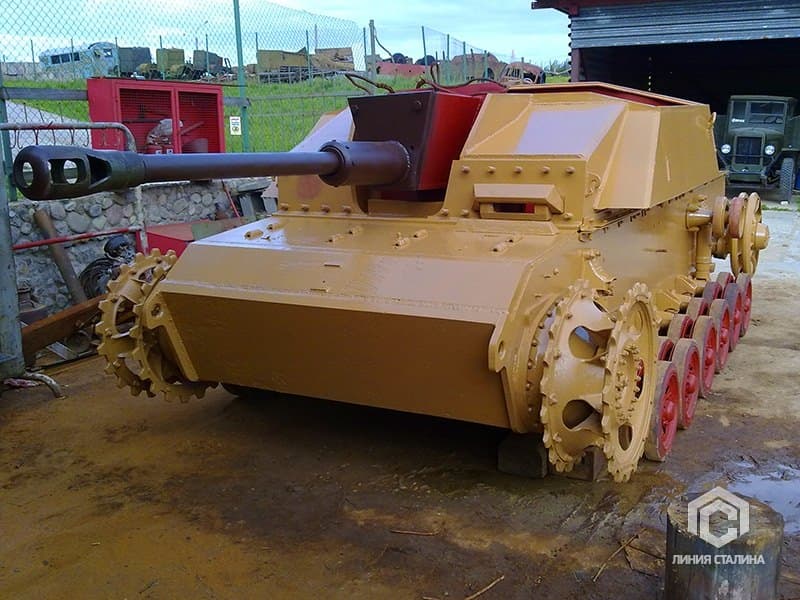
In September 1943, during the Smolensk–Roslavl Offensive, a German Sturmgeschütz III assault gun (abbreviated to StuG III) fell from a bridge into the River Vikhra near the Belarusian town of Mstislavl.
Amid the confusion of the retreat, the Germans made no attempt to recover their self-propelled gun. As the river was relatively shallow, part of the vehicle remained visible above the water. After the war, the roofs of the superstructure and engine compartment, sections of the sides and rear, as well as the gun and engine, were removed.
On 19 October 2010, the StuG III, which had become deeply buried in sand, was recovered from the river and transported to Stalin Line. Restoration work began on 11 May 2012.
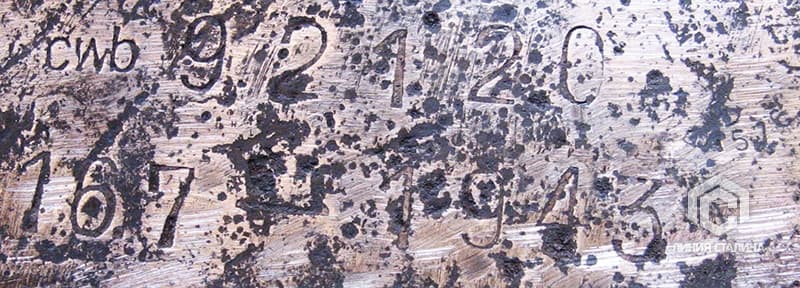
During restoration, the serial number cwb. 92 120 and the production date 16.7.1943 were discovered on the vehicle’s hull.
A name painted on the front hull plate was still visible, apparently Fuchs — German for ‘fox’.

If so, the photograph found online may show the very assault gun that we recovered: the name Fuchs can also be seen on the commander’s cupola.

Judging by its serial number, production date and design features, this self-propelled gun belongs to the most widely produced G variant (Sturmgeschütz III Ausf. G). Given that Mstislavl was liberated by our forces on 28 September 1943, this StuG III can have served at the front for only about two months. It may have formed part of the German 9th or 12th Army Corps of Army Group Centre.
In addition to the missing upper section, gun and engine, the vehicle lacked its left-hand idler wheel, two return rollers and half of its track. However, our restorers already had all these components, including a superstructure roof and sections of side and rear armour, recovered during previous expeditions.

All these ‘spare parts’ made our craftsmen’s work considerably easier. This was particularly true of the superstructure roof, which made it easier to shape and fit the missing section of the superstructure, as shown in the photograph.

However, the short-barrelled German 75 mm gun found in the Vitebsk Region could not be used, as the Sturmgeschütz III Ausf. G was armed with a long-barrelled 75 mm gun. Our restorers therefore had to adapt the famous Soviet 76 mm ZiS-3 gun for the purpose. They also modified its muzzle brake to resemble the German version. As a result, it looks convincing and, most importantly, it fires!
We would like to dispel one myth: because the restored self-propelled gun is painted sand-coloured, some assume that it once fought in Africa. However, the German Afrika Korps surrendered on 13 May 1943, while the vehicle we recovered was built two months later. At the time, all Wehrmacht vehicles left the factory in the standard colour known as dark yellow, RAL 7028, introduced in February 1943. Each vehicle was also supplied with two tins of paint, one olive green and the other red-brown, and crews in the field decided whether to apply camouflage patches. Numerous photographs show that German vehicles often went into battle without any additional camouflage. The StuG III at Stalin Line is therefore painted solely in the Wehrmacht’s standard factory colour for armoured vehicles.


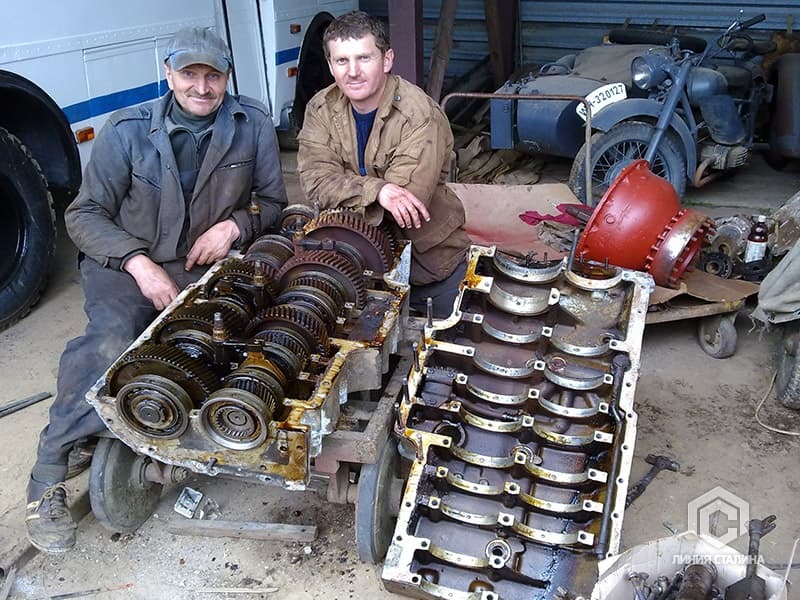
Explore our photographic feature on the restoration of the Sturmgeschütz III Ausf. G






 Russian
  English