

In July 1941, during the Soviet counter-attack near Lepel, a BT tank sank in a bog. This happened near the village of Shebeki in the Orsha District. The crew managed to abandon the vehicle before it was swallowed by the bog. At first, the tank did not sink very deeply, and its handrail antenna even protruded above the water. After the war, the copper antenna was removed by a resourceful local farmer. In the early 1970s, an attempt was made to recover the tank, but it slipped free and sank even deeper.
A new phase in the recovery of the BT tank began in 1998, when the Poisk (‘Search’) Club was established specifically to carry out such recovery and restoration work. Under a special directive issued by the Head of State, all organisations were required to assist Poisk. The team arrived at the site in November 1998. For the recovery operation, it was provided with an excavator, a pump and a powerful BAT-M artillery tractor, which had been used on a collective farm to compact silage.

The tank could not be found in its previous location. In the quarter of a century since the first recovery attempt, the BT had shifted sideways underwater. However, an instrument capable of detecting concentrations of metal enabled the team to locate it. To extract the tank, a special structure resembling the timber lining of a well was built at the recovery site. Wearing specialised equipment, the recovery team leader descended beneath the ice and, in the pitch darkness of the silt-blackened water, attached towing cables to the tank.
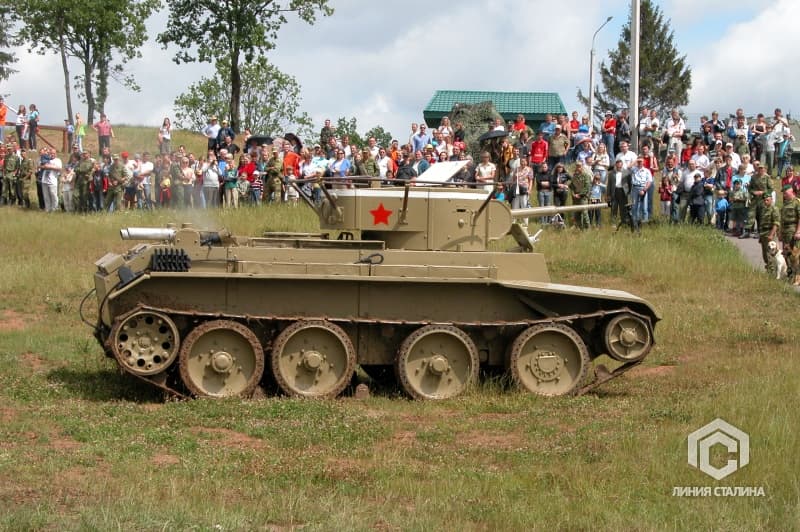
The recovered vehicle proved to be a BT-7 tank manufactured in 1935, when the model was still fitted with the cylindrical turret also used on the BT-5 and T-26. The presence of a radio indicated that it was a command tank. Everyone present was astonished by the BT’s state of preservation. Once it had been cleaned, not only were all the nuts, bolts and tools still in place, but there was petrol in the tanks, shells in the crates and fully loaded ammunition drums. Only the radio had been destroyed by acid leaking from the batteries.
When work began to restore the vehicle to running order, what surprised our restorers most was the quality of the Italian bearings, the complexity of the heavy copper BT radiators (the T-34 had simple, lightweight brass ones), and just how temperamental the M-17 petrol engine really was. Reading in books about the high fire risk posed by the carburettor engines of the BT, Panther and Tiger tanks was one thing; being inside a vehicle whose engine suddenly erupted in a hellish blaze after several attempts to start it was quite another! Because of the direct-flow injection system, petrol accumulated inside after an unsuccessful attempt to start the engine. When the engine eventually started, the excess petrol ignited and caused a fire. It is hardly surprising that, in the Red Army, one of the crew would stand beside the tank with a fire extinguisher whenever a BT was started. Yet the engine's 500 horsepower provided tremendous power, carrying our light BT as if on wings! No other pre-war tanks were as dearly loved as these high-speed machines. This was not because of their record-breaking speed or the length of the BT's jumps. Rather, once at the controls of the ‘BT’, yesterday's recruit felt he was master not only of a formidable fighting vehicle, but also responsible for the lives of his comrades!
This is the remarkable tank that our restorers succeeded in returning to running order. Our BT-7 even appeared in the feature film ‘The Priest’, where it was particularly memorable for the flames bursting from its exhaust.

These half-metre tongues of flame from the exhaust were another distinctive feature of the former M-17 aircraft engine fitted to BT tanks. With an engine like this, fuel quite literally went straight out of the exhaust, resulting in enormous consumption and making the tank unsafe to operate in peacetime. After the BT-7 took part in the 2004 Victory Day Parade, and particularly in view of plans to use it in historical reenactments, it was therefore decided to replace the fire-prone M-17 with a safer diesel engine from a PT-76 tank.






 Russian
  English