
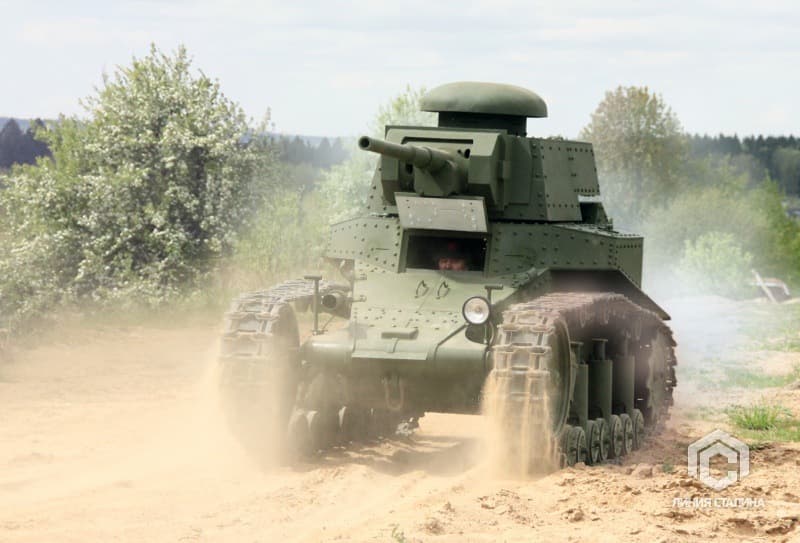
In December 2013, the “Memory of Afghanistan” Charitable Foundation for Assistance to Internationalist Veterans won a competition to construct (recreate) a full-size 1:1 replica of the final version of the MS-1 tank, armed with a 45 mm gun, using its own resources.
It should be made clear from the outset that restoration and recreation are two fundamentally different concepts. Restoration, the more labour-intensive of the two, involves returning the mechanisms and external appearance to their original condition. If restorers are unable to find a particular component, an exact copy may be made from the manufacturer’s drawings. Recreation involves producing the closest possible replica of a vehicle from that period, while still using newly manufactured components.
The story of the Soviet tank industry’s first production tank is remarkable. It became a ‘training ground’ for the first generation of Red Army tank crews and a test project for Soviet industry as it embarked on tank production for the first time. The MS-1 was designed to support infantry in battle, hence its name: ‘Small Support Tank, First Model’. Although 959 MS-1 tanks were built, only empty hulls and turrets have survived, and then only because they were installed in fortified regions. No MS-1 tracks are known to survive anywhere. The vehicle is less a tank than a mystery.
The MS-1 entered production in 1928 and initially formed the backbone of the Workers’ and Peasants’ Red Army tank fleet, but was soon superseded by the more advanced T-26. During the armed conflict over the Chinese Eastern Railway in the autumn of 1929, nine MS-1 tanks took part in the assault on Chinese fortified positions near Manchuria railway station. On the eve of the Great Patriotic War, these obsolete and severely worn tanks were withdrawn from service or used as static firing positions. When the war began, only a few serviceable MS-1 tanks went into action.
After their military service, these tanks did not enter museum collections. Consequently, the surviving examples were recreated from abandoned vehicles that had been installed as static firing positions in fortified regions of the Far East. Owing to errors and simplifications made during the work, all recreated MS-1 tanks differ significantly from the original. In particular, although every example is based on the 1930 modification, some are fitted with an imitation twin Fedorov machine gun, while the tank in Vladivostok even has a replica Maxim machine gun. The running gear of every vehicle is inaccurate to a greater or lesser extent.
At least six surviving MS-1 tanks are known in the Far East alone. Another example is displayed outdoors at the ‘Military Glory of the Urals’ Museum in Verkhnyaya Pyshma, Sverdlovsk Region.
On 4 January 2014, the VoenTV studio began preparing a report on the construction of an MS-1 tank in Belarus. The aim was to show viewers the process of recreating the historic vehicle from the very beginning.
What made the project unique was that the replica had to be built without any original MS-1 tank parts or components.
A joint search located an original MS-1 tank hull in the town of Vsevolozhsk, Leningrad Region. On 17 January 2014, a member of our staff was sent to Vsevolozhsk to take its measurements. He was assisted on site by internationalist veteran and reserve major Pyotr Pavlovich Bushkov.
Under the direction of Alexander Mikhailovich Metla, Director of the ‘Memory of Afghanistan’ Foundation, a team of restorers undertook the project: Alexander Mikalutsky, Vladimir Yakushev and his sons Alexei and Maxim. Thanks to their work, such well-known vehicles as the BT-7, two T-34s, two Panzer IIIs, a StuG III and the rare T-44 tank have already been given a new lease of life.
Like a good tailor, the team had to begin by cutting out the pieces, although in this case they were cutting 10 mm metal sheets rather than fabric. Invaluable assistance in solving this problem was provided by Vladimir Yuryevich Zhavrid, Deputy Director of BME-Diesel LLC, and his son Anton, a design engineer.
Even those who had commissioned the replica did not fully believe that the work could be completed within the specified timeframe.
Nevertheless, by mid-March the project’s overall form had begun to emerge. On 3 May 2014, the main work was completed and the tank underwent running trials.
The commissioning of the completed vehicle was a true celebration for everyone involved in the project.


 Russian
  English