
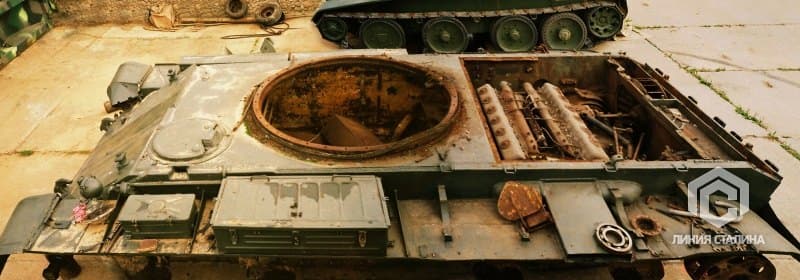
Until recently, only specialists and history enthusiasts in our country were aware of the T-44 tank’s existence.
Designed in 1944 and produced in a run of just 1,823 vehicles, the T-44 was overshadowed by such famous, mass-produced tanks as the T-34 (more than 50,000 built) and the T-54/55 (around 70,000 built). However, it was the T-44 that became the progenitor of the Soviet post-war medium tanks which rapidly displaced the traditional heavy tank class and became main battle tanks. From the outset, the medium T-44 weighed just 32 tonnes yet had strong armour and almost the same gun as the 56-tonne German Tiger heavy tank!
Such impressive performance for a medium tank was achieved through the T-44’s new layout. Its designers finally succeeded in increasing the hull width and mounting the engine transversely. The turret was moved towards the centre of the tank, the driver’s hatch was relocated to the hull roof, the glacis plate became a single solid plate, and crew protection was improved. Further changes to the layout made the T-44 30 cm lower than the T-34.

The weight saved was used to strengthen the T-44’s armour. The thickness of the frontal hull, turret and side armour increased to 90, 120 and 75 mm respectively, compared with 45, 90 and 45 mm on the T-34-85. Even with this level of protection, the T-44 weighed slightly less than the T-34-85! However, the military’s desire for a medium tank armed with a 100 mm gun led to the development of the next medium tank, the T-54. The T-44, produced in limited numbers, was assigned to the western military districts of the USSR. It did not take part in the Great Patriotic War. Its only combat deployment came in 1956, during the suppression of the uprising in Hungary; otherwise, it fought only on screen.
Even the T-34 might have envied the T-44’s film career! Remarkably, the T-44 appeared in films on numerous occasions in place of the T-34-85. This is all the more surprising because plenty of T-34s still remained after the war, and they themselves were often used to portray German tanks on screen. However, because its turret was positioned towards the front, the T-34 looked rather unconvincing in the role of a German tank.
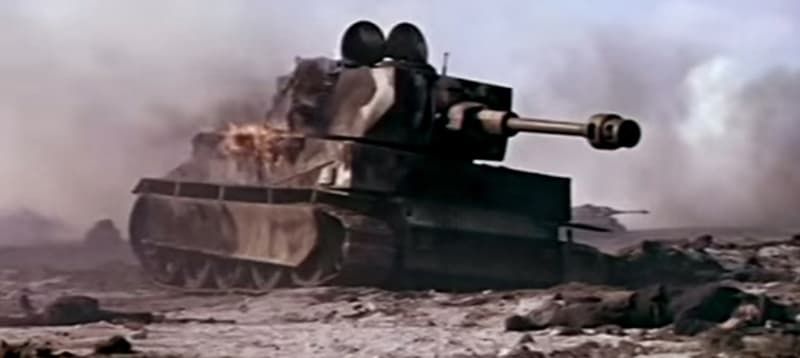
The T-44 was better suited to the role, as its turret was positioned towards the centre of the vehicle, like those of German tanks.
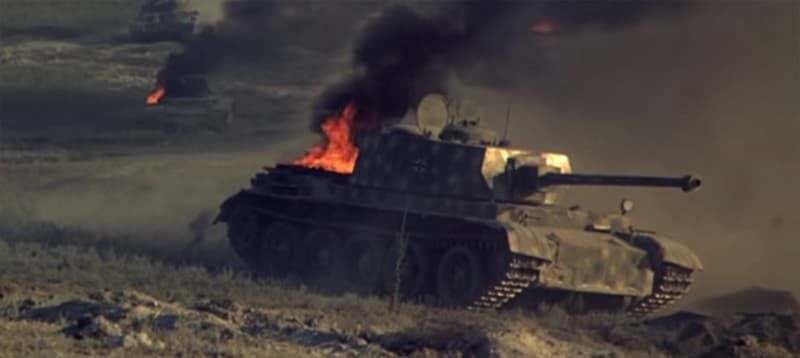
For around half a century, the T-44 has portrayed a generic German tank resembling a Panzer IV in Soviet and, subsequently, Russian films, with only minimal cosmetic alterations. Even when a genuine Panzer IV restored at Kubinka appeared in Nikita Mikhalkov’s film Burnt by the Sun 2: Exodus, the T-44 still dominated the picture.
Recently, http://orbicraft.livejournal.com/ posted online photographs of one such T-44 after its German ‘armour’ had been removed. Using these images, we were able to create a photomontage showing how the tank looked before and after filming.
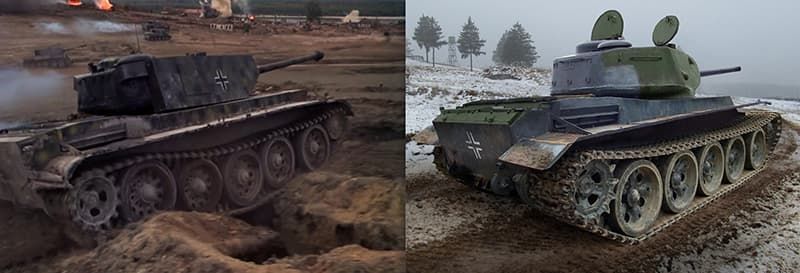
The photographs on the left are stills from the film They Fought for Their Country. On the right are photographs of the T-44 with its grey German ‘armour’ removed, revealing the green colour of the Soviet vehicle beneath.
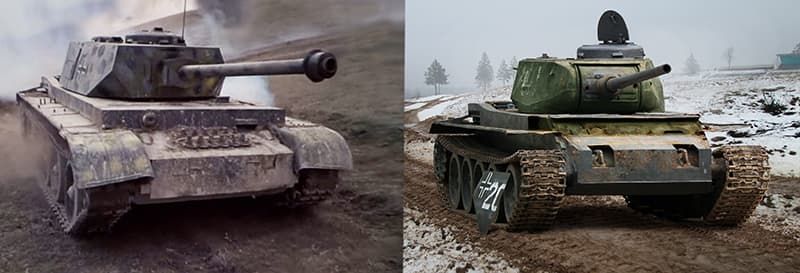
The pinnacle of the T-44’s film career was its appearance in Yuri Ozerov’s epic Liberation, in which our tank played none other than the German Tiger! Its appearance in the film’s opening shots must have come as a shock.
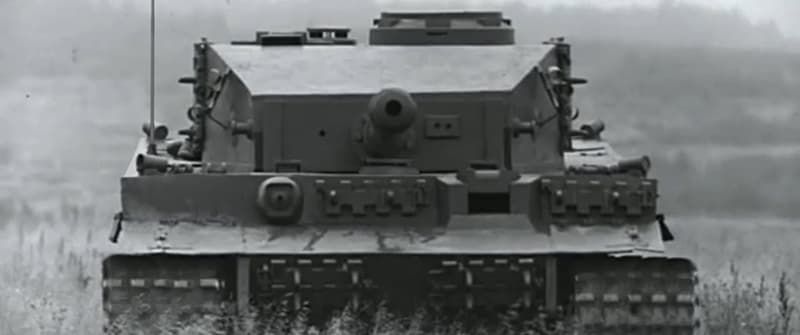
This time, the T-44 was disguised so thoroughly that not only ordinary cinema-goers in the 1970s, but even war veterans could easily have mistaken it for a genuine Tiger! This was hardly surprising: after the comical imitations previously seen on Soviet screens, a German tank suddenly appeared with many of the Tiger’s distinctive features. The filmmakers even moved the T-44’s engine exhaust from the left side to two Tiger-style exhaust pipes at the rear of the tank. The effort required to imitate the interleaved arrangement of its road wheels was no less remarkable!
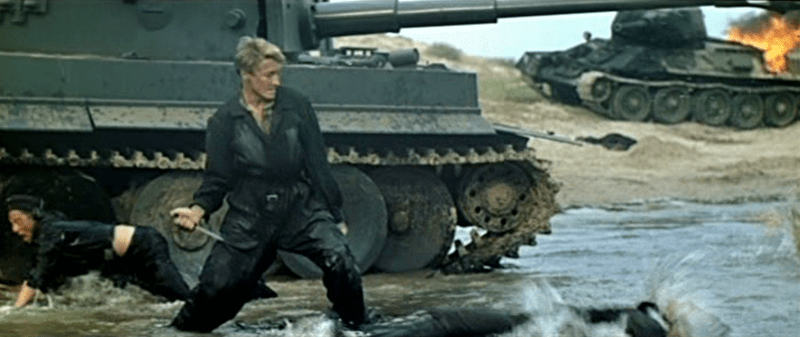
Although the additional road wheels soon fell off during filming, the T-44 still looked quite convincing without them.
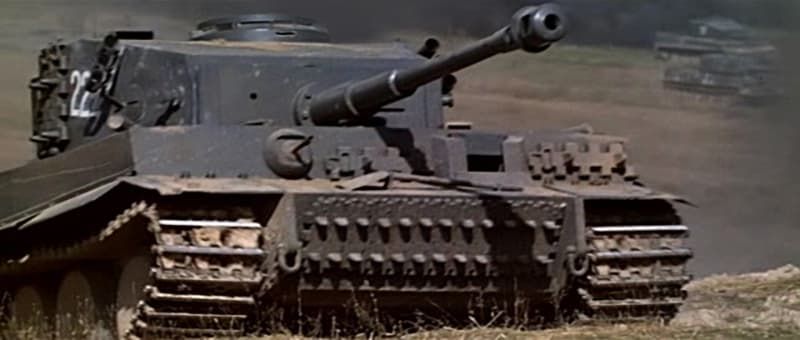
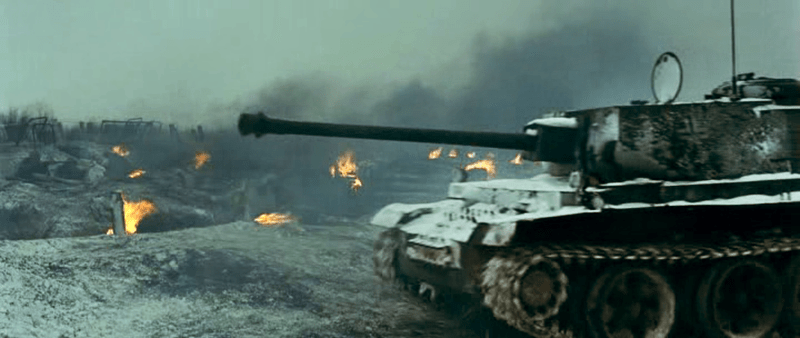
The T-44 subsequently appeared as a Tiger even without wide tracks, as in the film Hot Snow.
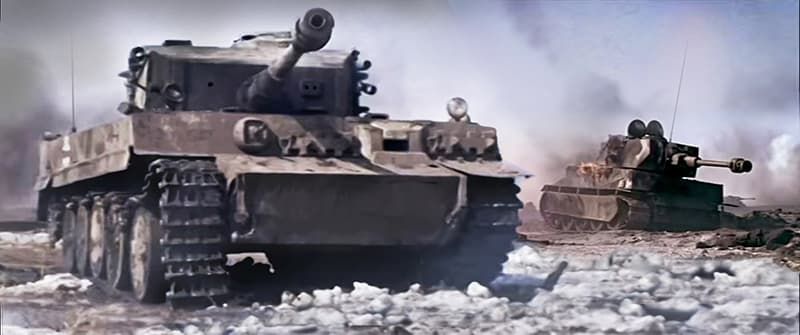
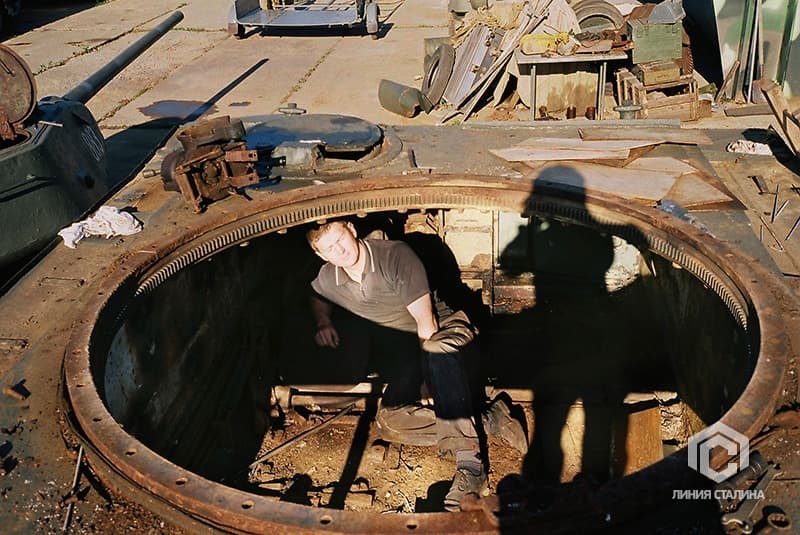
Curiously, in the 1990s the most striking scenes from Liberation featuring the ‘T-44 Tiger’ were converted into black and white and presented as… wartime newsreel footage! Meanwhile, the few surviving T-44s that had neither appeared in films nor been sent for scrap were placed on Great Patriotic War memorial plinths in place of T-34s. One such T-44 stood in a military garrison in the Vitebsk Region. When the garrison was closed, the tank was at risk of being sent to the blast furnace. However, our director, Alexander Mikhailovich Metla, managed to save this rare vehicle and bring it to Stalin Line. Its restoration began in the summer of 2009 with the involvement of Alexander Mikalutsky and Vladimir Yakushev, together with his son Maksim, who already had experience of restoring wartime tanks.
As the photographs show, the T-44 that came to us was in poor condition after 70 years. The suspension torsion bars and bearings were particularly badly damaged. The engine and gearbox were also unusable. Yet our specialists had to restore the T-44 to running order! To remove the fractured torsion bars that had seized inside the hull, they had to be cut from within the vehicle and forced out with a jack. The military provided a new engine from a T-54 tank and a gearbox. Although fitting them in the tank presented no particular difficulties, the new T-54 torsion bars had a completely different type of hull mounting. All ten torsion bars therefore had to be individually remachined to fit the T-44. Problems then arose when fitting the suspension arms. The correct mounting angle could be determined only from photographs of the sole suspension arm that remained serviceable. The turret ring also caused considerable difficulty, as more than a hundred special ball bearings had to be found for it.
The only original component remaining in the T-44 was the gear train that transmitted power from the engine to the gearbox, and even this required a great deal of work. Unsurprisingly, restoring the T-44 took a record amount of time: more than nine months!
Since 2011, however, the tank has taken part in military parades and portrayed a T-34-85 at Stalin Line in reenactments devoted to the Great Patriotic War. Apart from the vehicles owned by Mosfilm, our tank was the world’s only operational T-44 until 2015.
Only recently was another T-44 restored to running order at Kubinka.
You can learn how the T-44 was restored at Stalin Line in our photo gallery.



 Russian
  English