
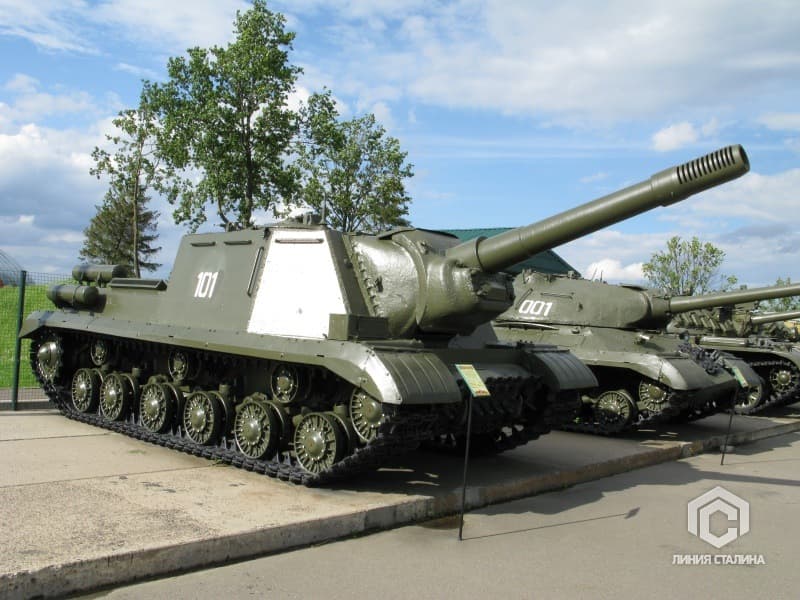
ISU-152 Heavy Self-Propelled Artillery Gun
The ISU-152 self-propelled gun was developed on the chassis of the IS-1 heavy tank (IS standing for Joseph Stalin) and entered service in November 1943. The new self-propelled guns were first used on a large scale in the summer of 1944 during Operation Bagration, the Belarusian strategic offensive. Self-propelled artillery regiments particularly distinguished themselves in the battles for Polotsk and Vitebsk.
122 mm 2S1 Gvozdika Self-Propelled Howitzer

The Gvozdika self-propelled howitzer entered service in 1971.
Its principal roles are to destroy and suppress enemy personnel and infantry weapons, demolish field fortifications, breach minefields and barbed-wire obstacles, and engage enemy artillery, mortars and armoured vehicles.
Three crew members are stationed in the turret: the gunner at the front left, the vehicle commander behind him and the loader to the right of the gun. The driver’s compartment and engine-transmission compartment are located in the front of the hull. The main armament of the 2S1 Gvozdika is a 122 mm D-32 howitzer mounted in a fully traversable turret. Its rate of fire is 4–5 rounds per minute. The gun has an elevation range of −3 to +70 degrees. The Gvozdika is equipped with a PG-2 periscopic sight for both indirect and direct fire. Its standard ammunition load usually consists of 35 high-explosive fragmentation shells and five HEAT shells. The HEAT shell can penetrate 180 mm of armour. The maximum firing range is 15,200 metres.
The Gvozdika chassis was developed from the MT-LB multi-purpose armoured tractor. Its road wheels are made of aluminium alloy.
The self-propelled gun has a watertight hull and can cross water obstacles while afloat. In the water it is propelled by its tracks, reaching a speed of 4.5 km/h. The Gvozdika has a combat weight of no more than 16 tonnes, allowing it to be transported by military transport aircraft.
152 mm 2S3 Akatsiya Self-Propelled Howitzer

Like the Gvozdika, the 152 mm Akatsiya self-propelled gun began entering service with the Soviet Army in the early 1970s. It has a combat weight of 27.5 tonnes and a crew of four. The self-propelled howitzer offers high speed and good cross-country mobility. It can reach 60 km/h on roads.
The 2S3 self-propelled gun is divided into three compartments: the driver’s compartment, engine compartment and fighting compartment.
The Akatsiya’s main armament is a 152 mm D-22 howitzer. The howitzer uses separate-loading ammunition: the shell is first rammed into the barrel, followed by the cartridge case containing the propellant charge. The Akatsiya’s standard ammunition load usually comprises 42 high-explosive fragmentation shells and four HEAT shells. In addition, a round carrying a 2-kiloton nuclear warhead was introduced in the 1970s. The maximum firing range is 17,400 metres.
The self-propelled howitzer is equipped with an air-filtration system, an automatic fire-suppression system activated when the temperature rises in the fighting or engine compartments, and a system that seals the crew compartments to protect the crew from the effects of chemical, biological and nuclear weapons. The latter is activated automatically upon detecting gamma radiation produced by a nuclear explosion.
The self-propelled howitzer can be transported by air, with an An-22 aircraft capable of carrying two vehicles at once. The Akatsiya self-propelled gun proved highly effective during combat operations in Afghanistan and Chechnya, as well as in other armed conflicts. Production of the Akatsiya ceased in 1993.



 Russian
  English