
The Stalin Line Historical and Cultural Complex was established to mark the 60th anniversary of the Soviet people’s Victory in the Great Patriotic War and opened on 30 June 2005 in memory of those who defended the approaches to Minsk. The idea for this unique memorial came from the “Memory of Afghanistan” Charitable Foundation for Assistance to Internationalist Veterans.

The Stalin Line Historical and Cultural Complex was established to mark the 60th anniversary of the Soviet people’s Victory in the Great Patriotic War and opened on 30 June 2005 in memory of those who defended the approaches to Minsk. The idea for this unique memorial came from the “Memory of Afghanistan” Charitable Foundation for Assistance to Internationalist Veterans.
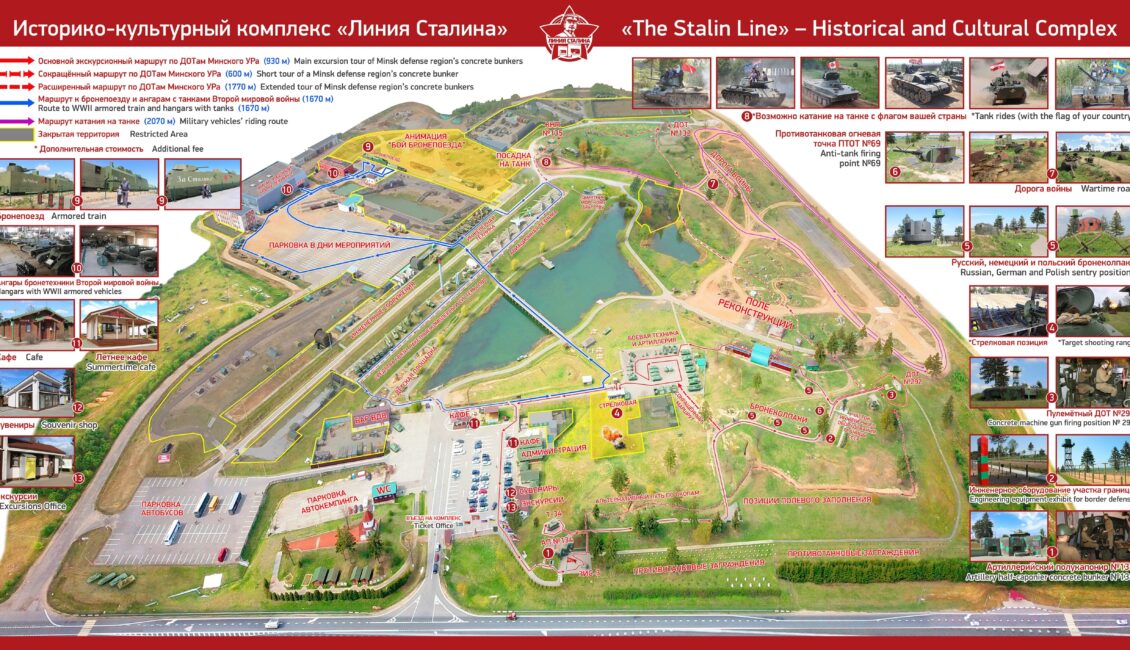
The Stalin Line Historical and Cultural Complex covers an area of approximately 30 hectares. Its historical core consists of permanent firing positions (pillboxes) of the Minsk Fortified Region dating from the 1930s. These comprise an Artillery Half-Caponier, three-embrasure and two-embrasure Machine-Gun Pillboxes, and a command and observation post. Two structures are currently open to visitors: Artillery Half-Caponier No. 134 and three-embrasure Machine-Gun Pillbox No. 292.
These unique structures formed part of a defensive system built along the western border of the Soviet Union in the early 1930s. The system became unofficially known as the Stalin Line.
The site features anti-tank and anti-personnel obstacles, reconstructed field emplacements and engineering works along the border sector.
A wide range of military equipment from the Great Patriotic War and the post-war period is on display, including aircraft, armoured vehicles and artillery.
A ferry crossing and a low-water military bridge, built to pre-war plans, are displayed on an artificial lake.
After exploring the complex, visitors can enjoy traditional soldiers’ porridge at the “Na Privale” Café, fire authentic historical weapons and ride in rare tanks from the 1930s and 1940s.







 Russian
  English