
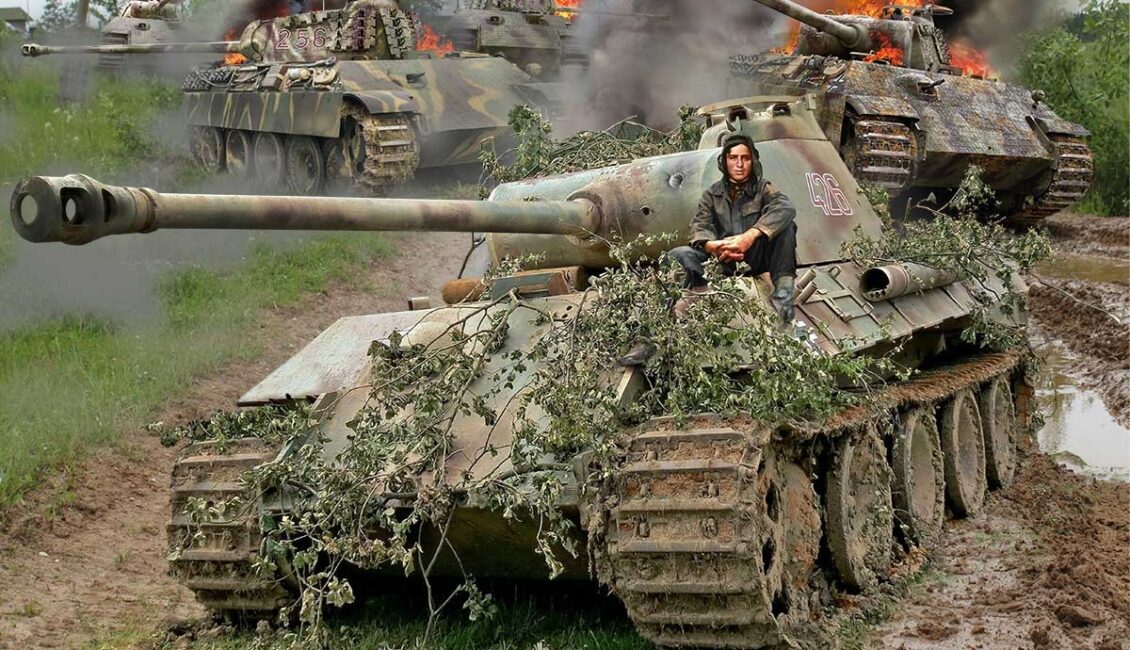
A tank crewman who has knocked out five or more tanks is considered a tank ace.
The most successful Soviet tank ace was Dmitry Lavrinenko, credited with 52 tanks. The leading German ace was Knispel, with 168 tanks. The second most successful Soviet ace was Vladimir Bochkovsky, with 36 tanks, while the German equivalent was Schröif, with 161. In third place were Ivan Korolkov, with 34, and the German ace Carius, with 150. The comparison of tanks knocked out continues as follows: Mikhail Kuchenkov (32) — Bölter (139), Nikita Dyachenko (31) — Wittmann (138), Nikolai Moiseyev (31) — Oberhuber (127)…
At first glance, the victory tallies of the German tank crews are astonishing; however, the comparatively modest figures achieved by their Soviet counterparts can be readily explained.
In the T-34’s two-man turret, the tank commander also served as the gunner. Tied to the gun sight and occupied with aiming the weapon, the commander had no time to look around, protect his tank or identify a new target promptly. It was in T-34s of this kind that our tank crews fought through the three bloodiest years of the war (1941–1944). By contrast, every German medium and heavy tank had a dedicated gunner, while the commander had a cupola providing all-round vision. This allowed him to observe the battle, identify targets quickly for the gunner and issue orders to the crew. The German forces therefore always had a chance of spotting the enemy first and firing before them. Moreover, they fought in this way not for three years, as our T-34 crews did, but for a full six years (1939–1945). It was only during the final year of the war that the T-34-85 appeared, with a three-man turret that finally provided room for a dedicated gunner.
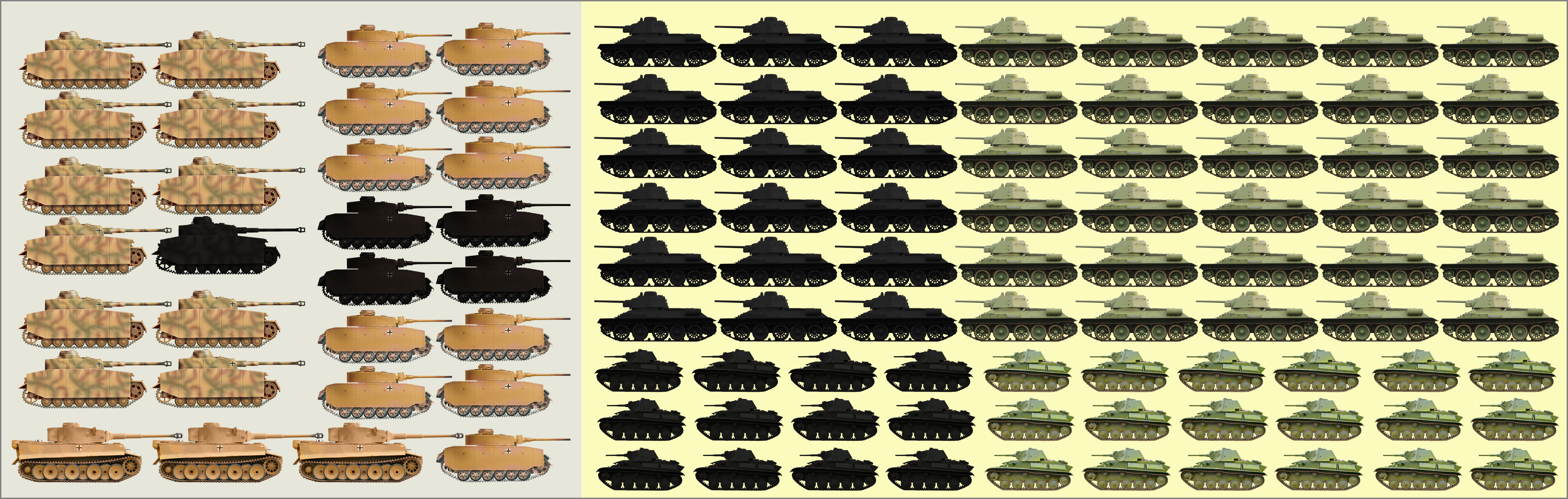
The Red Army had more tanks—which meant more targets for the Germans and more potential victories.
.jpg)
Suppose six Soviet tanks faced just one German tank. The German tank could consequently knock out several of them—or even all six—whereas our tanks could knock out only one. In other words, five Soviet tanks would not knock out any enemy tanks at all because there were no other targets for them.
.jpg)
In the USSR, cash rewards were paid for tanks knocked out, so the tank brigade commander, the head of its finance department and the auditor were very strict about requiring confirmation of victories. Soviet tank crews, however, did not fight for money and therefore made little effort to gather evidence of their victories. They had knocked out an enemy tank—and thank God for that!
By the Battle of the Kursk Salient in the summer of 1943, the Germans had not only developed the new and powerful Tiger and Panther tanks, but had also increased the frontal armour of their most numerous tanks, the Panzer III and Panzer IV, to 8 cm. Armour of this thickness could not be penetrated by the guns of the T-34 or KV-1. The modernised Panzer III and Panzer IV were therefore also referred to as “Tigers” by Soviet troops—the Type 3 Tiger and Type 4 Tiger. In other words, NO Soviet tank COULD penetrate the frontal armour of ANY German tank, whereas the German forces could penetrate theirs.
.jpg)
The German tank aces’ ‘victory’ tallies rose particularly sharply as a result of the Red Army’s widespread use in 1942–1943 of the lightly armoured, two-man T-60 (5,660 built) and T-70 (8,231 built) light tanks, armed with 20 mm and 45 mm guns respectively. They were designed to support infantry, not to engage enemy tanks. Germany’s tank aces took advantage of this and rapidly increased their tallies. In the tank battle near Prokhorovka, 301 T-70s went into action alongside 463 T-34s. According to the recollections of Alexander Fen, who fought in that battle in a T-70, only 15 of his battalion’s 39 tanks survived.
.jpg)
After their defeat at Kursk in the summer of 1943, the Germans were largely on the defensive, firing from static positions and ambushes — ideal conditions for achieving high scores. The advancing Soviet tanks, meanwhile, fired on the move, effectively at random, and had to stop to take accurate shots, at which point they became easy targets. It is therefore unsurprising that, in the famous Battle of Prokhorovka, 342 of the 789 attacking Soviet tanks were knocked out, while only 55 of the 311 German tanks holding defensive positions were knocked out. However, because the Germans retained control of the battlefield, they recovered some of their own damaged tanks and destroyed all damaged Soviet tanks that could have been repaired.
During the final three years of the war, all German tanks were armed with long-barrelled guns, whereas ours had them for only one year. For two full years, therefore, the German forces could destroy our tanks with impunity from ranges beyond the reach of our own guns.
The T-34’s ease of repair also contributed to the high victory tallies claimed by the Germans. More than 60% of knocked-out T-34s could be repaired overnight and returned to action the following day. A further 20% were restored within a couple of days. This meant that, day after day, the Germans could knock out the same tanks repeatedly! The T-34 was so easy to repair that our mechanics could even fit it with road wheels from a Panther!
.jpg/)
.jpg/)
.jpg/)
.jpg/)
.jpg/)
.jpg/)
.jpg/)
.jpg/)
Most German aces fought throughout all six years of the war. Ours fought for one year, or two at most. Lavrinenko fought for only two months.
In view of the above, the cost of the victories won by our tank crews becomes all the more apparent. Their names and victory tallies are as follows: Samokhin — 30 (killed in 1942), Burda — 30 (killed in 1944); Novitsky and Storozhenko — 29 each; Bryukhov and Lebedev — 28 each; Andreyev, Khazov and Khoroshilov — 27 each; Razumovsky and Sholokhov — 25 each; Kibizov and Maneshin — 24 each; Balashov, Dzhumagulov, Kolobanov, Kupriyanov, Markov and Savelyev — 23 each; Zamula — 22; Bulitsky, Gintovt, Adilbekov, Mazurin and Shopov — 21 each; Shishkin, Gribolev, Lyubushkin, Mochyony, Pimenov, Raftopullo and Tkachenko — 20 each…
And this is far from a complete list of our tank heroes.
The first Soviet tank ace of the Great Patriotic War was Grigory Naidin, which knocked out 15 tanks in a single day on 23 June 1941!
 Russian
  English