
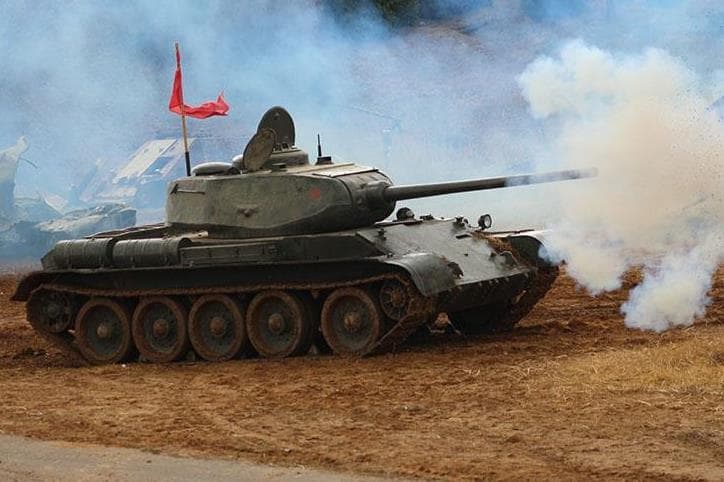
One of the most popular events held annually over the past few years by the Stalin Line Historical and Cultural Complex is the “Tank Biathlon” competitive show. The latest event took place on 16 April this year. As is customary, it consisted of two parts.
Part 1 – Reenactment
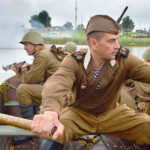
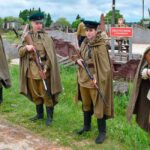
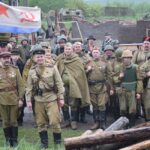
Military-historical reenactments are thrilling spectacles that attract large audiences to the museum complex. This time, the organisers included a performance devoted to the Red Army’s Rzhev–Vyazma Offensive Operation, one of the stages of the counter-offensive near Moscow. It took place from 8 January to 20 April 1942 and resulted in the liberation of the Moscow and Tula regions, as well as parts of the Kalinin and Smolensk regions.
The “battle” involved reenactors from various military-history clubs across the republic, as well as residents of the village of Loshany, supported by several “iron actors” fighting for the “Wehrmacht” (an Sd.Kfz. 222 armoured car, a BTR-40, a Pz-38 tank and a BMW R-71 motorcycle), and for the Red Army — a T-50 tank and a BA-11 armoured car. The performance was shorter than usual, comprising three five-minute scenes. However, the sound effects from gunfire and pyrotechnic explosions produced using gas-powered simulation equipment remained as intense as ever.


Part 2 – Tank Biathlon
As the formation began, preparations also got under way for the second part of the event — the tank biathlon itself. For the first time, the show was intended as entertainment rather than a sporting competition. This year’s leading participants were the T-50 and T-44 tanks and a crew comprising driver-mechanic Dmitry Vovk, loader Anton Zaitsev, gunner Vitaly Shabunya and tank commander Nikolai Mironchik. The first two are employees of the Stalin Line Historical and Cultural Complex, while their colleagues are members of the “Soldiers of Victory” Military-History Club established at the museum. The four-man crew completed two runs, first in one tracked fighting vehicle and then in the other.
“This year, we decided to change the format of our show. We wanted to make it more interesting by holding demonstration runs featuring two historic tanks — one light and one medium,” explained Alexander Metla, Executive Director of the Stalin Line Historical and Cultural Complex and chief organiser of the event.
“During military-historical reenactments, operational armoured vehicles are used below their full capabilities, including their maximum speeds, to comply with safety regulations and prevent emergencies. These runs, however, have no such restrictions, allowing us to demonstrate not only the maximum speeds of our historic vehicles but also the operation of all their systems,” Alexander Alexandrovich explained.
T-50 Tank

The T-50 is an exact replica of the Soviet light tank that served with the Red Army at the beginning of the Great Patriotic War. This example was built only this year and has already taken part in the event and military-historical reenactment marking “Defender of the Fatherland and Armed Forces of the Republic of Belarus Day”.
T-44 Tank

Unlike its younger “colleague”, whose operational career is only just beginning, the “forty-four” is one of the oldest examples of armoured fighting vehicles at the museum complex. It is a genuine tank transferred to the museum staff by the Ministry of Defence in 2009. Before then, it had stood on a plinth at a military base in the Vitebsk Region. After the garrison was disbanded, there were plans to scrap it, but Alexander Metla, Director of the “Memory of Afghanistan” Foundation, managed to bring the historic vehicle to the museum. The T-44 was in a dreadful condition, and it took the restoration team at the Stalin Line Historical and Cultural Complex nine months to restore it fully.
A total of 1,823 of these armoured vehicles were produced in the USSR. They did not see combat, but the model became the forerunner of all post-war Soviet medium tanks.
“Our museum has several historic models of Soviet medium tanks that take part in our military-historical reenactments. The T-44 is currently in the best technical condition, so it was chosen for this year’s demonstration,” noted the Executive Director of the Stalin Line Historical and Cultural Complex.
The Runs
The crew took first the T-44 and then the T-50 onto the course, where the tanks demonstrated their speed and negotiated various obstacles: smashing through a burning fence, climbing a hill and ascending a steep slope, crushing cars and more. Particularly thrilling moments included troops mounting the tanks, the assault on a house occupied by the “Germans”, and the destruction of an enemy BTR-40 carrying personnel and a motorcycle. All these actions took place with fire support from the tanks’ armament. Participants in the military-historical reenactment played the roles of the troops and their opponents.


 Russian
  English