
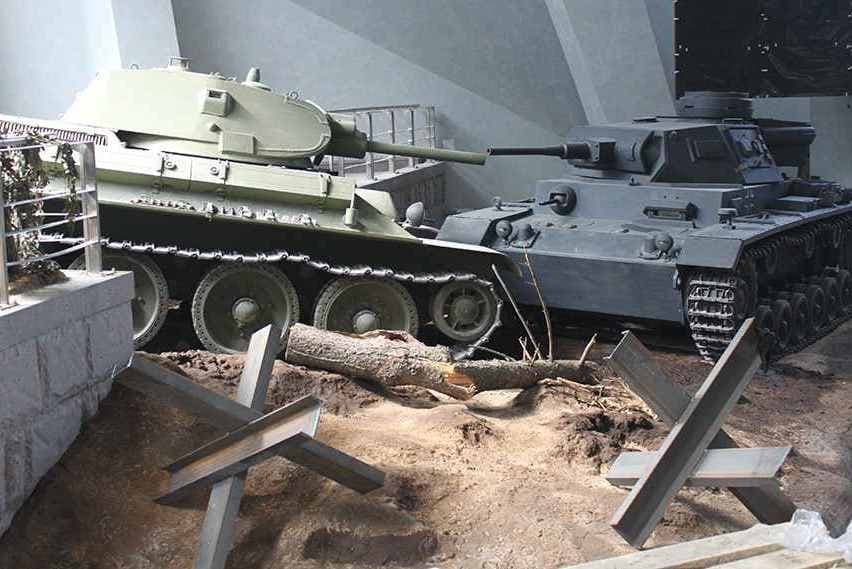
In July 2014, ahead of the 70th anniversary of the liberation of the Republic of Belarus from the German fascist invaders, a new exhibition opened in a purpose-built building of the Belarusian State Museum of the History of the Great Patriotic War in Minsk. Among its many displays, one in particular attracts the greatest interest: “Tank Ramming”.

“Tank Ramming” Exhibition
Background to the Display
While the new museum complex was still under construction, the museum’s management at the time came up with the idea of creating several new large-scale displays. One of these was to be “Tank Ramming”, depicting clashes between Soviet and German tanks in the summer of 1941 that ended with Soviet tanks ramming German armoured vehicles.
The museum staff approached Alexander Metla, chairman of the “Memory of Afghanistan” Charitable Foundation for Assistance to Internationalist Veterans, to put the project into practice.
“Before beginning work, we jointly considered several options. After much debate and discussion, we eventually chose the most suitable one,” said Alexander Metla.

Alexander Metla Senior
Creators of the Exhibition
The exhibition was created by restorers from the search and restoration team of the Stalin Line Historical and Cultural Complex: Alexander Mikalutsky, Vladimir Yakushev and his sons Alexei and Maxim. For many years, they have restored military vehicles and built replicas of various models. Most of these are now housed in a separate exhibition at the complex.

Stalin Line Restoration Team
How the Display Was Created
“The ‘Tank Ramming’ display depicts the opening phase of the Great Patriotic War, so its main protagonists are tanks that were in service with the Red Army and the Wehrmacht in 1941,” explained the chairman of the “Memory of Afghanistan” Charitable Foundation for Assistance to Internationalist Veterans.
Before work began, a preliminary model of the proposed display was produced, consisting of scale replicas of two tanks at 1:35 scale. The practical implementation of the project began only after the client had approved it.
The main “protagonists” were a Soviet T-34 tank and a German PzKpfw III.
History of the PzKpfw III
Although our country was at the centre of hostilities for several years, almost no unique examples of German tanks have survived in the Republic of Belarus. Only one PzKpfw III was found and installed at the famous Buinichi Field near Mogilev. The PzKpfw III formed the backbone of the German Army’s armoured forces at the beginning of the Great Patriotic War. In 2009, during one of their expeditions, the Stalin Line search team discovered another PzKpfw III — a hull with its original engine — in a bog and brought it back to the museum complex. It was established that the “German” had covered only 470 km before it was destroyed.

German PzKpfw III Tank
When the need arose, it was decided to use this particular find for the new exhibition. It had remained in one of the complex’s hangars for several years. The hull was used as the basis for the German tank, cleaned and restored to good condition. Using photographs, the team produced a new turret and gun incorporating all the characteristic features of the originals.

Hull of the Future PzKpfw III Tank
“The turret and gun proved so convincing that a non-specialist would be unable to distinguish them from the originals. Their characteristic, recognisable features were faithfully reproduced, something that not every craftsman can achieve,” said Boris Prokazov, an artist, photographer, author of books on military vehicles and member of staff at the Stalin Line Historical and Cultural Complex. Many others share his opinion.

Boris Prokazov
At the restorers’ request, track links were cast in Mozyr from original examples taken from a German Sturmgeschütz self-propelled gun, which had also been found in Belarus by the complex’s search team. Until these became available, tracks removed from a Soviet PTS-M amphibious transporter were used as a temporary measure while the “German” tank was being built.
“We made replica axes, shovels and crowbars for the PzKpfw III. The museum staff thought they were original too,” said Alexander Mikalutsky.
The armoured vehicle’s original paint had survived. Once the replica parts had been fitted, the entire vehicle was painted the same colour before being sent to the client. The small team completed all the work in around two months.
History of the T-34
The Soviet T-34 tank has its own story. The hull and tracks for the future vehicle were found at a military training ground. The tank had been used as a target, and the restorers counted more than 1,000 holes in it. It took Maxim Yakushev a month and a half simply to weld them all up. This was followed by cleaning, sandblasting and painting.

Soviet T-34 Tank
Most of the parts and assemblies on the “thirty-four” are original. They were recovered during search operations or obtained from various depots of the Ministry of Defence of the Republic of Belarus: original road wheels with holes in their rubber tyres, idler wheels, drive sprockets, tracks and other components. All the parts were restored to proper condition before being fitted to the replica.

Preparing to Assemble the T-34 Tank
There Were Some Problems Too
“We wanted to replace the axles fitted to the wheels, but the ones we had were thicker than the originals. We had to reduce them by 5 cm,” said Vladimir Yakushev. “Now the wheels turn freely.”
The turret and gun deserve particular mention. From the outset, it was decided to recreate an early version of the T-34 tank, “with a welded turret, the short L-11 gun and its distinctive mantlet, through which the barrel of the tank’s coaxial machine gun protrudes,” said Alexander Metla, Executive Director of the Stalin Line Historical and Cultural Complex.

The Future T-34 Tank
“We made the stowage boxes fitted to the tank in 1940–1941, along with their mountings and the standard tools. We had no drawings, and the internet was not yet available. We used a book of photographs as our reference,” explained Alexei Yakushev.

Alexander Metla Junior
P.S. Even the museum’s management did not expect the tanks to be built to such a high standard and with such historically accurate attention to detail, satisfying the acceptance committee.
Today, the “Tank Ramming” display is one of the most visited attractions at the Belarusian State Museum of the History of the Great Patriotic War, while the exhibits themselves are among those most frequently photographed and filmed by museum visitors.
Yuri VLODAVSKY
Photographs by the author and B. Prokazov
Based on material from https://adt.by/
 Russian
  English