

IS-3 Heavy Tank
The Joseph Stalin 3 heavy tank (abbreviated to IS-3) was the last Soviet tank to enter service during the Great Patriotic War, although it saw virtually no combat.
On 7 September 1945, a parade of Allied troops was held in Berlin to mark the end of the Second World War. It was there that the IS-3 was unveiled for the first time, causing a genuine sensation. The tank’s hull and turret were of a highly unusual shape for the time. The cast turret had a flattened spherical shape, with walls varying in thickness from 75 to 230 mm. An anti-aircraft machine gun was mounted on the turret roof and could be fired by either the loader or the commander.
A 122 mm tank gun and a coaxial DT machine gun (7.62 mm Degtyaryov tank machine gun) were mounted in a cast mantlet. The bow of the hull also had an unusual, ship-like shape, jokingly nicknamed the ‘pike nose’ by its designers.
Combat weight: 46 tonnes; crew: 4; maximum speed: 40 km/h.
T-10 Heavy Tank
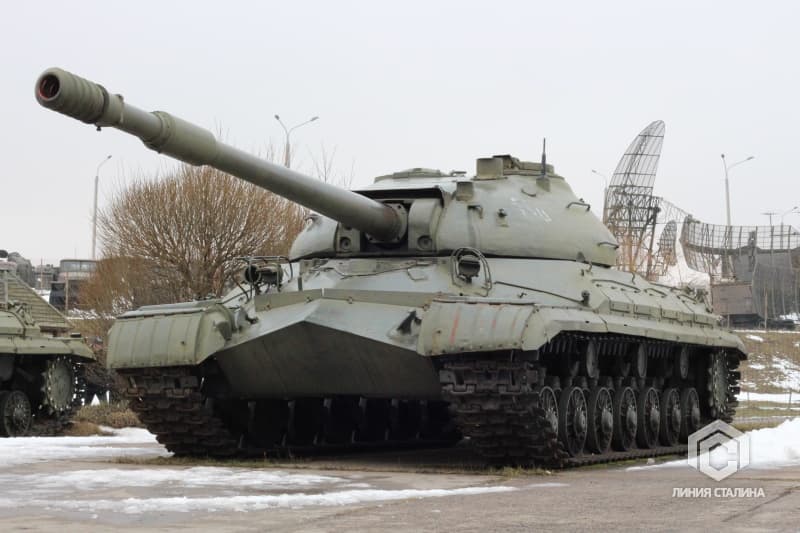
The T-10, the last Soviet heavy tank to be mass-produced, was the most advanced vehicle in its class and the most widely produced heavy tank in the history of tank design. It was developed by the design bureau of the Chelyabinsk Kirov Plant.
The tank’s prototypes were initially designated IS-8, IS-9 and IS-10, but following Stalin’s death, the vehicle entered production in late 1953 under the designation T-10. The tank’s hull was complex in shape, with a frontal configuration similar to that of the IS-3 (the ‘pike nose’). The turret was cast and streamlined. On the right was the loader’s hatch, above which an anti-aircraft machine-gun mount was fitted. On the left was a hatch with the commander’s cupola above it. The tank was armed with a 122 mm tank gun. Its secondary armament comprised a coaxial 12.7 mm machine gun. The effective range using the telescopic sight was 5,000 metres.
The T-10 was powered by a 700 hp diesel engine.
T-10 tanks served with the Soviet Army’s Guards heavy tank divisions and were not exported.

 Russian
  English