

The events commemorated near the village of Uzlyany unfolded the day after Minsk was liberated from the German fascist occupiers, amid the final victorious salvos of the Bagration Belarusian Strategic Offensive Operation.
In the summer of 1944, the German fascist invaders were retreating from Bobruisk along the only suitable unpaved road, flanked by marshes on both sides. If Soviet troops seized even one section of this escape route, the enemy would be placed in a difficult position. The task of cutting the road and denying the enemy a convenient route for withdrawing its troops was assigned to the artillery battery commanded by Guards Captain Anton Leontyuk. Instead of the standard complement of 100 men and four guns, it had only 49 soldiers, although they were experienced and battle-hardened veterans of the bloody fighting at Stalingrad and on the Kursk Salient. They knew not only how to fire their guns, but also how to cut down fascists in hand-to-hand combat. After the battles near Moscow and Vyazma, Leontyuk’s machine gunners were equally difficult to intimidate with the enemy’s numerical superiority and heavy fire.
The award citation recommending the conferment of the title Hero of the Soviet Union, signed by the commander of the artillery of the 1st Belorussian Front, Colonel-General of Artillery V. I. Kazakov, briefly recounts the feat of arms performed by battery commander Captain Leontyuk and his men. The citation includes the following passages: ‘On 3 July 1944, battery commander Guards Captain A. K. Leontyuk received orders to proceed as part of a landing force to the Rudensk area. Upon arriving in Rudensk at 14:00, the battery encountered resistance from a group of up to 200 Germans attempting to encircle it. Deploying immediately and leaving a three-man crew with each gun, Guards Captain Leontyuk and the remaining personnel attacked the enemy as infantry, supported by the guns. In the brief engagement, 50 enemy troops were killed and the remaining 150 were taken prisoner.
Continuing its mission, at 03:00 on 4 July 1944 the battery encountered the remnants of a German infantry regiment supported by artillery and mortars near the village of Uzlyany. Using concealed approaches, the German infantry advanced without firing a shot to within 100–150 metres of the battery before launching a surprise attack with heavy small-arms, mortar and artillery fire. The battery commander, Guards Captain Leontyuk, gave the order: “Repel the German counterattack!”, and 49 Guardsmen engaged 1,000 Germans. The battle lasted three hours. Captain Leontyuk personally killed 40 Germans. When the fascists drew even closer, Leontyuk led the Guardsmen in an attack. Shouting “Hurrah!” and “For the Motherland!”, he charged forward, rallying his men to follow. The battery commander was wounded during the battle but did not leave the battlefield.
The first German attack was repelled. The battery’s men killed more than 200 German soldiers and officers. Supported by mortars, the Germans launched six counterattacks. The gun crews fired both their artillery pieces and submachine guns. Three Guardsmen died a heroic death during the battle. “For our fallen comrades!” cried Guards Captain Leontyuk, and in repelling the attacks the Guardsmen killed up to 700 Germans and destroyed two mortars.’
This memorable battle was depicted in a painting by the Belarusian artist Vasily Bartashevich, featured as the main image for this article. The image of the painting was kindly provided by the administration of the Pukhovichi District Museum of Local History.
All 49 members of Leontyuk’s battery were awarded decorations for their courage and heroism. Five valiant artillerymen from the battery were awarded the title Hero of the Soviet Union: Guards Captain A. K. Leontyuk, Guards Sergeants D. L. Chepusov, Ye. G. Kurochkin and A. G. Chernyak, and Guards Junior Sergeant V. F. Tokarev.
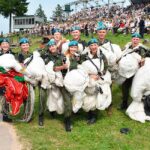
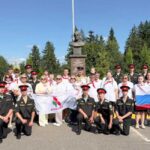
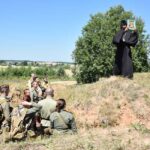
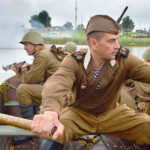
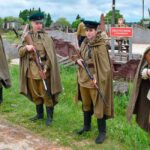
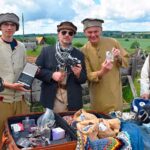
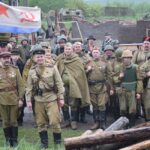
Every year on 3 July, Stalin Line hosts a historical reenactment commemorating the Battle of Uzlyany.

Anton Leontyuk, Dmitry Chepusov, Vasily Tokarev, Afanasy Chernyak, Yefrem Kurochkin.
 Russian
  English