
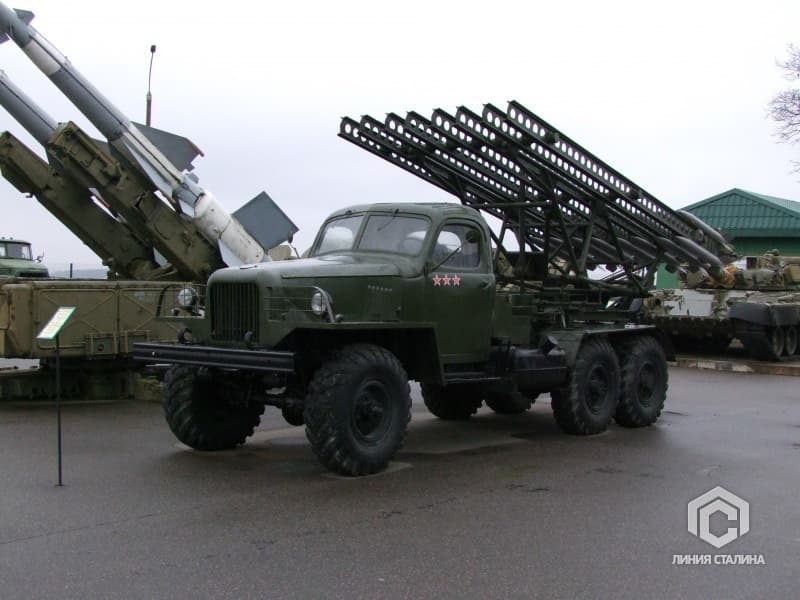
Rocket artillery is a type of field artillery that uses unguided rockets to engage targets. As these rockets have considerable dispersion, the required effectiveness is achieved by using multiple launchers to fire salvos at area and group targets. The exhibition at the Stalin Line Historical and Cultural Complex currently features three multiple launch rocket systems (MLRS): the BM-13 Katyusha, BM-14 and BM-21 Grad.
BM-13 Katyusha Rocket Artillery Combat Vehicle
BM stands for combat vehicle, while 13 denotes the calibre in centimetres. The BM-13 soon became known among Soviet soldiers as the Katyusha, after the heroine of a song that was popular at the time. On 21 June 1941, the launcher was demonstrated to the leaders of the Communist Party and the Soviet government. That same day, just hours before the outbreak of the Great Patriotic War, a decision was taken to begin urgent serial production of the M-13 rockets and their launcher.
The combat vehicle fired a salvo of 16 rockets in 7–10 seconds and took 5–8 minutes to reload. It could be brought from travelling to firing position in no more than 2–3 minutes. Soviet ZiS-5 and ZiS-6 vehicles, as well as Studebaker and Ford-Marmon vehicles supplied under Lend-Lease, were used as the base chassis.
A fire-control panel was fitted opposite the combat vehicle commander’s seat. A wiring harness connected the panel to a dedicated battery and each launch rail. One turn of the panel handle closed the electrical circuit, activated the pyrotechnic igniter, ignited the rocket propellant and launched the rocket.
The Katyusha received its baptism of fire with a battery commanded by Captain Ivan Andreyevich Flyorov. At 15:15 on 14 July 1941, the battery’s first salvo obliterated the Orsha railway junction, together with the German trains stationed there. The exceptional effectiveness of Captain Flyorov’s battery helped to accelerate the production of rocket weapons.
140 mm BM-14-16 Multiple Launch Rocket System
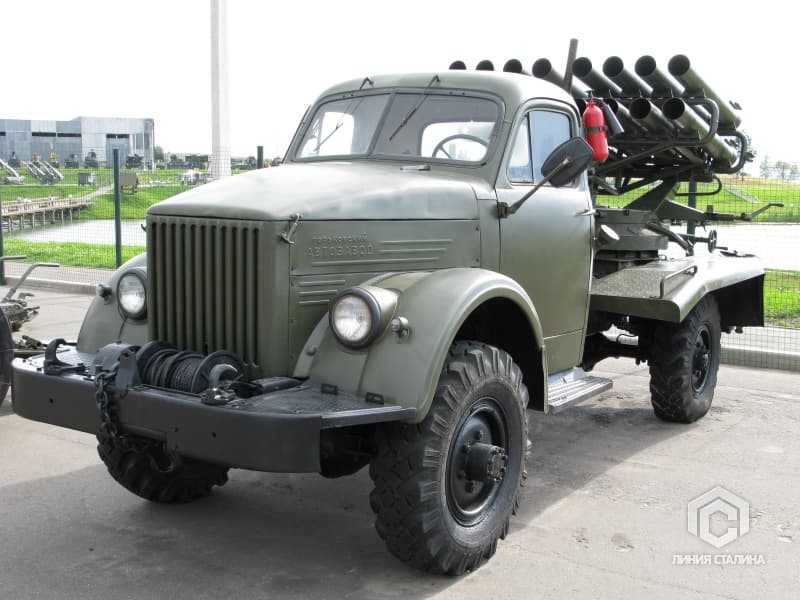
The BM-14-16 multiple launch rocket system entered service with the Soviet Army in 1952. BM stands for combat vehicle, 14 denotes the rocket calibre in centimetres, and 16 the number of launch tubes. The launcher was produced on ZiL-157, ZiL-131 and GAZ-63A cross-country vehicle chassis.
The launcher assembly comprises sixteen smooth-bore tubes arranged in two rows of eight. A salvo takes 7–10 seconds. Firing is controlled from the vehicle cab or by means of a remote-control unit. The launcher has a crew of seven. On the march, the vehicle commander and driver sit in the cab, while the other crew members occupy open seats fitted behind it. The system fires 140 mm unguided spin-stabilised rockets.
This system was produced by the Soviet defence industry for many years. In addition to the Soviet Army, it entered service with the Warsaw Pact countries, as well as Algeria, Angola, Egypt, North Korea and Vietnam. The BM-14-16 remains in service in many of these countries today.
122 mm BM-21 Grad Multiple Launch Rocket System (9K51)

The BM-21 Grad multiple launch rocket system entered service with the Soviet Army in 1963.
It is designed to engage exposed and sheltered personnel, unarmoured vehicles and armoured personnel carriers in concentration areas, artillery and mortar batteries, command posts and other targets.
The artillery unit comprises an assembly of 40 launch tubes. The laying mechanisms allow the launcher assembly to be elevated to +55 degrees. Its horizontal traverse is 172 degrees: 102 degrees to the left of the vehicle and 70 degrees to the right. A 122 mm unguided rocket was developed for the Grad system. Its maximum range is almost 21 kilometres. A full salvo takes 20 seconds. If necessary, a salvo could be fired not from the cab,
but from a remote-control unit. The system can fire within a wide temperature range, from −40 to +50 °C.
The launcher is mounted on the chassis of a Ural-375D cross-country lorry. On roads, it can reach a speed of 75 km/h. Its operational range is 750 km.
The BM-21 Grad is currently in service with the armed forces of more than 30 countries worldwide.



 Russian
  English