

It would appear that I need to explain the ‘distinctive features’ of the way in which I ‘honour the feat of the Soviet soldier’, as well as how these ‘distinctive features’ relate to my way of thinking.
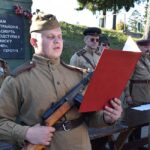
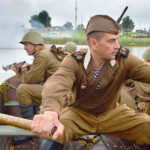
1. Every time I put on the uniform of a Soviet soldier, I feel immensely proud to have the opportunity to wear it.
It is the greatest mark of respect for those who wore this uniform and defended both their Motherland and mine.
For me, it is a special Honour—not ‘about buttons and piping’.
2. I have visited Khatyn twice in my life. I was about eight the first time and 41 the second.
In the 1980s, my grandmother went on a tour of Belarus and brought back a black-and-red booklet from Khatyn. To me, it was the most terrifying book I had ever read.
On both occasions when I visited Khatyn, I could not remain there for more than 20–30 minutes. To me, it is a TERRIBLE TRAGEDY.
Besides Khatyn, I have also visited Shunevka and Litovets. I have been to places marked on old maps as mass graves. Each time, I felt all the horror I could imagine as I contemplated what had happened there.
3. Alexander Alexandrovich and I once appeared on television, where we were asked: ‘What is important to you in reenactment?’
Alexander replied that the audience’s appreciation was very important, as were complete immersion in the subject and dramatic impact. He may have said something else worthwhile, but I cannot remember.
I said that, for me, the most important part of a reenactment was the ‘Minute’s Silence’.
That is when the purpose of the preparations, rehearsals and the entire reenactment becomes clear.
The culmination, the catharsis and the outcome of all my preceding actions is the ‘Minute’s Silence’.
It is the realisation that 80 years ago, on that very day, at that very hour and minute, my brothers were dying so that I would have the opportunity to observe this ‘Minute’s Silence’.
It is for the sake of this ‘minute’ that I live, prepare for reenactments and devote my personal time.
4. Andrei Vitoldovich gave an absolutely precise moral definition of Victory Day in a conversation we had only today:
‘Victory Day is like a memorial gathering—indeed, it is not merely “like” one; that is exactly what it is: a memorial gathering.’
Unfortunately, following the collapse of the USSR and the passing of the veterans of the Great Patriotic War, the moral meaning of Victory Day has been distorted.
To return to the principal song of Victory Day: it is a celebration with tears in our eyes…
5. What, in my understanding, is the Victory Day parade? It is a direct link to the Red Army Parade on Moscow’s Red Square on 24 June 1945. Nothing more and nothing less.
It is the Parade of the Victors, a tribute to all who died and a Parade in Honour of all those still living.
The formations of modern troops marching past are directly associated with those who took part in the 1945 parade.
Their march-past should make spectators understand that these soldiers and officers are ready to carry out their duty at any moment, and that the tragedy of 1941–1945 could befall both those marching in the parade and those watching it.
This is necessary to appreciate the fragility of peacetime: peacetime is a glass sphere held aloft by thousands of hands, and if people play with that sphere and toss it into the air, those thousands of hands may fail to catch it. The consequences are well known…
6. The cynicism of our times is terrifying.
I shall give a few examples. At one event, a heavily intoxicated man initiated a provocative conversation. In essence, he spoke of his grandfather, a collaborationist policeman who had fought the ‘Commie Bolsheviks’. For this, his grandfather received a prison sentence, served his time and remained dissatisfied with the Soviet authorities for the rest of his life. The drunken man then called the other participants’ grandfathers, who had fought at the front, ‘waste’. The grandsons and great-grandsons of those front-line veterans immediately punched him in the eye.
Yet two years later, those same grandsons and great-grandsons of front-line veterans took a direct part in the unrest of 2020, rallying beneath the white-red-white banners under which traitors had helped the fascists establish their ‘new order’ during the war! In other words, those grandsons and great-grandsons ended up on the same side as the man they had previously punched in the eye.
What sort of astonishing metamorphosis is this?
How can these two things coexist in someone’s mind: reverent respect for the memory of their grandfathers who fought at the front, followed by acceptance of the collaborationist policeman’s position—dissatisfaction with Soviet rule and its legacy?
I simply cannot understand it.
Here is another example. I have an acquaintance in Kharkov, a former Soviet citizen with a Russian surname from Ryazan and no Ukrainian roots. In 2014, he suddenly became a ‘Banderite’, supported the Maidan and ‘cursed the damned Muscovites and threatened them with the gallows’.
In 2022, after the start of the Special Military Operation, he posted on social media: ‘My city stands firm like Stalingrad…’
I had to write back to him: ‘What do you mean, Stalingrad, you scum? On your shirt, you wear the trident of those who fought against us alongside the fascists! You belong in a hideout in the forest outside Lviv. And keep your hands off the great Soviet history, since you have renounced it.’
Once again, I was astonished to discover that it is apparently possible to combine a sound Soviet upbringing and… Banderite slogans in one’s mind with cynical virtuosity!
7. Later, I decided to work out for myself why this happens.
The matter came down to something very simple: these people have low cognitive complexity—their assessment of what is happening is limited to whether they ‘like it or dislike it’.
This should not be taken literally; it is a particular type of personality development.
I shall give a simple example:
Suppose you are talking to someone about wild mushrooms. To you, wild mushrooms mean getting up early, hot coffee, travelling to the forest, morning dew on your shoes, nature awakening, the first mushroom, the first porcini, a basket full of mushrooms, pleasant tiredness, returning home, a huge bowl of mushrooms, cleaning and cooking them, enjoying both the flavour and the result, and wanting to repeat the whole process the following day.
To the person you are talking to, however, wild mushrooms are simply about whether they ‘like or dislike’ their flavour, wanting to eat them and what they need to do in order to eat them.
In reality, there is only one point on which you agree: you both like eating them. Yet it seems to you that the other person shares your enthusiasm and feelings, when in fact they simply like eating them.
Therefore, as you encounter a great many people throughout your life, you may never suspect that they have low cognitive complexity, but it will inevitably become apparent during prolonged interaction.
So there is no reason to be surprised by metamorphoses such as those described in point 6.
To these people, everything is logical and supporting evidence can always be found. This will continue until someone points out the contradictions in their model and the presence of mutually exclusive propositions.
The only question is: why raise other people’s children, especially when they are adults?
8. What is the purpose of this entire text?
For some, historical memory means running around in uniform, showing off their new bits of kit, meeting friends and drinking to their grandfathers’ Victory, thereby paying tribute and showing respect to the fallen.
For others, historical memory is the complex process of sharing in the tragedy and the shattered lives of millions of people; rejecting distortions of history and arbitrary interpretations of it; rejecting flippant jokes; and being determined to defend the truth and the right to do so.
There is only one similarity: everyone honours the memory of their grandfathers. But, as it turns out, each does so differently.
 Russian
  English
  Chinese