Victory Day

On 9 and 10 May 2026, the Stalin Line Historical and Cultural Complex, with the support of the Ministry of Defence of the Republic of Belarus, will hold commemorative events marking Victory Day in the Great Patriotic War. The Stalin Line Historical and Cultural Complex has become a traditional venue for tens of thousands of residents and visitors to the Republic of Belarus to celebrate Victory Day.

On 9 May 1945, the Soviet people achieved victory in the Great Patriotic War, which had lasted 1,418 days and nights.
For the people of our country, this is not only a day of celebration, but also a day of remembrance, profound respect and gratitude to Soviet servicemen, workers on the home front, partisans and members of the underground resistance — all those who helped bring the Great Victory closer. Belarus was the first of the Soviet republics to bear the brunt of the German fascist invasion, becoming the scene of fierce fighting. During the war, the enemy destroyed 209 cities and urban settlements and more than 9,000 villages in Belarus; one in three of the republic’s inhabitants lost their lives. The memory of the terrible war and the Great Victory is forever inscribed in the history of our country and every Belarusian family, and remains a source of grief and pain, glory and pride for the Belarusian people.

On 2 July, bus service No. 948E, ‘Minsk — Stalin Line’, will operate for event visitors from 08:45 to 17:30.
The one-way bus fare ranges from 1 to 4.91 Belarusian roubles, depending on the boarding and alighting stops. Children under the age of seven travel free. Buses will run continuously along the route: Kuntsevshchina Bus Terminal – Kamennaya Gorka Metro Station – Zhdanovichi Station – School No. 1 – Stalin Line Historical and Cultural Complex.

As large numbers of visitors are expected, we recommend arriving early — three to four hours before the reenactment begins — and buying tickets in advance on the website. This will help you avoid queues at the ticket offices. Parking spaces are limited. Based on previous years, there may be no spaces left after 11:00, or possibly even earlier.

Among all tickets purchased through the website, 30 certificates for tank rides will be given away. All tickets purchased by 20:00 on 8 May will be entered into the prize draw. Once the draw has taken place, the winning ticket numbers will be published on the complex’s Instagram account, and each winner will receive a certificate by e-mail at the address provided when purchasing the ticket. The ticket is valid for a visit to the complex on either 9 or 10 May
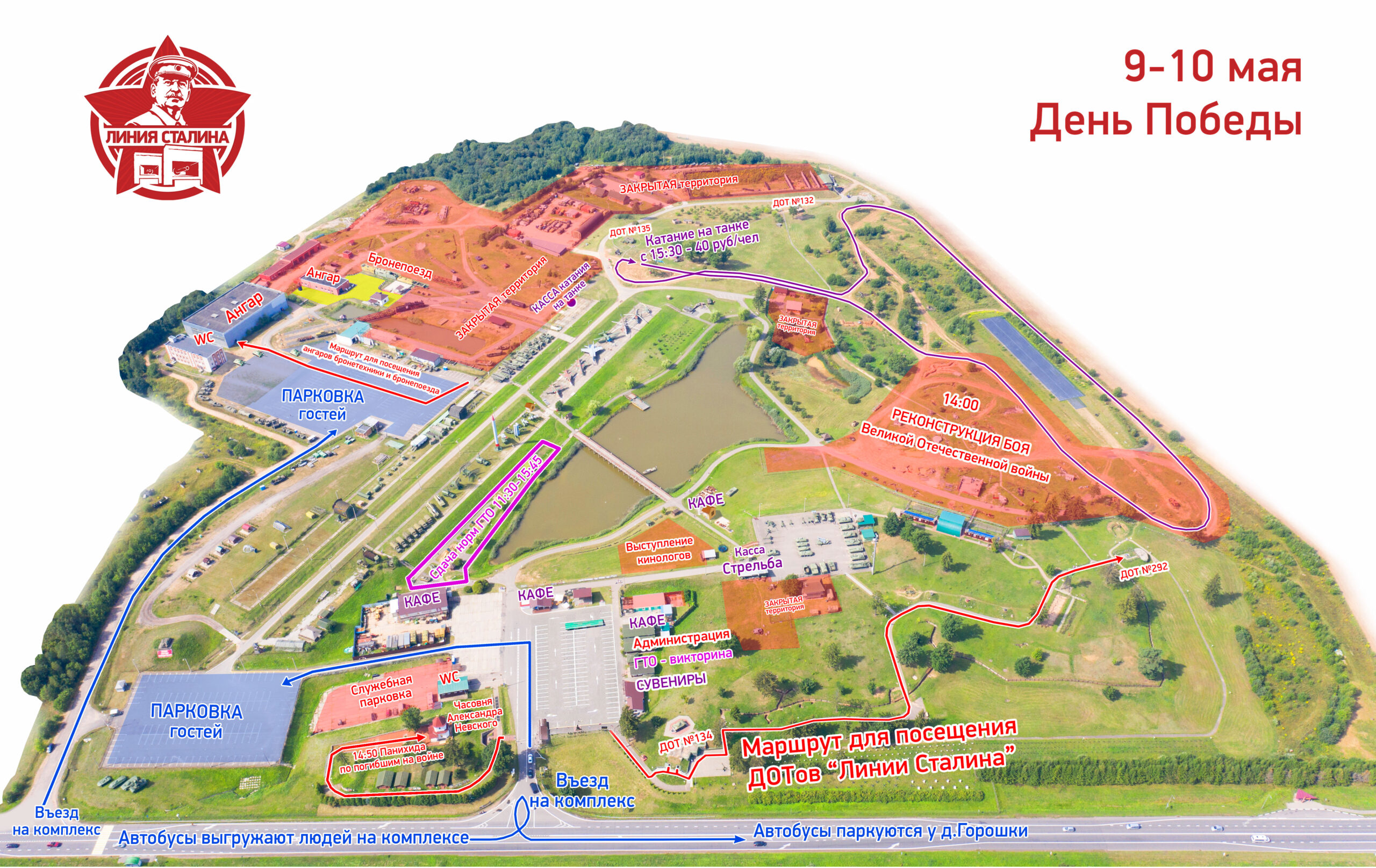
Event Details
  • Start Date
    May 9, 2026
  • End Date
    May 10, 2026

Opening of guided-tour and interactive areas to visitors:

  • “Stalin Line” Guided Tour Route
  • “Our Armoured Train” Exhibition
  • Operational Military Vehicle Display
  • Photo Area
  • Shooting from a tank and gun**
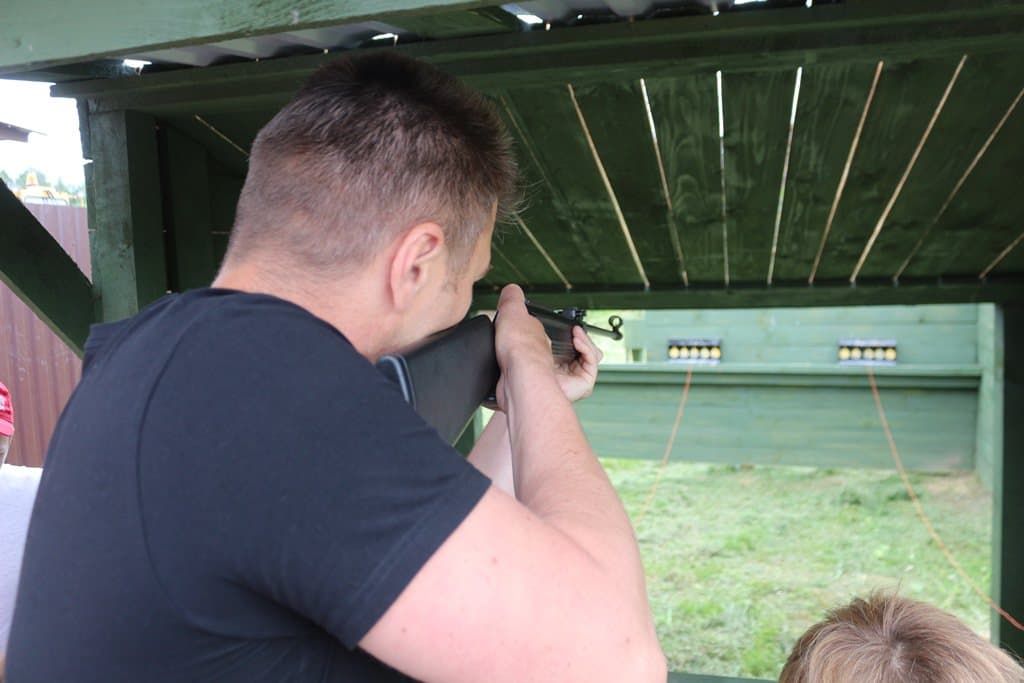
  • Blank-Firing Weapons Shooting**

Ready for Labour and Defence (GTO) These are interactive entertainment areas.

Everyone taking part in the Stalin Line GTO Challenge Area can enter the prize draw.

To enter the prize draw, you must:

  • Complete all GTO areas and receive a score for each one
  • Arrive at the specified time for the announcement of the prize-draw results
  • Certificates and prizes will be awarded exclusively to participants who attend the prize-giving ceremony.

Main GTO areas:

  • Airgun Shooting

  • Weapon Assembly and Disassembly

  • Scout Trail

  • Historical Quiz

  • Grenade Throwing

  • Artillery School

The Combined Concert Group was formed in September 2013 as part of the joint Russian-Belarusian Zapad 2013 exercises. The most talented service personnel from various Air Force and Air Defence Forces units were selected to take part in the programme. During the exercises, the Combined Concert Group gave 16 concerts, travelling 1,200 km and visiting 16 military units.

In 2014, the Combined Concert Group began an active programme of creative work, welcoming new performers, exploring new horizons and reaching new heights. Variety was brought to the concert programme by the Beskonechnost Vocal and Instrumental Ensemble, composed entirely of conscripts from the 8th Radio-Technical Brigade. The ensemble remains part of the Concert Group to this day. 

Its continuous artistic development and growing professionalism have led to participation in various international competitions and festivals.  

In 2016, soloists from the Concert Group became prize-winners and laureates at the nationwide “Shield of Russia” festival in Nizhny Novgorod. In 2017, the group added an honourable second place and the special prize for “Best Performance of a Patriotic Song” to its collection of awards at the 12th nationwide “Katyusha” festival of folk art for members of the Armed Forces of the Russian Federation and other security services, war and military service veterans, and their families, held in Moscow. Members of the Concert Group have also repeatedly received awards at various editions of the televised “Zvezda” festival of army songs.

Throughout the history of the canine service, it has recruited dedicated professionals with an excellent knowledge of operational duties and the ability to establish a rapport with man’s four-legged friends.

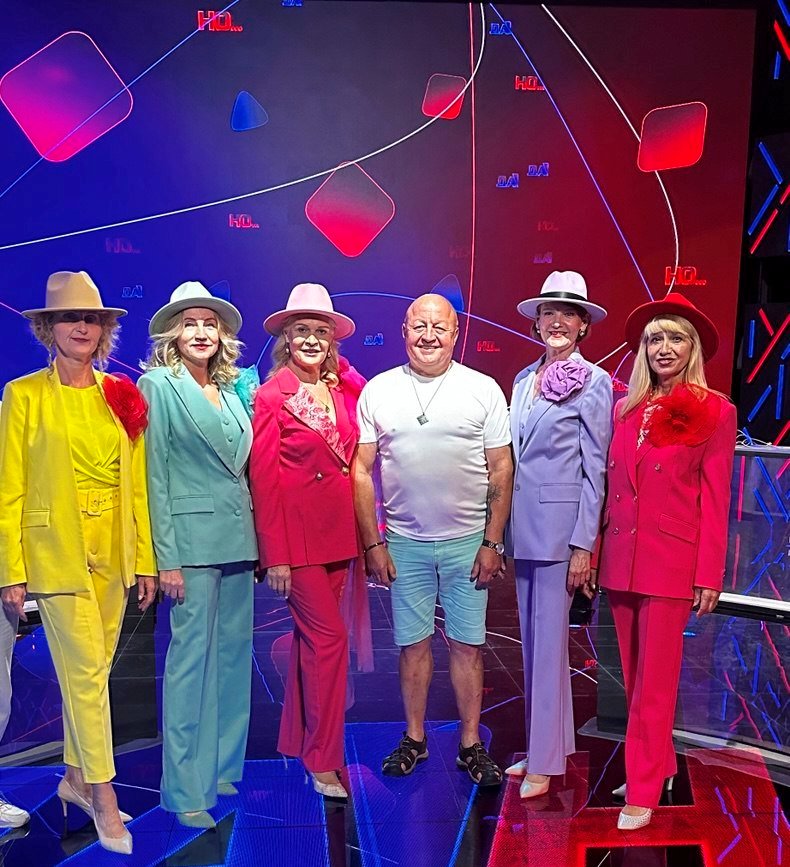
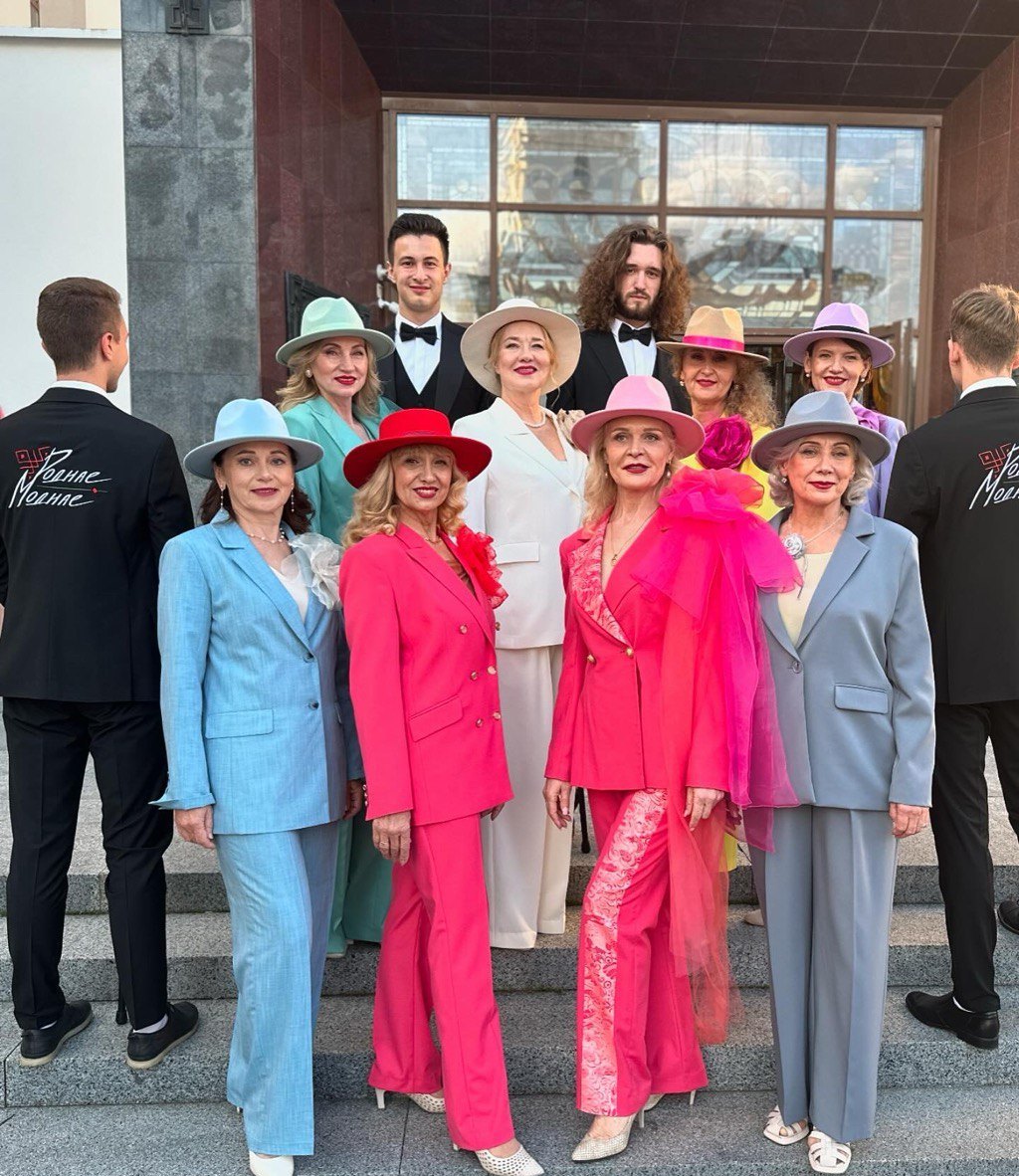
We present a fashion show featuring clothing from the pre-war years, with models from Real Age Studio and the “Real Age” Fashion Theatre.
The show will feature performances set to music from the war years and themed compositions: “In the Dugout”, “Song of the Front-Line Driver”, “Ah, Those Clouds in the Blue”, “Ode to a Woman”, “Echo of Love”, “Cranes”, “Poppies” and “The Road to Berlin”.
The Real Age fashion theatre is a social and charitable project. It aims to give every participant an opportunity to discover and love herself, gain confidence and find a source of vitality and success. Modelling provides positive motivation, social interaction, activity and vivid emotions, while fostering charisma and the art of transformation.
Real Age Studio’s models include both women and men. The average age of the female participants is 60; the youngest is 52 and the oldest is 72.
Real Age Studio’s models take part in film and photo shoots, advertising campaigns and music videos. They also model collections by well-known Belarusian brands: the Belarusian Fashion Centre (BfC), BelCredo, Elema, Kalinka, Kupalinka, Polesie, Alesya and Belarusachka.
The modelling team takes an active part in Belarusian festivals and competitions, including the Slavianski Bazaar in Vitebsk; the “Vytoki. A Step towards Olympus” cultural and sporting festival; “Flax Festival. Home-Grown Is Fashionable”; the national Kupala Night celebration, “Alexandria Gathers Friends”; the international “Textile Bouquet” festival; the national “Two Rivers” Festival of Friendship and Art in Dokshitsy; and the Dozhinki harvest festival and fair.
Real Age Studio models also take part in international events, including Neva Fashion Week, PROFESSIONAL FASHION FESTIVAL — F 2022 in St Petersburg, and Milan Fashion Week in Italy.
The Real Age modelling team.
brings together active and creative people who seek to discover new aspects of themselves, transform themselves and the world, and bring positivity, emotion, love and beauty to it.

The Service Dog Handler Training School was established on 24 January 1995 at the Smorgon Border Guard Training Detachment in the settlement of Devyatni, Smorgon District, Grodno Region. 

In October 1995, the Service Dog Handler Training School was relocated to the Smorgon Border Guard Detachment in the settlement of Gauti, Smorgon District, Grodno Region. 

In November 2002, the Service Dog Handler Training School was reorganised as the Canine Centre. 

The Canine Centre is now a training unit of the border guard service. It trains, retrains and provides advanced training for canine specialists, as well as training service dogs for a variety of duties, including tracking people by scent, sentry duties, specialised searches for narcotic drugs and psychotropic substances, weapons, ammunition and explosives, and guarding facilities. It also breeds and raises working dog breeds. 

Today, the Canine Centre of the border guard service is recognised as one of the best not only in the CIS, but also in Eastern Europe. 

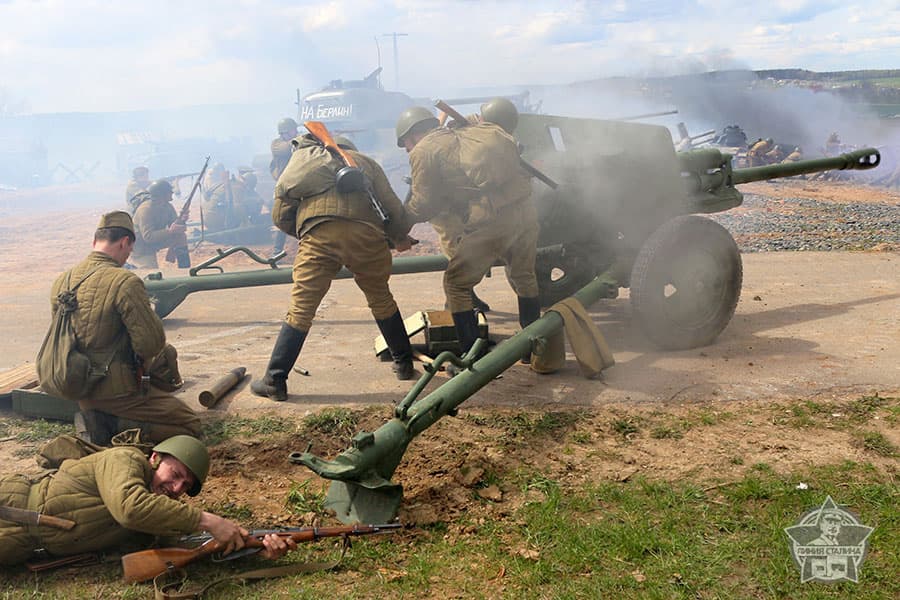
The reenactment of the Berlin Offensive Operation will depict the nature of the fighting, as well as the armoured vehicles, weapons and uniforms of the Red Army and our enemies from the Hitler coalition.

The battle between the Red Army and the enemy on the approaches to Berlin will be recreated in several stages: encircling the enemy and establishing control over the liberated territory, an attempt by the Wehrmacht to break through towards Berlin, and the final defeat of the German forces by our troops.

The reenactment will conclude with a ceremonial parade of all participants.

In 1945, the Red Army successfully completed the Vistula–Oder Offensive, liberating Poland from the fascist invaders. Having crossed the whole of Poland in 20 days, our troops halted just 60 km from Berlin on 3 February 1945 and began preparations for the Berlin Strategic Offensive Operation.

The Nazi leadership began withdrawing some troops from the Western Front and redeploying them to defend Berlin. This enabled the Allied forces to eliminate the German grouping in the Ruhr and launch their offensive. By 15 April, their forward units had reached the Elbe and were 80 km from the capital of the Reich.

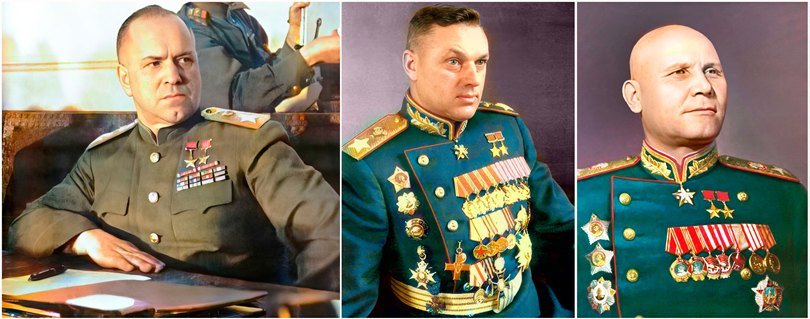
On 16 April 1945, the Red Army launched the Berlin Strategic Offensive Operation. It was conducted by three fronts under the command of Georgy Zhukov, Konstantin Rokossovsky and Ivan Konev.

Georgy Zhukov, Konstantin Rokossovsky and Ivan Konev — commanders of the Berlin Offensive

A total of 2,000,000 personnel, 6,250 tanks, 41,600 guns and 7,500 aircraft.

Events of the Berlin Strategic Offensive

The German force comprised around 1,000,000 fascists, 1,500 tanks, 10,400 guns and 3,300 combat aircraft. Berlin itself had been transformed into a formidable fortified region and prepared for street fighting. Three defensive rings had been established around Berlin, while more than 400 permanent reinforced-concrete firing positions had been constructed within the city. Three defensive lines had been established on the approaches to Berlin. The defences on the Seelow Heights, which guarded the direct route to the capital of the Reich, were particularly strong.

Here, the 1st Belorussian Front under Zhukov's command launched its offensive. Some of its troops broke through the enemy defences in the centre, while others began to encircle Berlin from the north.

The 2nd Belorussian Front under Rokossovsky, covering Zhukov’s forces from the north, set about destroying the German Army Group Vistula.

The 1st Ukrainian Front under Konev, covering Zhukov’s forces, swept around Berlin from the south, pushing the German Army Group Centre into Czechoslovakia.

In just nine days, from 16 to 25 April, our forces broke through the German defences, destroyed the German 9th Field Army and 5th Panzer Army, preventing them from retreating to Berlin, encircled the city and reached the Elbe, where they met the Allies.

As a result of the destruction of the German armies outside Berlin, only 120,000 fascists, with 3,000 guns and 60 tanks, remained in the city.

On our side, 464,000 troops, 12,700 guns, 1,500 tanks and 2,100 Katyusha rocket launchers took part in the assault on Berlin.

The capital of Nazi Germany was captured in nine days, from 24 April to 2 May.

Throughout the Berlin Offensive, the Red Army lost 81,116 men killed, while the Fascists lost 396,845. Such precise figures for enemy fatalities can be explained by the fact that their bodies were buried by special teams under the supervision of special NKVD units. Zhukov’s troops killed the largest number of Fascists — 232,726; Konev’s troops killed 114,349, and Rokossovsky’s troops 49,770.

During the Berlin Offensive, the defending Germans lost five (!) times as many men killed as the advancing Red Army. Why? Because, as at Königsberg, where 33,778 Fascists were killed for every 9,230 fallen Soviet heroes, our troops were by then fighting not through strength of numbers, but through skill.

Awaiting the Soviet offensive, the enemy remained entrenched in defensive positions. First, their positions, depots and command posts were subjected to a devastating attack by Soviet aircraft and ‘Stalin’s sledgehammers’ — super-heavy artillery. Special assault groups equipped with flamethrowers and large quantities of explosives then advanced to storm the enemy positions. Their advance was supported by self-propelled guns and tanks, as well as specialist teams of riflemen or snipers who eliminated enemy firing positions. On 24 April, our troops broke into Berlin; by 30 April, the battle for the Reichstag had begun, and Hitler took his own life.

On 2 May 1945, following the surrender of the Berlin garrison, our soldiers Mikhail Yegorov and Meliton Kantaria ceremonially climbed onto the dome of the Reichstag in the presence of press photographers and raised the Soviet Victory Banner.

During the Berlin Offensive, 559 Red Army soldiers and commanders were awarded the title Hero of the Soviet Union. Yet the most heroic deeds, almost inconceivable to the European mind, were performed by two Soviet soldiers: the Belarusian Trifon Lukyanovich and the Russian Nikolai Masalov.

The Germans killed Trifon Andreyevich Lukyanovich’s wife and two daughters in Minsk. Despite this, the Soviet hero saved a German girl.

On 29 April 1945, during the fighting in Elsenstrasse, Trifon saw a little girl crying beside the body of a German woman. The street was under continuous fire from SS troops, but Trifon decided to rescue the girl from the gunfire. The Soviet hero crawled over to her and dragged her out of the line of fire. As he handed the girl over in a safe place, an enemy bullet struck Lukyanovich in the neck and severed his aorta. The Soviet hero died five days later. He was 26 years old.

Unaware of Lukyanovich’s deed, 23-year-old Senior Sergeant Nikolai Ivanovich Masalov performed a similar feat on 30 April near Berlin’s Tiergarten.

Nikolai Masalov survived. Both deeds are commemorated by the Soviet War Memorial featuring the Liberator Soldier in Treptower Park, Berlin. It depicts a Soviet soldier standing on the shattered remains of a swastika. The liberator holds a lowered sword in one hand and supports the German girl he rescued with the other.

A commemorative plaque has been installed in Berlin at the site where Nikolai Masalov performed his heroic deed. Trifon Lukyanovich’s feat is commemorated in a bas-relief in Minsk.

Eternal memory to the Soviet heroes!

The price is 40 BYN per person for both children and adults. Children aged 4 to 7 accompanied by an adult ride free of charge. Children under the age of 4 are not permitted.

Payment is accepted at the boarding point. Card payments are available.

* The organisers reserve the right to amend the programme due to weather, technical or other circumstances.
** Additional charges apply

Opening of guided-tour and interactive areas to visitors:

  • “Stalin Line” Guided Tour Route
  • “Our Armoured Train” Exhibition
  • Operational Military Vehicle Display
  • Photo Area
  • Firing from a tank, field gun and anti-aircraft gun **
  • Firing deactivated weapons adapted for blank ammunition **

Ready for Labour and Defence (GTO) These are interactive entertainment areas.

Everyone taking part in the Stalin Line GTO Challenge Area can enter the prize draw.

To enter the prize draw, you must:

  • Complete all GTO areas and receive a score for each one
  • Arrive at the specified time for the announcement of the prize-draw results
  • Certificates and prizes will be awarded exclusively to participants who attend the prize-giving ceremony.

Main GTO areas:

  • Airgun Shooting

  • Weapon Assembly and Disassembly

  • Scout Trail

  • Historical Quiz

  • Grenade Throwing

  • Artillery School

In accordance with the reform plan for the Armed Forces of the Republic of Belarus, and to improve the security of military facilities belonging to Armed Forces units and institutions, the 1st Military School for Junior Specialists (Service Dog Training) was established in 1993. Now the Armed Forces Canine Centre, it is based in Krupki, Minsk Region. Its official date of establishment is 16 November 1993, when the first school order was issued.

In 1995, recognising the importance and potential for the development of military working dog training, a decision was made to relocate the Armed Forces Canine Centre to the settlement of Kolodishchi, Minsk District.

Since the centre was established, it has trained more than three thousand service dogs and over three thousand military working dog specialists.

Today, the Armed Forces Canine Centre is a military training unit responsible for training military working dog specialists and service dogs for a variety of roles, including mine detection, search and rescue, tracking, the detection of weapons, narcotics and explosives, guard duties, patrol work and others.

The centre devotes considerable attention to breeding and dog shows. More than 500 dogs and puppies have taken part in national and international shows.

The centre’s dogs hold titles including International Champion, Candidate for International Champion, Champion of Belarus, Candidate for Champion of Belarus, class winner and FCI group winner.

The Canine Centre plays an active role in the military-patriotic education of schoolchildren and in enhancing the prestige of military service. To this end, the centre’s personnel give demonstrations, conduct informative guided tours and take part in other civic and patriotic events.

Since the centre was established, there has not been a single breach of any facility guarded by service dogs trained there.

The reenactment of the Berlin Offensive Operation will depict the nature of the fighting, as well as the armoured vehicles, weapons and uniforms of the Red Army and our enemies from the Hitler coalition.

The battle between the Red Army and the enemy on the approaches to Berlin will be recreated in several stages: encircling the enemy and establishing control over the liberated territory, an attempt by the Wehrmacht to break through towards Berlin, and the final defeat of the German forces by our troops.

The reenactment will conclude with a ceremonial parade of all participants.

In 1945, the Red Army successfully completed the Vistula–Oder Offensive, liberating Poland from the fascist invaders. Having crossed the whole of Poland in 20 days, our troops halted just 60 km from Berlin on 3 February 1945 and began preparations for the Berlin Strategic Offensive Operation.

The Nazi leadership began withdrawing some troops from the Western Front and redeploying them to defend Berlin. This enabled the Allied forces to eliminate the German grouping in the Ruhr and launch their offensive. By 15 April, their forward units had reached the Elbe and were 80 km from the capital of the Reich.

On 16 April 1945, the Red Army launched the Berlin Strategic Offensive Operation. It was conducted by three fronts under the command of Georgy Zhukov, Konstantin Rokossovsky and Ivan Konev.

Georgy Zhukov, Konstantin Rokossovsky and Ivan Konev — commanders of the Berlin Offensive

A total of 2,000,000 personnel, 6,250 tanks, 41,600 guns and 7,500 aircraft.

Events of the Berlin Strategic Offensive

The German force comprised around 1,000,000 fascists, 1,500 tanks, 10,400 guns and 3,300 combat aircraft. Berlin itself had been transformed into a formidable fortified region and prepared for street fighting. Three defensive rings had been established around Berlin, while more than 400 permanent reinforced-concrete firing positions had been constructed within the city. Three defensive lines had been established on the approaches to Berlin. The defences on the Seelow Heights, which guarded the direct route to the capital of the Reich, were particularly strong.

Here, the 1st Belorussian Front under Zhukov's command launched its offensive. Some of its troops broke through the enemy defences in the centre, while others began to encircle Berlin from the north.

The 2nd Belorussian Front under Rokossovsky, covering Zhukov’s forces from the north, set about destroying the German Army Group Vistula.

The 1st Ukrainian Front under Konev, covering Zhukov’s forces, swept around Berlin from the south, pushing the German Army Group Centre into Czechoslovakia.

In just nine days, from 16 to 25 April, our forces broke through the German defences, destroyed the German 9th Field Army and 5th Panzer Army, preventing them from retreating to Berlin, encircled the city and reached the Elbe, where they met the Allies.

As a result of the destruction of the German armies outside Berlin, only 120,000 fascists, with 3,000 guns and 60 tanks, remained in the city.

On our side, 464,000 troops, 12,700 guns, 1,500 tanks and 2,100 Katyusha rocket launchers took part in the assault on Berlin.

The capital of Nazi Germany was captured in nine days, from 24 April to 2 May.

Throughout the Berlin Offensive, the Red Army lost 81,116 men killed, while the Fascists lost 396,845. Such precise figures for enemy fatalities can be explained by the fact that their bodies were buried by special teams under the supervision of special NKVD units. Zhukov’s troops killed the largest number of Fascists — 232,726; Konev’s troops killed 114,349, and Rokossovsky’s troops 49,770.

During the Berlin Offensive, the defending Germans lost five (!) times as many men killed as the advancing Red Army. Why? Because, as at Königsberg, where 33,778 Fascists were killed for every 9,230 fallen Soviet heroes, our troops were by then fighting not through strength of numbers, but through skill.

Awaiting the Soviet offensive, the enemy remained entrenched in defensive positions. First, their positions, depots and command posts were subjected to a devastating attack by Soviet aircraft and ‘Stalin’s sledgehammers’ — super-heavy artillery. Special assault groups equipped with flamethrowers and large quantities of explosives then advanced to storm the enemy positions. Their advance was supported by self-propelled guns and tanks, as well as specialist teams of riflemen or snipers who eliminated enemy firing positions. On 24 April, our troops broke into Berlin; by 30 April, the battle for the Reichstag had begun, and Hitler took his own life.

On 2 May 1945, following the surrender of the Berlin garrison, our soldiers Mikhail Yegorov and Meliton Kantaria ceremonially climbed onto the dome of the Reichstag in the presence of press photographers and raised the Soviet Victory Banner.

During the Berlin Offensive, 559 Red Army soldiers and commanders were awarded the title Hero of the Soviet Union. Yet the most heroic deeds, almost inconceivable to the European mind, were performed by two Soviet soldiers: the Belarusian Trifon Lukyanovich and the Russian Nikolai Masalov.

The Germans killed Trifon Andreyevich Lukyanovich’s wife and two daughters in Minsk. Despite this, the Soviet hero saved a German girl.

On 29 April 1945, during the fighting in Elsenstrasse, Trifon saw a little girl crying beside the body of a German woman. The street was under continuous fire from SS troops, but Trifon decided to rescue the girl from the gunfire. The Soviet hero crawled over to her and dragged her out of the line of fire. As he handed the girl over in a safe place, an enemy bullet struck Lukyanovich in the neck and severed his aorta. The Soviet hero died five days later. He was 26 years old.

Unaware of Lukyanovich’s deed, 23-year-old Senior Sergeant Nikolai Ivanovich Masalov performed a similar feat on 30 April near Berlin’s Tiergarten.

Nikolai Masalov survived. Both deeds are commemorated by the Soviet War Memorial featuring the Liberator Soldier in Treptower Park, Berlin. It depicts a Soviet soldier standing on the shattered remains of a swastika. The liberator holds a lowered sword in one hand and supports the German girl he rescued with the other.

A commemorative plaque has been installed in Berlin at the site where Nikolai Masalov performed his heroic deed. Trifon Lukyanovich’s feat is commemorated in a bas-relief in Minsk.

Eternal memory to the Soviet heroes!

The price is 40 BYN per person for both children and adults. Children aged 4 to 7 accompanied by an adult ride free of charge. Children under the age of 4 are not permitted.

Payment is accepted at the boarding point. Card payments are available.

* The organisers reserve the right to amend the programme due to weather, technical or other circumstances.
** Additional charges apply

On 9 and 10 May, bus route No. 948E, Minsk – Stalin Line, will operate from 09:00 to 19:00 for visitors attending the event.

A single bus fare ranges from 1 to 4.91 BYN, depending on the boarding and alighting stops.
Children under 7 travel free of charge. Buses will run continuously along the following route:
Kuntsevshchina Bus Station – Kamennaya Gorka Metro Station – Zhdanovichi Station – School No. 1 – Stalin Line Historical and Cultural Complex.

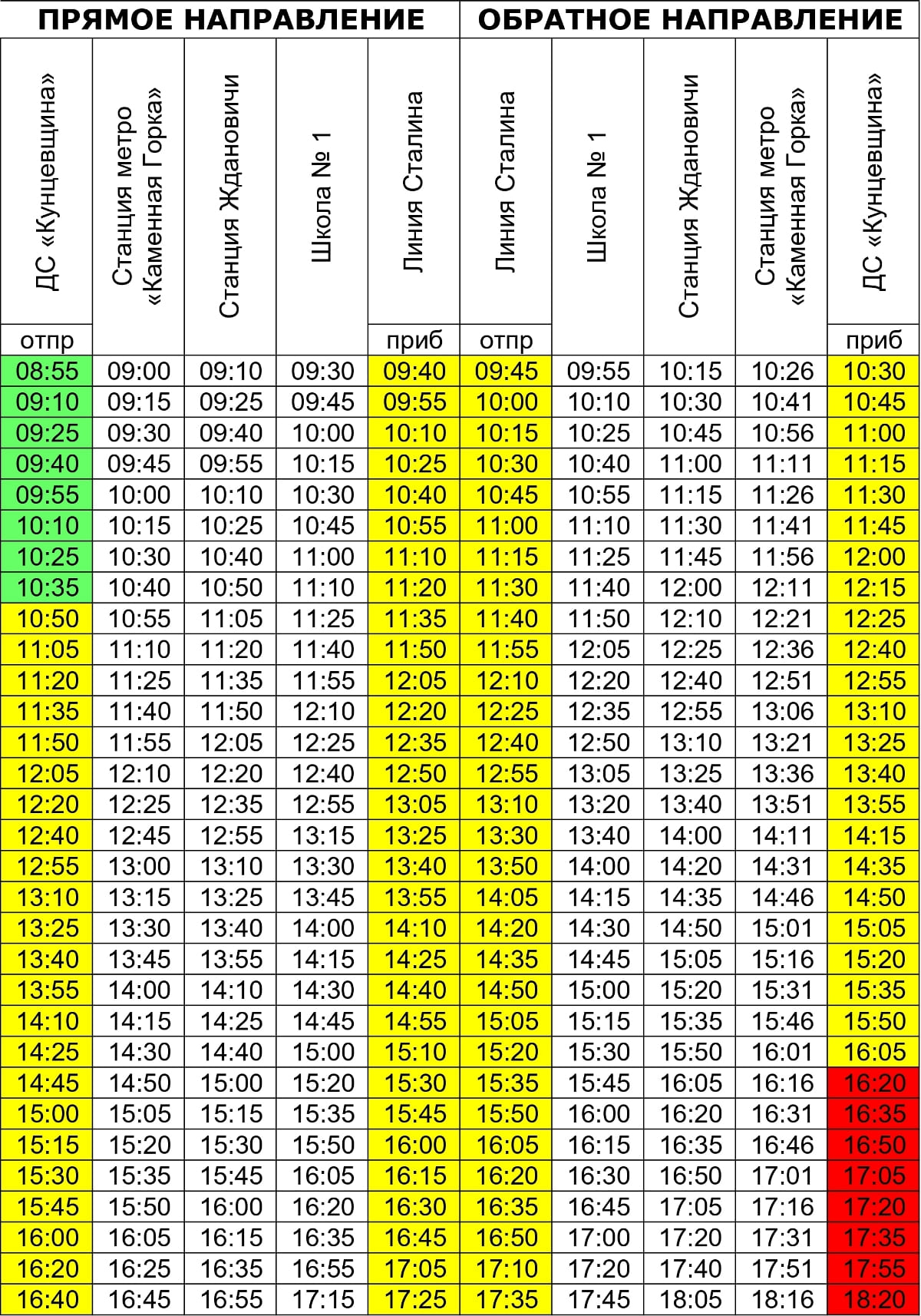
9 May: Minsk – Stalin Line – Minsk Bus Timetable
Bus Timetable for 9 May

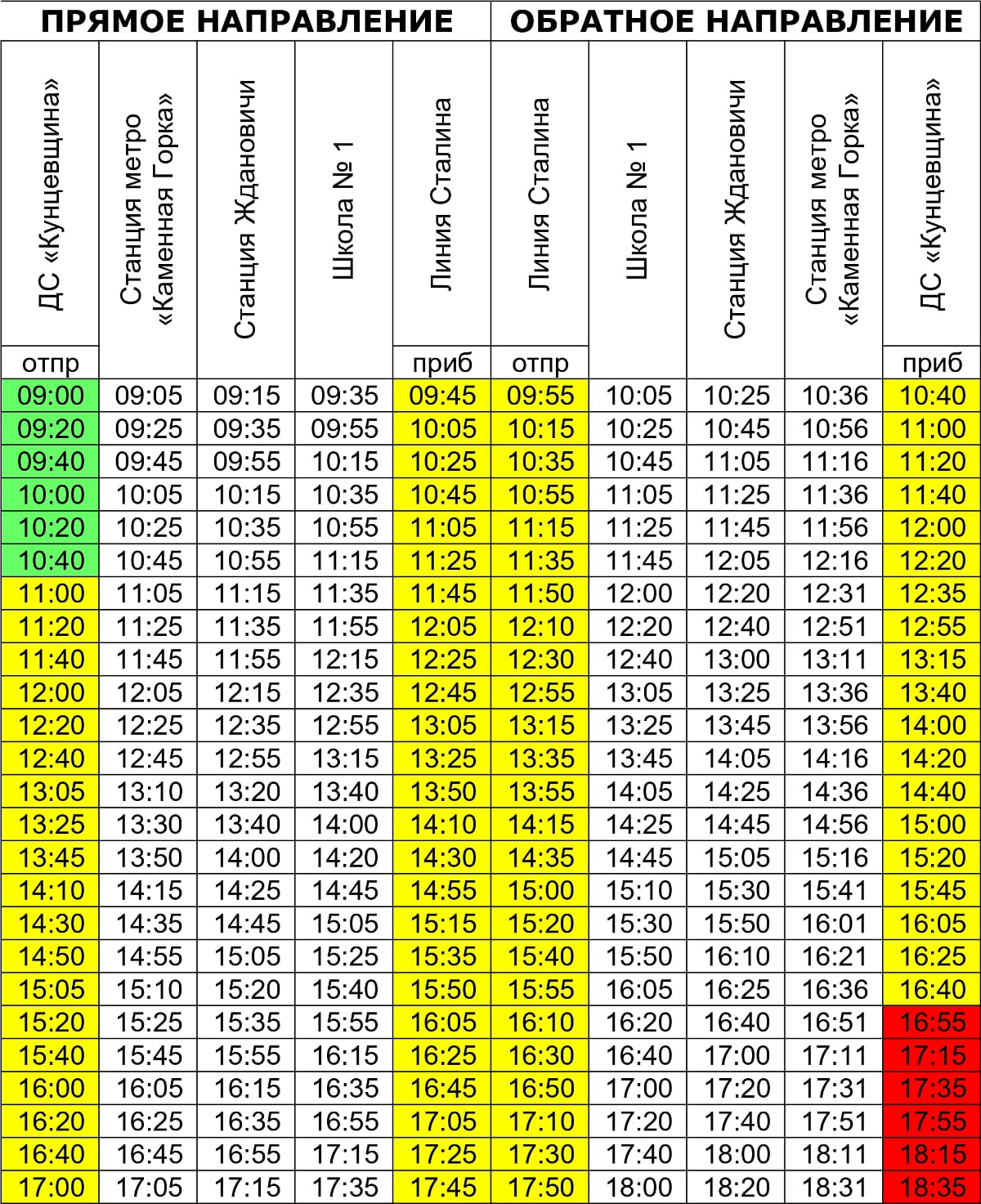
10 May: Minsk – Stalin Line – Minsk Bus Timetable
Bus Timetable for 10 May

Bus Pick-Up Point
Bus Timetable for 10 May

The Stalin Line Historical and Cultural Complex is located at kilometre 31 of the P28 road (Minsk–Molodechno), 20 km from the Minsk Ring Road.

For visitors travelling without a car:

Shared minibuses on the Minsk–Radoshkovichi (Minsk–Sosnovy Bor) route depart every 30 minutes from the stop at 19 Bobruiskaya Street, opposite the Tsentralny Bus Station. Alight at the Stalin Line stop.

Shared minibuses to Molodechno depart every 20 minutes from the stop at 9 Bobruiskaya Street, near the junction with Leningradskaya Street and across the road from the Minsk–Molodechno railway services. Alight at the Stalin Line stop.

Three designated car parks with a total capacity of 1,500 vehicles are available for visitors travelling by car.

Directions to the Stalin Line Historical and Cultural Complex are available here.

The Stalin Line Historical and Cultural Complex is located at kilometre 31 of the P28 road (Minsk–Molodechno), 20 km from the Minsk Ring Road.

For visitors travelling without a car:

Shared minibuses on the Minsk–Radoshkovichi (Minsk–Sosnovy Bor) route depart every 30 minutes from the stop at 19 Bobruiskaya Street, opposite the Tsentralny Bus Station. Alight at the Stalin Line stop.

Shared minibuses to Molodechno depart every 20 minutes from the stop at 9 Bobruiskaya Street, near the junction with Leningradskaya Street and across the road from the Minsk–Molodechno railway services. Alight at the Stalin Line stop.

Three designated car parks with a total capacity of 1,500 vehicles are available for visitors travelling by car.

Directions to the Stalin Line Historical and Cultural Complex are available here.

Dear visitors! To avoid traffic congestion at the entrance to the complex, please purchase electronic tickets and arrive 2–3 hours before the reenactment begins.

Admission tickets may be purchased online or from the complex’s ticket offices on the day of the event.

There is no limit on the number of tickets available. Please note that a ticket grants admission to the complex but does not entitle the holder to a seat in the grandstand for the reenactment. Grandstand seats cannot be reserved or purchased.

Once electronic tickets have been purchased and paid for, PDF copies will be sent to the email address provided during registration. The tickets must be presented at the entrance to the complex, either printed or on a mobile device. The unique QR code on each ticket must be clearly visible. If you have paid for your tickets but have not received them by email, please also check your spam folder and then use our Telegram bot. The bot will instantly find your order using the email address provided when you made your purchase and send you all your tickets as PDF files.

Admission prices:

  • Adults – 30.0 Belarusian roubles;
  • Students with valid student ID – 25.0 Belarusian roubles;
  • Schoolchildren – 15.0 Belarusian roubles;
  • Children aged 6 and under do not require a ticket and may attend the event free of charge when accompanied by an adult.

Discounts:

  • For large families, upon presentation of a large-family certificate, children’s tickets cost 10 roubles and are available only from the complex’s ticket offices.
  • Free admission:

    • Orphans (on presentation of valid identification)
    • People with Group I or II disabilities and those accompanying them
    • Veterans of the Soviet–Afghan War and the Great Patriotic War
    • Conscripts

    You can pay for tickets using a MIR card

    Dear visitors! To avoid traffic congestion at the entrance to the complex, please purchase electronic tickets and arrive 2–3 hours before the reenactment begins.

    After payment, e-tickets are automatically sent as PDF files to the email address provided during registration.

    What to do:

    • Check your inbox.

    • Be sure to check your spam folder.

    • Make sure that the email address was entered correctly.

    If you cannot find the email, please use our Telegram bot. The bot will instantly find your order using the email address provided when you made the purchase and resend the tickets as PDF files.

    At the entrance, you must present your ticket:

    • as a printout
      or

    • on the screen of a mobile device

    The unique QR code must be clearly visible and available for scanning.

    Parking for cars and minibuses is free for e-ticket holders, subject to availability.

    When purchasing tickets at the complex ticket offices:

    • Car or minibus – 3.0 BYN per day
    • Coach parking costs BYN 4.0 per day.

    Dear visitors! To avoid traffic congestion at the entrance to the complex, please purchase electronic tickets and arrive 2–3 hours before the reenactment begins.

    Visitors with electronic tickets may park a car or minibus free of charge, subject to availability.

    We recommend arriving early, as parking spaces can fill up quickly on major event days.

    No, grandstand seats cannot be purchased or reserved in advance.

    Seating is on a first-come, first-served basis:
    those who arrive first can watch the performance from the grandstand.

    We recommend arriving early so that you can find a good seat without rushing.

    To avoid congestion when entering the complex, we recommend:

    • purchasing electronic tickets in advance;

    • arriving 2–3 hours before the reenactment begins.

    This will give you enough time to:

    • pass through the entry checks without rushing,

    • find a good seat,

    • park conveniently.

    Yes, there are several cafés and food outlets within the complex.

    On major event days, additional mobile food outlets offer hot meals, drinks and snacks.

    Visitors can also purchase traditional soldiers’ porridge at the complex. It forms part of the atmosphere of military-history events and is especially popular with visitors attending reenactments.

    We recommend arriving early to avoid queues during peak visitor times.

    Yes, the complex is suitable for families.

    There is a children’s playground where children can enjoy active play in a safe environment.

    For the most active youngsters, there is also an interactive Ready for Labour and Defence (GTO) activity zone at Stalin Line.

    Everyone taking part in the GTO activity zone can enter the prize draw.

    To enter the prize draw, you must:

    1. Complete all the GTO zones and receive a score for each one.

    2. Be present at the specified time for the announcement of the results.

    Certificates and prizes will be awarded exclusively to participants who are present at the prize-giving ceremony.

    Animals are permitted within the complex.

    Please note, however, that reenactments and demonstrations involve extremely loud gunfire, explosions and operating military vehicles. This may cause severe stress to dogs and other animals.

    We ask owners to consider their pets’ sensitivity to loud noises and assess any potential risks to their health and behaviour in advance.

    The owner bears full responsibility for the animal’s welfare and behaviour.

    If you:

    • purchased a ticket for the wrong event;

    • made an error when purchasing your ticket;

    • were unable to attend the event;

    • made an error when entering your details during purchase;

    • or have any other questions about tickets,

    please email:

    bilet@stalin-line.by

    In your email, please provide:

    • your full name,

    • the date and name of the event,

    • the email address used for the purchase,

    • a description of the problem.

    The support team will review your enquiry and contact you to resolve the issue.

    Event Details
    • Start Date
      May 9, 2026
    • End Date
      May 10, 2026