Border Guards Day

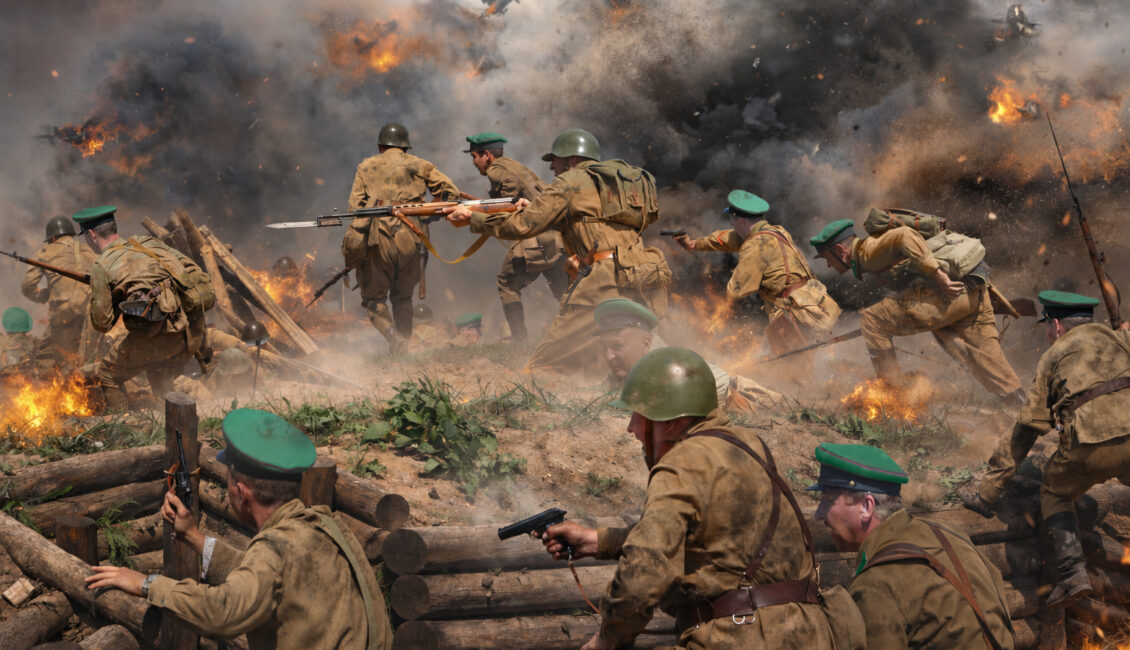
On 30 May, visitors to the complex will see a reenactment of the 1939 reunification of Belarus and the battle fought by a border outpost in June 1941. The “Soldiers of Victory” Military-Patriotic Club and military vehicles from the Great Patriotic War will take part.

The year 2026 marks the 85th anniversary of the beginning of the Great Patriotic War. Border outposts were among the first to face the enemy assault in the opening hours and days of the war. Despite being heavily outnumbered, the Soviet border guards displayed courage, fortitude and devotion to military duty, defending the frontiers of their Motherland to the last. Their feat became a symbol of indomitable will, self-sacrifice and devotion to the Fatherland.

Border Guards Day is celebrated on 28 May because it was on this day in 1918 that a decree of the Council of People’s Commissars established the Border Guard Service of the Russian Soviet Federative Socialist Republic, which at the time also encompassed Belarusian lands. The Main Directorate of the Border Guard Service was established at the same time, with all officers of the former Directorate of the Separate Russian Border Guard Corps transferring to it. The border guards’ honour and dignity, indomitable will and unwavering devotion to duty, together with their readiness for self-sacrifice, enabled them to defend the frontiers of the Fatherland and laid the foundations for the coming Victory in the Great Patriotic War. After gaining independence, Belarus retained the tradition of celebrating Border Guards Day on 28 May as a tribute to the feat of the Soviet border guards.

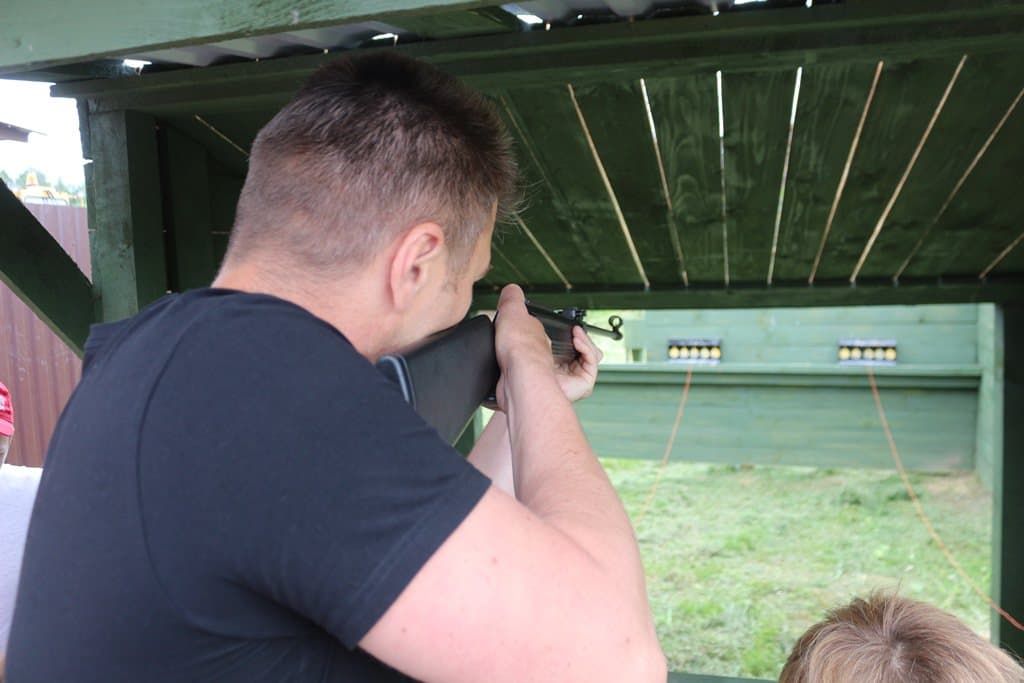
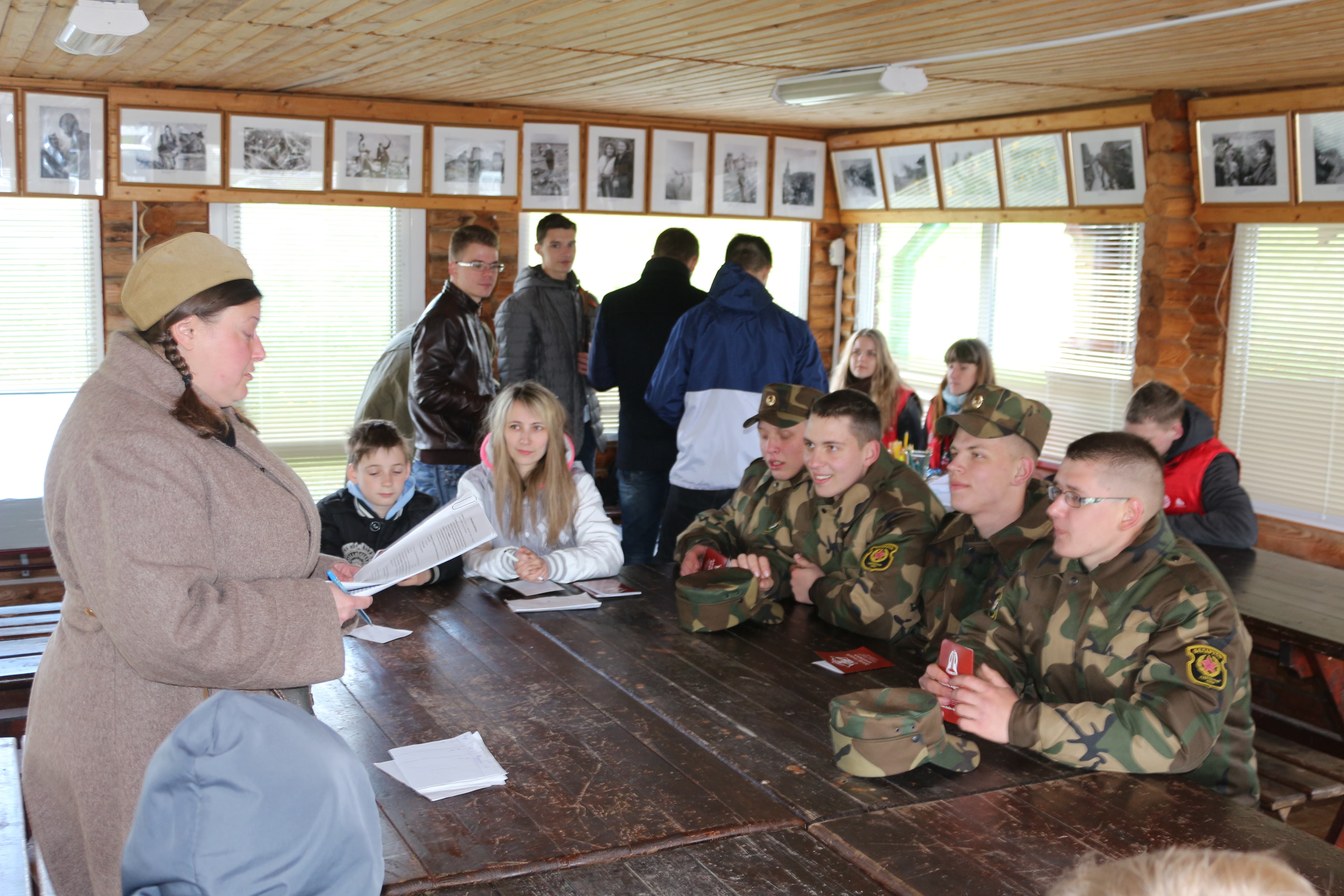
In addition to the main event programme, several interactive areas will be open to visitors. Everyone will have the opportunity to test their skills in a history quiz, airgun shooting, weapon assembly and disassembly, grenade throwing and other workshops. The most active participants in the Ready for Labour and Defence (GTO) area will receive certificates and valuable prizes.

Dear visitors!  To avoid congestion at the entrance to the complex, please purchase your tickets online and arrive 2–3 hours before the reenactment begins! Visitors with electronic tickets may park cars and minibuses FREE OF CHARGE, subject to availability!!!

Among all tickets purchased through the website, 10 tank ride certificates will be awarded in a prize draw. All tickets purchased by 20:00 on 29 May will be entered into the prize draw. The results, including the winning ticket numbers, will be published on the VKontakte and Instagram social media accounts after 20:00 on 29 May. Each winner will receive a tank ride gift certificate at the email address provided when purchasing the ticket.
 

Event Details
  • Start Date
    30 May 2026

Opening of guided-tour and interactive areas to visitors:

  • “Stalin Line” Guided Tour Route
  • “Our Armoured Train” Exhibition
  • Operational Military Vehicle Display
  • Photo Area
  • Shooting from a tank and gun**
  • Blank-Firing Weapons Shooting**

Ready for Labour and Defence (GTO) These are interactive entertainment areas.

Everyone taking part in the Stalin Line GTO Challenge Area can enter the prize draw.

To enter the prize draw, you must:

  • Complete all GTO areas and receive a score for each one
  • Arrive at the specified time for the announcement of the prize-draw results
  • Certificates and prizes will be awarded exclusively to participants who attend the prize-giving ceremony.

Main GTO areas:

  • Airgun Shooting

  • Weapon Assembly and Disassembly

  • Scout Trail

  • Historical Quiz

  • Grenade Throwing

  • Artillery School

  • Tracker

  • Hand-to-Hand Combat

Школа по подготовке инструкторов служебных собак была сформирована 24 января 1995 года на<базе Сморгонского учебного пограничного отряда (н.п. Девятни, Сморгонского района, Гродненской области).

В октябре 1995 года Школа по подготовке инструкторов служебных собак передислоцирована в<Сморгонский пограничный отряд (н.п.Гаути, Сморгонского района, Гродненской области).

In November 2002, the Service Dog Instructor Training School was reorganised as the Canine Centre.

В настоящее время Кинологический центр является учебным подразделением органов пограничной службы, и предназначен для подготовки, переподготовки и повышения квалификации специалистов-кинологов и подготовки служебных собак по различным видам служб, таким как розыскная (поиск человека по запаховому следу), сторожевая, специальная (поиск наркотических средств и психотропных веществ, оружия, боеприпасов и взрывчатых веществ), караульная (охрана объектов), а также для разведения и<выращивания собак служебных пород.

Today, the Border Service Canine Centre is recognised as one of the best not only in the CIS, but also in Eastern Europe.

Through the military-historical reenactment, spectators will have an opportunity to witness first-hand a pivotal event in the history of our country: the unification of the lands of Western and Eastern Belarus within a single republic in the autumn of 1939. This will be followed by scenes depicting the defence of the new border, the establishment of peaceful life and the tragic outbreak of war. Visitors will witness the determined defence of one of the border posts.

On this day, we would also like to recount the tragic events of 22 June, when the border posts bore the full brunt of the initial fighting against the advancing German forces.

The reenactment recreates events that took place in the Vladimir-Volynsky sector. Although it presents a composite portrayal, similar actions occurred in one form or another along the entire western border of the USSR.

It should be noted that war does not begin without warning, and by 21 June the border troops’ intelligence service had gathered extensive evidence that Germany would begin the war in the very near future.

In a document dated 2 June 1941, L. P. Beria, People’s Commissar for Internal Affairs of the USSR, reported the following to Comrade Stalin:

The NKVD border detachments of the Byelorussian, Ukrainian and Moldavian SSRs have obtained the following information on German military activities near the border with the USSR.

Two army groups are concentrating in the Tomaszów and Leżajsk areas. The headquarters of two armies have been identified in these areas: the headquarters of the 16th Army in the small town of Ulanów, 85 km south-west of Lublin, and the headquarters of another army at the Usmierz estate (45 km south-west of Volodymyr-Volynskyi), commanded by General Reichenau (subject to confirmation).

On 25 May, troops of all arms were observed moving from Warsaw towards Lublin–Chełm and along the Lublin–Zamość–Hrubieszów route. Troop movements are taking place mainly at night.

Pontoons, canvas boats and inflatable boats have been concentrated at numerous locations near the border. The largest numbers have been observed on the approaches to Brest and Lviv.

Work continues on the construction of defensive positions near the border, mainly at night.

Leave for servicemen in German Army units has been cancelled.

People’s Commissar for Internal Affairs of the USSR Beria»

By the end of 21 June, reliable information on the date and time of the offensive had been obtained from defectors. Unfortunately, however, the border guards never received orders to take up their defensive positions… This was not the case everywhere: for example, after learning from a defector that the invasion was about to begin, the commander of the 90th Border Detachment placed all 16 border posts on combat alert.

Each border outpost guarded a six-to-eight-kilometre section of the state frontier. The front occupied by an advancing German division was of a similar width. It goes without saying that the border guards had to fight superior enemy forces along the entire western frontier. The enemy outnumbered them in manpower by between six and twenty to one, and in small arms by between five and seventeen to one. The outposts fought while encircled, down to their last round. On the Vladimir-Volynsky axis, the 4th, 6th, 12th and 14th Border Outposts of the 90th Vladimir-Volynsky Border Detachment were wiped out to a man.  Some border outposts held their positions even when completely encircled. One example was the 13th Border Outpost, commanded by Lieutenant Lopatin, which held its defences until 3 July 1941.

Supported by servicemen of the 1st Battalion, 16th Rifle Regiment, the 4th Border Outpost of the 90th Border Detachment drove the enemy back and held its positions for several hours under enemy artillery and machine-gun fire. What we know of those battles comes from the terse lines of official reports: ‘In the sector of the 4th Outpost, at 03:10 on 22 June 1941, an enemy force of up to two infantry regiments, supported by artillery and machine guns, crossed the river and launched a vigorous attack on the outpost. After allowing the enemy to approach to within 70–100 metres, the outpost opened heavy machine-gun and rifle fire, halting the enemy advance. However, a small enemy force succeeded in seizing the outpost building.

A bold and decisive counter-attack by the outpost, supported by heavy rifle and machine-gun fire, drove the enemy back to its starting positions…»

The Germans themselves also acknowledged this. The diary of the Chief of the German Army General Staff contains the following entry: ‘Reports from the front confirm that the Russians are fighting everywhere to the last man… The Russians’ stubborn resistance compels us to fight in strict accordance with all the rules laid down in our field manuals. In Poland and in the West, we could permit ourselves certain liberties and departures from established principles; now this is no longer acceptable.’

Returning to the 4th Border Outpost, the border guards, with support from the personnel and equipment of the 16th Rifle Regiment, repelled enemy attacks and managed to hold their positions against elements of the Wehrmacht’s 298th Infantry Division for several more hours.

To overcome the defiant outpost, the enemy had to commit armoured vehicles and tanks from the 14th Panzer Division. Only then did the forward elements of the 298th Infantry Division manage to break through the border guards’ defences and begin advancing eastwards.

The border guards’ heroic stand allowed the 212th Howitzer Artillery Regiment to deploy and take up firing positions. Its fire delayed the Germans’ further advance in the Ustyluh–Volodymyr-Volynskyi sector.

The price is 40 BYN per person for both children and adults. Children aged 4 to 7 accompanied by an adult ride free of charge. Children under the age of 4 are not permitted.

Payment is accepted at the boarding point. Card payments are available.

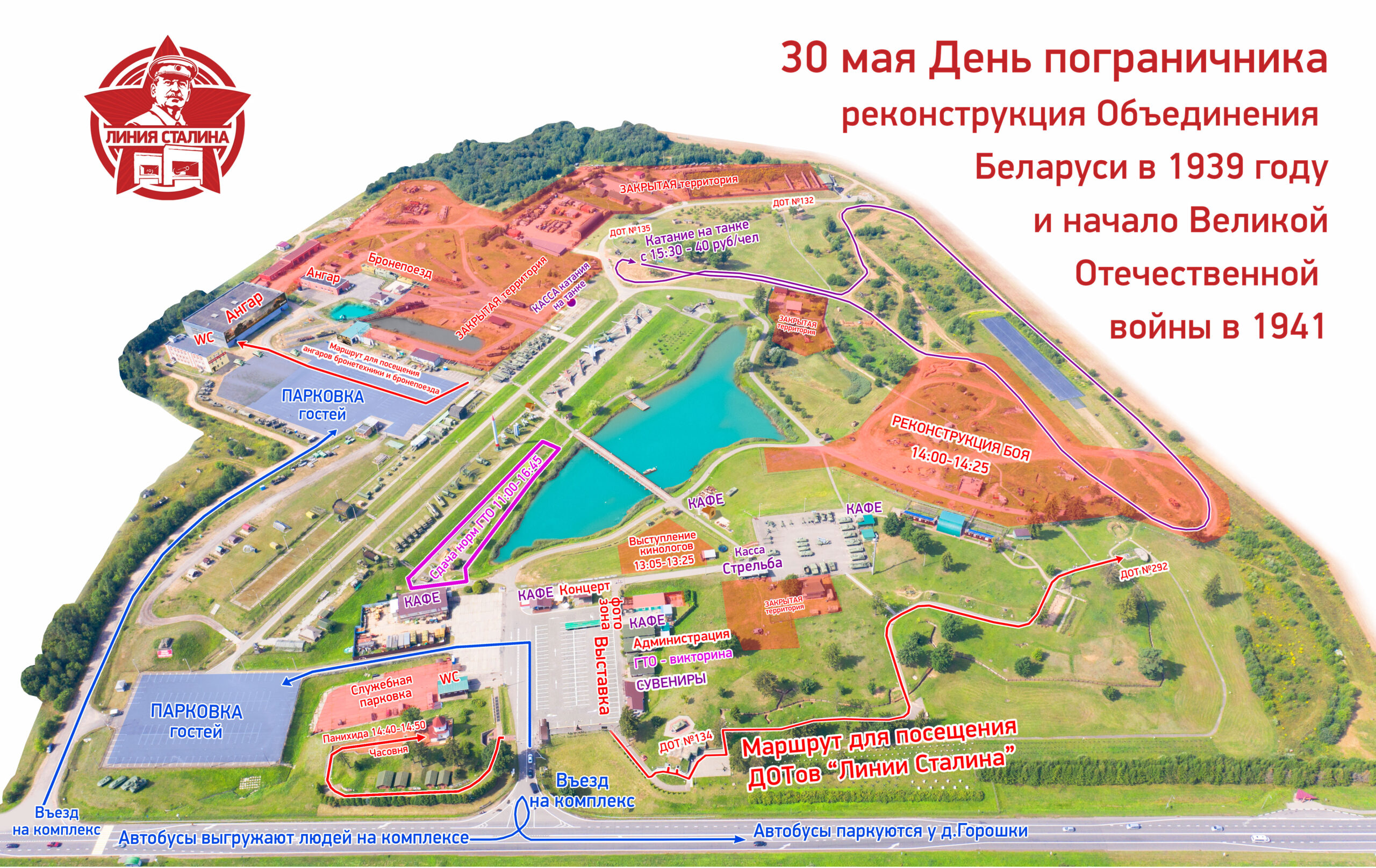
The boarding point is marked on the map.

The ride location is marked on the map:

* The organisers reserve the right to amend the programme due to weather, technical or other circumstances.
** Additional charges apply
*** weather permitting
Schoolchild
15,00 BYN
Student
25,00 BYN
Adult
30,00 BYN

Admission tickets are available to all visitors on our website or from the complex ticket offices on the day of the events. There is no limit on the number of tickets available. Please note that the ticket grants admission to the complex but does not include a seat in the grandstand for viewing the reenactment. Grandstand seats cannot be reserved or purchased.

After electronic tickets have been purchased and paid for, PDF versions will be sent to the email address provided during registration. These tickets must be presented at the entrance to the complex, either in printed form or on a mobile device. The unique QR code on each ticket must be clearly visible. If you have paid for your tickets but have not received them by email (please also check your spam folder), use our Telegram bot. The bot will immediately find your order using the email address provided when purchasing and send you all your tickets in PDF format.

Admission prices:

- Adults – 30.0 BYN;
- Students (with valid student ID) – 25.0 BYN;
- Schoolchildren – 15.0 BYN;
- Children aged 6 and under do not require a ticket and may attend the event free of charge when accompanied by an adult.

Discounts:

- For large families (upon presentation of a large-family certificate), children’s tickets cost 10 BYN and are available only from the complex ticket offices.

Free admission:

- Orphans (upon presentation of the relevant certificate)
- People with Group I or II disabilities and those accompanying them
- Veterans of the Afghan War and the Great Patriotic War
- Conscript servicemen

Parking:

- Parking for cars and minibuses is free for visitors with electronic tickets, subject to availability.
When purchasing tickets at the complex ticket offices:
- Car or minibus – 3.0 Belarusian roubles per day
- Coach parking – 4.0 Belarusian roubles per day


Dear visitors! To avoid traffic congestion at the entrance to the complex, please purchase electronic tickets and arrive 2–3 hours before the reenactment begins.

All visitors who purchase a ticket for the event will receive a unique bonus code for the game “World of Tanks”.

The bonus code is available only when purchasing an electronic ticket or a ticket from the complex ticket offices. Complimentary tickets to the event do not entitle holders to a bonus code. The bonus code can be obtained in one of the following ways:

  • When purchasing an electronic ticket (the unique bonus code will be shown on the ticket purchased).

  • Together with your receipt when purchasing tickets from the complex ticket offices on the day of the event (the unique bonus code will be printed on a separate receipt).

Contents of the “World of Tanks” bonus code

For all players:

  • 5,000 gold
  • Account activations: 1
  • Code validity period: until 6 June

Where can I activate my “World of Tanks” code?

  1. On the lesta.ru or tanki.su portal, click “Log in” and sign in to your account. Then click your username and select “Activate Lesta Code”.
  2. Sign in at the Premium Shop at lesta.ru/shop/redeem and enter the code.
  3. Via Lesta Game Center: click ‘Log In’ and sign in to your account; then click your username and select ‘Activate Lesta Code’.

If you do not have an account for ‘World of Tanks’, you will need to register at tanki.su.

The Stalin Line Historical and Cultural Complex is located at kilometre 31 of the P28 road (Minsk–Molodechno), 20 km from the Minsk Ring Road.

For visitors travelling without a car:

Shared minibuses on the Minsk–Radoshkovichi (Minsk–Sosnovy Bor) route depart every 30 minutes from the stop at 19 Bobruiskaya Street, opposite the Tsentralny Bus Station. Alight at the Stalin Line stop.

Shared minibuses to Molodechno depart every 20 minutes from the stop at 9 Bobruiskaya Street, near the junction with Leningradskaya Street and across the road from the Minsk–Molodechno railway services. Alight at the Stalin Line stop.

Three designated car parks with a total capacity of 1,500 vehicles are available for visitors travelling by car.

Directions to the Stalin Line Historical and Cultural Complex are available here.

The Stalin Line Historical and Cultural Complex is located at kilometre 31 of the P28 road (Minsk–Molodechno), 20 km from the Minsk Ring Road.

For visitors travelling without a car:

Shared minibuses on the Minsk–Radoshkovichi (Minsk–Sosnovy Bor) route depart every 30 minutes from the stop at 19 Bobruiskaya Street, opposite the Tsentralny Bus Station. Alight at the Stalin Line stop.

Shared minibuses to Molodechno depart every 20 minutes from the stop at 9 Bobruiskaya Street, near the junction with Leningradskaya Street and across the road from the Minsk–Molodechno railway services. Alight at the Stalin Line stop.

Three designated car parks with a total capacity of 1,500 vehicles are available for visitors travelling by car.

Directions to the Stalin Line Historical and Cultural Complex are available here.

Dear visitors! To avoid traffic congestion at the entrance to the complex, please purchase electronic tickets and arrive 2–3 hours before the reenactment begins.

Admission tickets may be purchased online or from the complex’s ticket offices on the day of the event.

There is no limit on the number of tickets available. Please note that a ticket grants admission to the complex but does not entitle the holder to a seat in the grandstand for the reenactment. Grandstand seats cannot be reserved or purchased.

Once electronic tickets have been purchased and paid for, PDF copies will be sent to the email address provided during registration. The tickets must be presented at the entrance to the complex, either printed or on a mobile device. The unique QR code on each ticket must be clearly visible. If you have paid for your tickets but have not received them by email, please also check your spam folder and then use our Telegram bot. The bot will instantly find your order using the email address provided when you made your purchase and send you all your tickets as PDF files.

Admission prices:

  • Adults – 30.0 Belarusian roubles;
  • Students with valid student ID – 25.0 Belarusian roubles;
  • Schoolchildren – 15.0 Belarusian roubles;
  • Children aged 6 and under do not require a ticket and may attend the event free of charge when accompanied by an adult.

Discounts:

  • For large families, upon presentation of a large-family certificate, children’s tickets cost 10 roubles and are available only from the complex’s ticket offices.
  • Free admission:

    • Orphans (on presentation of valid identification)
    • People with Group I or II disabilities and those accompanying them
    • Veterans of the Soviet–Afghan War and the Great Patriotic War
    • Conscripts

    Dear visitors! To avoid traffic congestion at the entrance to the complex, please purchase electronic tickets and arrive 2–3 hours before the reenactment begins.

    After payment, e-tickets are automatically sent as PDF files to the email address provided during registration.

    What to do:

    • Check your inbox.

    • Be sure to check your spam folder.

    • Make sure that the email address was entered correctly.

    If you cannot find the email, please use our Telegram bot. The bot will instantly find your order using the email address provided when you made the purchase and resend the tickets as PDF files.

    At the entrance, you must present your ticket:

    • as a printout
      or

    • on the screen of a mobile device

    The unique QR code must be clearly visible and available for scanning.

    Parking for cars and minibuses is free for e-ticket holders, subject to availability.

    When purchasing tickets at the complex ticket offices:

    • Car or minibus – 3.0 BYN per day
    • Coach parking costs BYN 4.0 per day.

    Dear visitors! To avoid traffic congestion at the entrance to the complex, please purchase electronic tickets and arrive 2–3 hours before the reenactment begins.

    Visitors with electronic tickets may park a car or minibus free of charge, subject to availability.

    We recommend arriving early, as parking spaces can fill up quickly on major event days.

    No, grandstand seats cannot be purchased or reserved in advance.

    Seating is on a first-come, first-served basis:
    those who arrive first can watch the performance from the grandstand.

    We recommend arriving early so that you can find a good seat without rushing.

    To avoid congestion when entering the complex, we recommend:

    • purchasing electronic tickets in advance;

    • arriving 2–3 hours before the reenactment begins.

    This will give you enough time to:

    • pass through the entry checks without rushing,

    • find a good seat,

    • park conveniently.

    Yes, there are several cafés and food outlets within the complex.

    On major event days, additional mobile food outlets offer hot meals, drinks and snacks.

    Visitors can also purchase traditional soldiers’ porridge at the complex. It forms part of the atmosphere of military-history events and is especially popular with visitors attending reenactments.

    We recommend arriving early to avoid queues during peak visitor times.

    Yes, the complex is suitable for families.

    There is a children’s playground where children can enjoy active play in a safe environment.

    For the most active youngsters, there is also an interactive Ready for Labour and Defence (GTO) activity zone at Stalin Line.

    Everyone taking part in the GTO activity zone can enter the prize draw.

    To enter the prize draw, you must:

    1. Complete all the GTO zones and receive a score for each one.

    2. Be present at the specified time for the announcement of the results.

    Certificates and prizes will be awarded exclusively to participants who are present at the prize-giving ceremony.

    Animals are permitted within the complex.

    Please note, however, that reenactments and demonstrations involve extremely loud gunfire, explosions and operating military vehicles. This may cause severe stress to dogs and other animals.

    We ask owners to consider their pets’ sensitivity to loud noises and assess any potential risks to their health and behaviour in advance.

    The owner bears full responsibility for the animal’s welfare and behaviour.

    If you:

    • purchased a ticket for the wrong event;

    • made an error when purchasing your ticket;

    • were unable to attend the event;

    • made an error when entering your details during purchase;

    • or have any other questions about tickets,

    please email:

    bilet@stalin-line.by

    In your email, please provide:

    • your full name,

    • the date and name of the event,

    • the email address used for the purchase,

    • a description of the problem.

    The support team will review your enquiry and contact you to resolve the issue.

    Event Details
    • Start Date
      30 May 2026
    Sponsors